
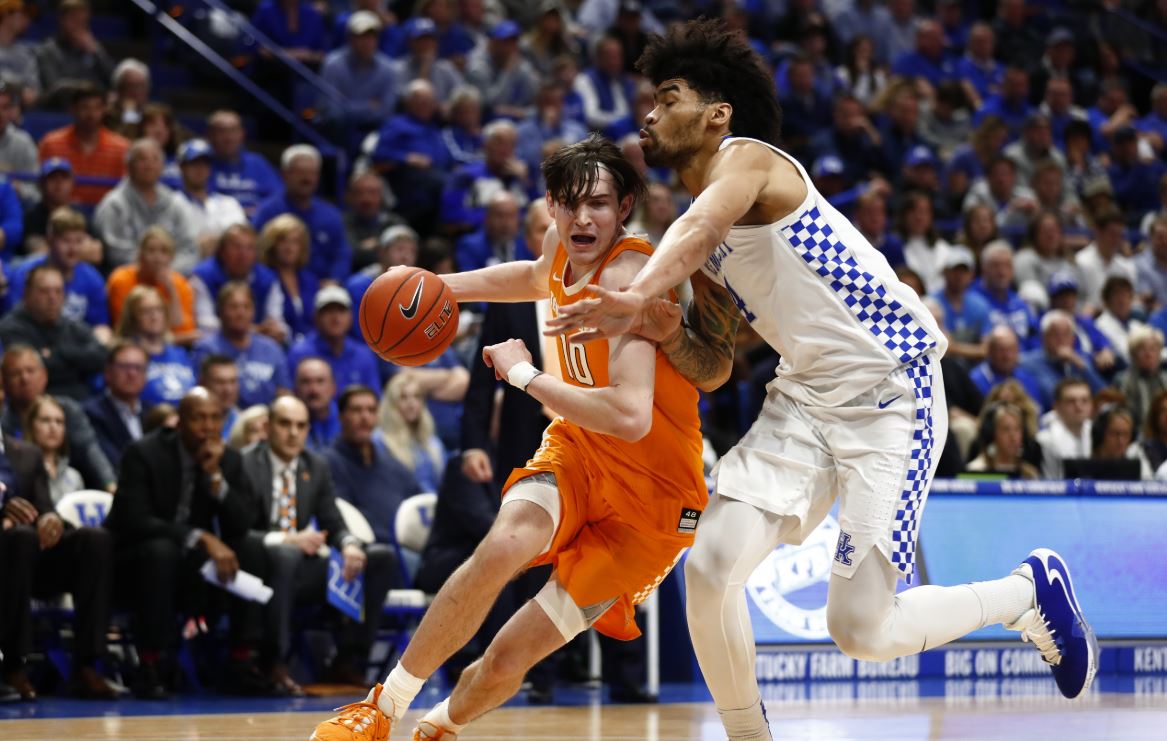
DEFENSE
What worked and what didn’t in 2019-20?
For the first 2.5 months of the 2019-20 Tennessee basketball season, the defense was essentially everything fans had hoped for. Through 18 games, the Vols had allowed opponents to top a point per possession just five times, and per Bart Torvik, the Tennessee defense ranked 18th as a unit when adjusted for strength of schedule. Despite a high amount of roster turnover, Rick Barnes and company had crafted a defense that was NCAA Tournament-worthy and frequently caused havoc for superior rosters. Cracks began to show in January, with a pair of 1.2+ PPP outings allowed to LSU and Georgia, but on the whole, the Tennessee defense remained solid.
Tennessee was spurred forward by an utterly outstanding two-point defense for most of the first half of the season, ranking third-best nationally in opponent 2PT% on January 24 and blocking a giant amount of shots. Yves Pons and John Fulkerson were leading a defense that forced tons of tough shots in and around the paint, and unless opponents were able to shoot over the top of them, like LSU and Georgia did, it was going to be tough to score against them.
At the time, Tennessee’s game with Kansas was viewed as a tough, fierce battle where this undermanned Tennessee roster took the #1 team in the nation all the way to the wire, coming up just six points short of stealing a program-defining road victory. It was fine for most people to not think much of this loss, as Tennessee beat most expectations and Yves Pons had a breakout game on national television. In retrospect, though, this is where the cracks turned into the whole dam breaking.
Take these stats into note below:
- Tennessee, first 18 games (pre-Kansas): 41.2% 2PT% allowed (3rd), 28.1% opponent Free Throw Rate (85th), 27.3% DREB% allowed (136th)
- Tennessee, final 13 games: 48.3% 2PT% allowed (110th), 46% opponent Free Throw Rate (338th), 34.6% DREB% allowed (344th)
When I went back to watch the Kansas game in preparation for this preview, I noticed two things. First: despite being undermanned themselves and missing two key frontcourt rotation pieces for the game, Kansas started the game off by attacking the rim in numerous ways and never stopped, taking over half of their field goal attempts within four feet of the rim. Kansas attempted twelve more shots at the rim than Tennessee did, converting 17 of 28 attempts (60.7%).


Is that a great conversion rate? Not really. But it didn’t matter, as Kansas’ relentless attack forced Tennessee to play with uncontrolled aggression defensively in the paint. It was why the Jayhawks attempted 33 free throws to Tennessee’s 16 – not poor officiating, but simple “we are better and taller than you” logic.
Tennessee still blocked seven shots in this game, but it was the first game of the season where an opponent figured out a hole in the Tennessee defense – only Yves Pons could block lobs, and only John Fulkerson could contain post-ups – and drove it into the ground. No SEC opponent had a center quite like Udoka Azubuike, but for the most part, all SEC teams have at least one rim-running big that can handle lobs and work the boards. Simply put, Tennessee had no real way of containing this, whether it was off of a drive to the basket:

A simple post-up move:

Or, well, getting demolished on the boards.

This will be touched on in the next section, but Tennessee’s backcourt, with the exception of 2017-18, has never been super aggressive in terms of forcing turnovers and attempting to get hands on the ball. It’s a defense that’s more reliant on staying in front of the other guard and forcing them into bad shots. This works if you’re able to control the ball after a miss, and it works if you’re able to force bad shots in the first place. Tennessee forced an above-average amount of turnovers last season, but their rebounding was disastrous to close the season out and once opponents figured out how to attack the basket, they didn’t force many bad shots, either. Couple this with various players being unable to stay on the court due to foul trouble:


And you get a Tennessee defense that went from an 18th-ranked unit in the first 18 games to a 136th-ranked unit in the final 13.
Over the final 13 games, Tennessee’s rim defense dropped 7.5%, which wasn’t good, but it wasn’t the whole of the story. This is where the backcourt defensive issues come in. While I liked Jordan Bowden a lot as a one-on-one defender, he was just one guy. Tennessee’s opponent Assist Rate was just 43.4% in the last month-and-a-half of hoops. Let me translate: opponents scored a ton of points in one-on-one action against guys who simply could not stop them, and when Tennessee did try to stop them, they generally just committed a bad foul anyway.

Now, for the good: Tennessee did have a couple of useful, workable defensive lineups during this time. From January 25th to the end of the season, the main five of Vescovi/Bowden/JJJ/Pons/Fulkerson held opponents to a luck-adjusted 0.961 PPP. Subtract James and add Gaines for a small 57-possession sample, and this falls to 0.827 PPP. Back to the bad, though: during these 13 games, our hated Death Lineup of any two of Fulkerson, Plavsic, Nkamhoua, and Pember allowed 154 points over 140 possessions (1.1 PPP). Despite having two bigs in the game at once, Tennessee allowed opponents to rebound an astounding 40.5% of missed shots. Two-big lineups are a thing of the past; hopefully Tennessee knows this by now.
Can Tennessee force more turnovers with a deeper backcourt?
Uh, yeah. Probably. This section could end there and we’d be okay, but I’ll explore it a little bit more. To start, let’s revisit Tennessee’s surprisingly great 2017-18 team. You remember them, right? Lots of fun to be had there!
As a base, Tennessee forced turnovers on 20.4% of opponent possessions, which ranked 53rd-best in the country. That’s not an elite rate, but it’s a pretty good one, especially considering Tennessee played 13 games against teams in the top 75 nationally in offensive turnover rate. While that team was significantly less deep than this one is, it had an important advantage: a backcourt that had four key players getting 19 or more minutes a game. All three of James Daniel, Jordan Bone, and Jordan Bowden posted individual steal percentages of 1.9% or higher, and Daniel – assumed by many to be the worst defender of the group when he transferred to Tennessee – ended up having the highest steal rate by a hair.
Add Lamonte Turner to that group, an underrated defender in his own right, and you start to understand why Tennessee’s defense suddenly became elite in 2017-18. Because Tennessee consistently had multiple options in the backcourt without much dropoff from one to the other, Tennessee’s guards were enabled to play a much more aggressive style of individual defense. Having three quality guard options, plus a revitalized frontcourt, helped Tennessee push for more steals:


Which inherently lends its hand to easier points. Watch those plays, and then watch this clip from 2018-19:

Nothing Tennessee does is technically wrong here, and they do force a miss, but notice that it’s not quite as aggressive before the shot. (Also, fun reminder that this is the play where Naz Reid definitely should’ve been ejected.) Move forward just one year, Tennessee only has three guard options for an entire game, even before we get to Turner spending the majority of non-conference play out with a shoulder injury. By the end of the season, Rick Barnes was having to play both Bone and Turner 35+ minutes a game, with Turner playing an astounding 117 minutes and Bone 111 in three NCAA Tournament games. The loss of Daniel to graduation and the lack of an immediate replacement – remember when potential transfer Khwan Fore committed, then decommitted, to Tennessee? – left Tennessee with a small, yet very important hole in its rotation that they didn’t fill until this season.
Add back the 2% loss of turnovers the Tennessee defense suffered in 2018-19, and the 42nd-ranked unit becomes a top-30 one. This may not seem like much, but Tennessee was an overtime away from the second Elite Eight in program history, and just one extra turnover could’ve made the difference. Unsurprisingly, Tennessee went 0-4 in their four games where opponents turned it over on 10.5% or fewer of possessions; they went 31-2 in all other fixtures.
Last year, Tennessee already had a limited backcourt, and that was before Lamonte Turner’s career-ending injury. By the end of the season, Jordan Bowden was playing nearly 37 minutes a game in a role he wasn’t fit for, and midseason transfer Vescovi was regularly hitting 30+. I assume it will not surprise you to hear Tennessee’s defensive turnover percentage also dropped in the back half of the season from 20.2% to 18.7%, although this only represented a 33-spot drop.
Now, Tennessee enters 2020-21 with a variety of backcourt options. Any and all of Santiago Vescovi, Victor Bailey, Jaden Springer, Keon Johnson, and even Josiah-Jordan James will see plenty of time in the backcourt, which should enable the Vols to play the more aggressive, more fun, more havoc-inducing style of defense that revitalized the program in the first place.
Who steps up to join Pons, James, and Fulkerson as defensive focal points?
Similarly to the last two points, the Tennessee team defense works best when it’s got a deeper backcourt, and the 2020-21 edition should have this in spades. However, the 2019-20 edition gave us an important thing to take note of, especially in conference play. When Tennessee was able to play both Josiah-Jordan James and Yves Pons, they had roughly the equivalent of a top-40 defense. Again, that’s not elite, but the previous team defense ranked 42nd, so it’s holding steady.
When one or the other was off the court – AKA, on 48.9% of possessions in conference play – Tennessee’s defensive efficiency fell by over five points per 100 possessions, giving them the rough equivalent of a 110th-ranked defense. That’s a huge fall-off, and when you struggle to score in the ways Tennessee did last season, it explains a lot of why Tennessee looked really good in some games and genuinely atrocious in others. Add fellow focal point John Fulkerson to the mix, and Tennessee had a borderline top-20 defense when all three were on the court together in conference play.
The challenge here is a simple one: with Tennessee’s newfound depth, these three likely will not be playing as many minutes together this year, and they already didn’t play a ton together in 2019-20’s SEC schedule. Just 40.7% of defensive possessions featured all three players, and when any of the three were off, Tennessee went from that borderline top-20 defense to a borderline top-120 unit. (You’ll be unsurprised to hear Pons suffered the most when without both of his partners, as he was asked to take on a lot of unfair responsibilities.)
The good news is that Tennessee’s newcomers are all well-known for having defensive intensity, which both enables Rick Barnes to hide Santiago Vescovi in a man-to-man set and lets him run out any number of James, Pons, Johnson, Springer, and Bailey all at once. We know that Tennessee has three legitimately excellent defensive pieces already built in; our two questions to answer will be if anyone can join them and if Tennessee can keep all three on the court when it matters.
What’s Tennessee’s best defensive lineup in a close game?
Well, we kind of just solved that with the above brain mathematics, no?
…alright, we’ll investigate. As of now, Tennessee should expect to have two or three main challengers for the SEC title. Of these three teams – Kentucky, questionably Florida, and questionably LSU – only Kentucky is expected to regularly feature a player taller than 6’9” (Wake Forest transfer Olivier Sarr). This doesn’t mean that Tennessee won’t run into different challenging opponents throughout the season, but for the purposes of this, we should pretty much exclusively focus on the good opponents, as those are the ones most likely to be in a close game with Tennessee.
In most situations, Tennessee should and will feel perfectly fine having John Fulkerson at center to close, with Yves Pons at the 4. Florida and LSU’s expected starting lineups both feature 4-men in the 6’6”-6’7” range, and Kentucky may be in that same boat as well. I do worry a bit about Fulkerson being able to vertically challenge lobs to Sarr, especially as Sarr would’ve been the fourth-leading dunker in the SEC last year. Still, it’s the best Tennessee can do, and having Pons’ verticality should help. Tennessee has also thrown out a zone against Kentucky more than any other opponent the last three seasons, which could mitigate some of Sarr’s post threat. At least to begin the season, I think Rick Barnes is probably going to be more comfortable having Josiah-Jordan James in one of the two wing spots, for reasons mentioned above. So that’s three of our five.
Now comes the fun part. Both Keon Johnson and Jaden Springer have been praised dutifully by scouts for their attention to detail on the defensive end, and both seem ahead of the curve as 18-year-old prospects in terms of individual defense. To start the season, though, no one can realistically blame Barnes if he chooses one or neither of these freshmen to be on the court. By the end of the season, one if not both should be in every key lineup to finish out games. We’ll split the difference and say one of Johnson or Springer gets the other wing spot.
At point guard…well, yeah. Santiago Vescovi is the only true 1-guard Tennessee has. But consider this: even when adjusting the numbers for luck, Tennessee was an astounding 14.5 points worse defensively in conference play when Vescovi was on the court. He frequently got lost, and Tennessee couldn’t do much in terms of stopping one-on-one scoring from the perimeter.
However: I’m willing to give him another chance, simply because entering a new team and system halfway through a season is an insane thing to ask of an 18-year-old. He should be better; if not, he won’t play to finish out games. Victor Bailey, Jr. was not exactly known for his defense at Oregon, and unless the stats are wholly wrong on that front, I would be a bit surprised to see him end up in any closing lineup.
Something I want to note: Kentucky’s expected closing lineup will go 6’3”/6’6”/6’7”/6’7”/7’. While Tennessee can obviously match Vescovi on 6’3” Davion Mintz, I worry about a lineup where Kentucky has a clear height and rebounding advantage in a close game. Therefore, I’d be curious about a lineup with JJJ at point, a place where he has lots of experience and would have a serious length advantage on Mintz and would perfectly match primary ball-handler B.J. Boston (6’6”). In either of these scenarios, JJJ is more likely to guard Boston than Vescovi, but a lineup that eliminates Vescovi also eliminates the need to hide him on Mintz or even one of Kentucky’s two 6’7” options. So think about this: against Kentucky specifically, could we see a closing lineup of JJJ, Springer, Johnson, Pons, and Fulkerson? It’s a lot to ask, but any lineup that goes no shorter than 6’5” in height and still has several scoring options is a really unique thing.
 Stats by Will