
THE SCHEDULE
Non-conference
To make things easier for readers, this seems like a section better broken down by chunks of games rather than one-by-one; as much as I follow college basketball, I am not going to have extreme in-depth knowledge this far out about Cincinnati or someone as I will Tennessee. Therefore, we have chunks, which just seems easier.
The March Mainstays: Gonzaga and Kansas. Both of these teams are going to be in the title hunt come March; both will be huge potential wins for Tennessee. Gonzaga enters as a universal top-five team in every metric I’ve looked at, while Kansas is more in the 6-10 range on average but it’s Kansas so what do you expect. For once, neither of these games are true road fixtures; Gonzaga will be held in front of no fans in Indianapolis, while Kansas is a home game in Knoxville. Gonzaga still has a name you’ll know from the 2018-19 squad Tennessee defeated (Corey Kispert), alongside a whole host of older (Joel Ajayi, Aaron Cook) and younger (Jalen Suggs) talent. Kansas, meanwhile, is in the midst of a partial rebuild. The two best players from last year’s #1 team are gone, and the rotation is not currently expected to go more than seven or eight deep. Any of Ochai Agbaji, Marcus Garrett, or Tyon Grant-Foster could be the go-to player by the time the game arrives in January.
Bubble Boys: Notre Dame and Cincinnati. Neither team is expected to light the world on fire, but both are expected to at least contend for an NCAA Tournament spot. After two straight Elite Eight runs in 2015 and 2016, Notre Dame has rapidly declined into being a bottom-half ACC squad; the elite shooting that defined both Elite Eight teams is now just mediocre. Cincinnati overcame a bad start to the season to win the American pre-COVID and would’ve been a tough 11/12 seed to handle; expectations appear very similar this season. Cincinnati lost AAC Player of the Year Jarron Cumberland and two other starters, but they made a pair of huge offseason acquisitions: Michigan transfer David DeJulius and…Colgate giant Rapolas Ivanauskas, the pink eye guy who beat Cincinnati on their home court barely a year ago. Both of these games are ones Tennessee will be expected to win, but neither will be an easy ride home. Simply because it’s a road game, Notre Dame is the more likely loss of the two, but Cincinnati is the significantly tougher opponent.
Fairly Challenging Mid-Majors That You Should Not Lose To: VCU and Charlotte. Tennessee happens to draw both of these teams in their season-opening Multi-Team Event on Thanksgiving week, which, hey, is next week. Anyone else feel like this year is going at 7% and 700% speed at once? Anyway, Tennessee will be 10-15ish point favorites in both of these games, but both teams present unique, different challenges. Charlotte is the lone team on Tennessee’s schedule to play a true pack-line defense, as head coach Ron Sanchez was Tony Bennett’s lead assistant for several years. VCU, meanwhile, still plays the same hectic press-after-made-baskets defense that forces turnovers on nearly a quarter of possessions and will be particularly challenging to prepare a backcourt full of freshmen and sophomores for. There is not a real reason for Tennessee to lose either of these, but it feels like there are two likely outcomes: either both games are 15-point wins or Tennessee wins one by 23 and the other by 6.
You Paid $90K For Them to Show Up and Lose by 25: Appalachian State, Tennessee Tech, and USC Upstate. I mean, they are literally paid to do this. None of these three are worthy of great exposition. Dustin Kerns took App State to its best season in a decade last year and should get a better job in the next year or two. Not entirely sure why Tennessee Tech hired John Pelphrey of all people. USC Upstate has won double-digit conference games twice in 13 seasons and lost by 36 to Charlotte last year.
SEC opponents
Same thing as above. Specifically, because I can’t guarantee these games will happen at their proposed times due to COVID, if at all, I’m breaking them down into chunks. It’s just easier this way, and it helps you get to know Tennessee’s general expectations for their competition.
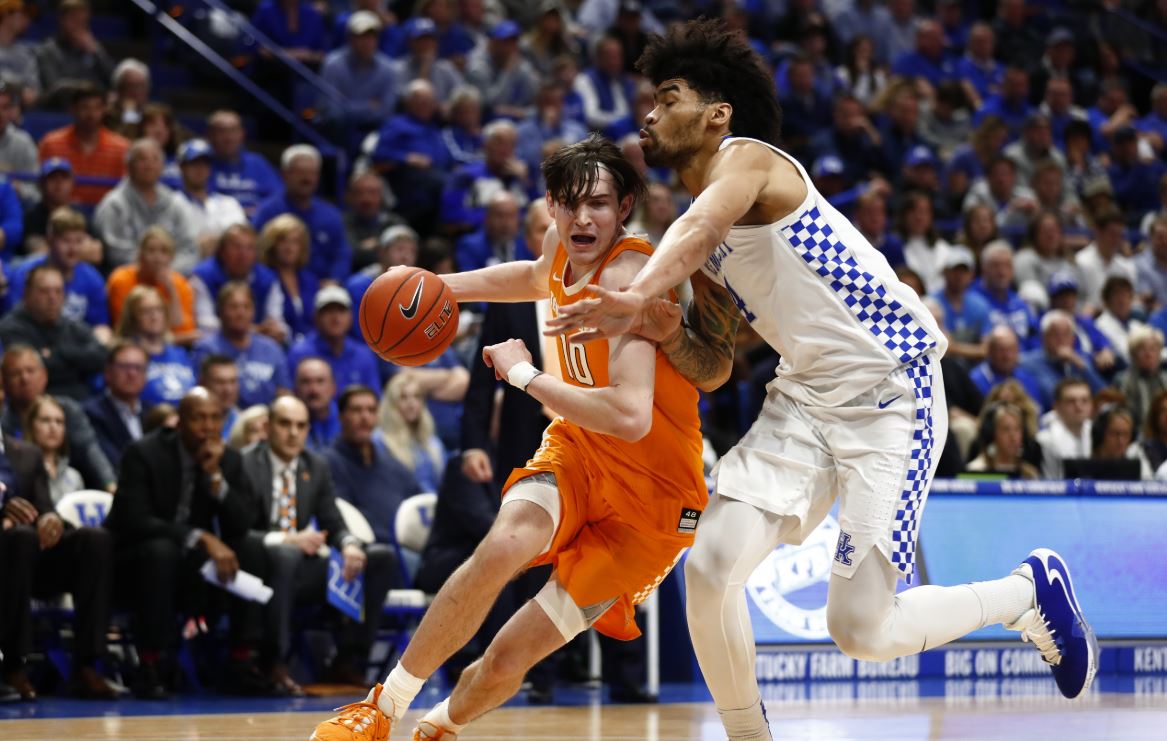
The SEC Title Contenders: Kentucky, Florida, and LSU. I covered these three in greater detail in a part of the defensive section, but this should be Tennessee’s main conference competition. Obviously, anything can happen, and someone from a tier or two below (like Tennessee once did) could make a surprise run for it. Until then, we’ll stick with this being the main group. Kentucky only returns 7% of their minutes from 2019-20, one of the lowest amounts in modern basketball history, which would almost certainly eliminate them from title contention if their name was not Kentucky. They brought in several key recruits and added a pair of important transfers to the pile to stay afloat. Most don’t seem to expect them to be a peak Calipari team, but pretty much everyone that pays attention to college hoops expects them to at least contend for the SEC title and be a low-end Top 25 mainstay.
Florida is coached by Mike White, which should eliminate them from this tier, but only Tennessee can match their combination of returning talent and added recruits. They return 68% of minutes from a top-35ish team last year and add a pair of new, highly-touted players. The problem, as it has been for three seasons now, is that Mike White bafflingly went from a high-speed offense and defense to a slow, sludgy bore that thrills no one. It’s like Cuonzoball with somewhat greater success. LSU has Will Wade, which means they are in the title hunt every year now, but they lost their two best players (Skylar Mays, Emmitt Williams) and will be relying on scoring from Javonte Smart and Trendon Watford, a pair of very good players that weren’t nearly as efficient as Mays or Williams.
The Second-Tier Bubble Boys: Ole Miss, Alabama, Arkansas, and…uh… I was fierce last year in saying the SEC sucked, start to finish. I sincerely did not think the league had even a single Elite Eight squad among its ranks, and I wouldn’t have been surprised to see none of them even make the Sweet Sixteen. That said, I do think these bubble boys are generally a bit better than last year’s. Ole Miss was hit with the news that Kermit Davis tested positive for COVID-19, but that won’t matter much for SEC play. The Rebels return a lot of talent from last year’s squad and added Romello White, a consistently good three-year starter at Arizona State. Alabama was the Chaos Watch last year, a team that won or lost seemingly every game 87-85. Their fortunes looked better when it temporarily seemed Kira Lewis would return, but most other key pieces from last year do, anyway. This will be John Petty’s 15th season in college basketball.
Arkansas is the team I’m most afraid of missing on. On paper, there really isn’t much there; the Hogs return just 35% of minutes from an NIT team last year and highest-ranked recruit Moses Moody isn’t expected to be as good as any of the Big Three freshmen (Johnson, Springer, Boston). Still, I think Eric Musselman is a top-four SEC coach at worst, and with a similarly bland-looking roster last year, he got them to overachieve by a few wins and, for about two months, looked like a legitimate 10 seed or thereabouts in the NCAA Tournament.
NIT, Barring Some Unexpected Overachieving: Missouri, Auburn, South Carolina, and Texas A&M. Yes, yes, I know; you’re stunned to see Auburn here. More on that in a bit. Firstly: Missouri. This is tougher than you may think! Missouri returns 89% of minutes from a bad team last year, which probably doesn’t excite most people, but continuity matters a lot in college hoops. For instance, Colorado returned the third-most minutes of anyone last season and progressed from 63rd to 35th in KenPom – not a huge jump, but more than enough to make a theoretical NCAA Tournament. Missouri needs a larger jump than that, but Cuonzo should have enough resources to be more competitive than he’s been. If Missouri can’t finish in the top half of the SEC standings, they should probably fire him, even in a pandemic. Auburn, meanwhile, has simply been a very good team for two seasons in a row. Why would they stop now? Because they return just 21.5% of available minutes and are staring down a reality where their top three scorers will likely be two freshmen and a sophomore. In a pandemic year, it’s really hard to make that work unless you’re Kentucky or a blue blood; we’ll see how great a coach Bruce Pearl really is.
South Carolina always does this thing where they fart around for two months then suddenly become a top-six SEC team in conference play, so I assume that will happen yet again. Texas A&M did finish 7th last year in the SEC and they return 65% of minutes. Why so low? Because A&M was far, far worse than you remember. Despite going an astounding 9-2 in games decided by six points or less (as you’ll recall, we’ve determined that these games are a lot more luck-influenced than you may think), A&M went just 16-14 overall, meaning they went 7-12 in games that weren’t close. That’s not even in the ballpark of Good Team territory. They’ve still got a lot of work to do.
12 PM JP Sports Tipoff: Mississippi State and Georgia. Mississippi State lost several important pieces from a team that wasn’t going to make the NCAA Tournament. Georgia had Anthony Edwards – which, let me remind you, WENT #1 IN THE NBA DRAFT LAST NIGHT – and went 5-13 in SEC play. Tom Crean isn’t good.
Vanderbilt: Vanderbilt. To quote our pal Cosmis from Twitter: “No other way to describe this team than ‘bad.’”
 Stats by Will