Process

January 26: #18 Tennessee 78, Florida 71 (14-5, 5-3 SEC)
January 29: Texas 52, #18 Tennessee 51 (14-6)

And I saw Sisyphus at his endless task raising his prodigious stone with both his hands. With hands and feet he tried to roll it up to the top of the hill, but always, just before he could roll it over on to the other side, its weight would be too much for him, and the pitiless stone would come thundering down again on to the plain.

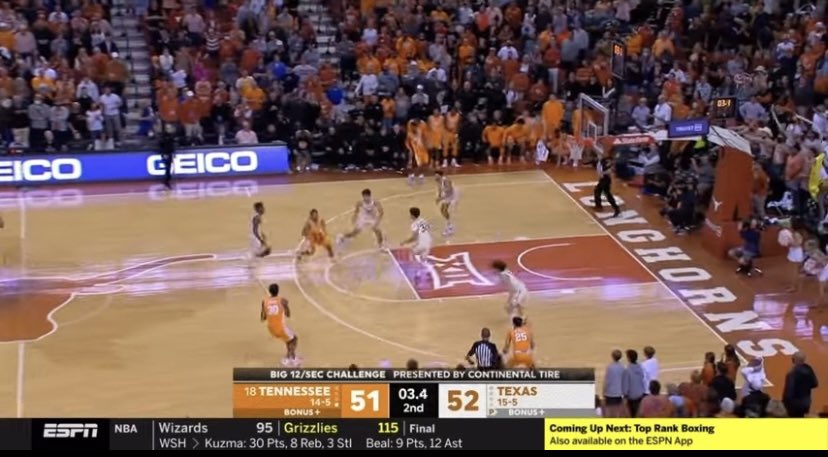
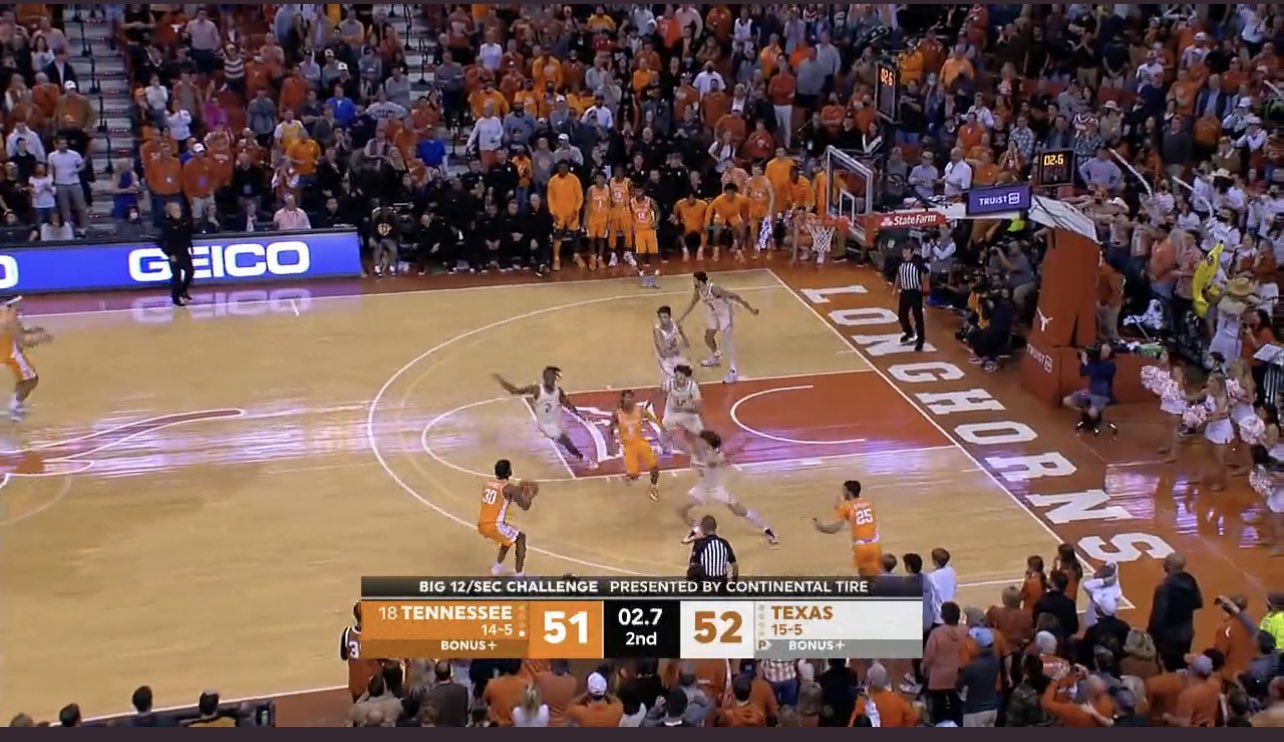
Here is the final play of Saturday’s game with precisely 3.4 seconds on the clock. Zakai Zeigler takes the inbound, uses his Jared Harper-like speed to get down the court extremely quickly, and goes into the final play. Right here, right now, Zeigler is stopped as he touches the top of the key. With Nkamhoua trailing by way of receiving the final inbounds pass, Tennessee is playing 4-on-5, but look at the attention Zeigler draws. This turns the play into a 3-on-2.
Image

Two players are covered up: Victor Bailey, Jr. in one corner, Santiago Vescovi in the other. Would I have had Bailey on the court? Probably not, because Justin Powell is objectively better. But Justin Powell did not tie the game with a genuinely spectacular rebound and putback, so I get why Bailey is there. When Zeigler pulls up at 3.4 seconds to pass the ball, the highest-quality option on this play, as this screencap suggests, is Josiah-Jordan James for an open three on the right wing.

For his career on this shot – a three-pointer of any kind on the wing – James is a 31% shooter. For his career in general, James is a 31% three-point shooter. For his career on catch-and-shoot threes of any kind, James is 31% from the field. He is remarkably consistent, if nothing else. Yet some context is needed. When James receives the ball, he has scored eight of Tennessee’s 16 points as part of a 16-0 run that turned the game from a 51-35 ball of pathetic annoyance to a 51-51 ball of I Am Actually Laughing. He is 3-for-6 from three; every other player on the team combined is 2-for-11, including partner Vescovi, who is 0-for-5 from deep and 1-for-8 from the field.

James receives the ball. Here’s how it looks with 2.7 seconds to go.
Image

When James starts his shooting motion, I would charitably say that the closest Texas defender is five feet away. In the study Jimmy Dykes showed during last week’s LSU game, Tennessee had been shooting roughly 38% on any three where the defender was four feet or further away. James could have passed this to Vescovi, which I would’ve been fine with, but at that time, the Texas defender (Devin Askew) is closer to Vescovi than James.

The final play, which Rick Barnes drew up out of a timeout, gave Tennessee’s best three-point shooter on the night a pretty open look. People online keep screaming “YOU DON’T NEED A THREE!” or whatever. I suppose they are factually correct. Zakai Zeigler could have taken his little body, plowed directly ahead into three players of oncoming traffic, and either attempted to draw a foul that may or may not have been called or tossed up a floater over triple coverage. Considering that Zeigler has attempted all of four floaters this season, maybe you’re right. Maybe that is the right call: a shot that Tennessee’s roster as a whole hits 41% of the time, or 0.82 points-per-shot.

Or maybe the process of the play provided the best outcome it reasonably could have. If James gets the ball to Vescovi, great. Take off a second for the pass, take off an additional 0.5-1 seconds for Vescovi to get into his shooting motion. Vescovi reasonably gets that shot off with 0.7 or so seconds left, and maybe it goes in. Fine, luckfarts happen, whatever. But Tennessee did that exact same thing in this exact same game two months ago and everyone pretended they hated it then because “YOU DON’T NEED A THREE!”

That was on a night where the entire team shot at the rate the non-James players shot against Texas.

Because neither of these shots went in, everyone hates them, and everyone wants Rick Barnes jailed for some sort of crime against humanity. (Let it be known that Chris Beard should be held equally accountable for an offense that turned it over on a third of their possessions.) Because no one can seem to understand that the process is fundamentally different than the result, and the process can be good even if and when the result is bad, and the process can be bad even when the result is good (remember when a certain beloved player who shot 30% from three his final two seasons somehow made a fadeaway three to beat VCU?) we are here yet again. And boy, what an absolute joy it is to write about it.

Karl Havoc / "I Don't Even Want To Be Around Anymore" | Know Your Meme


The good news is that Tennessee overcome what felt a little like a luckfart game in midweek against Florida. It’s the exact kind of annoying slop you have to get through to achieve an SEC Tournament double-bye. I no longer have delusions of grandeur that Auburn is somehow going to blow the 1 seed; that seems very well locked up. The more interesting thing is that Tennessee still remains on track to battle Kentucky for the 2 seed. While neither side would admit it, it benefits both to simply avoid Auburn as long as they have to.

The process of Tennessee’s midweek game against Florida was pretty fantastic. In that one, Tennessee got off 21 catch-and-shoot attempts; 12 were deemed unguarded by Synergy, which was genuinely surprising and positive against a Florida defense that hadn’t allowed that many open three-point attempts in months. Tennessee deservingly had their best day from deep in some time.

That Vescovi open three was the result of Justin Powell, of all people, driving to the lane and dishing it to the corner to the best shooter on the team. Florida and Texas have fundamentally different defensive structures that result in much different outcomes, but in this game, Tennessee’s roster simply knew where to strike to create good processes that resulted in good, happy outcomes.

The funny thing about all of what’s happening with Tennessee basketball right now is that immediately after I described them as the kings of slop, they went out and produced the most watchable SEC game they’ve played in since 2018-19. Florida/Tennessee would’ve been a blast to watch if you were a neutral fan, or if you simply were unaware that Pat Adams was in existence. All sorts of great shot-making; all sorts of quality individual play. Tennessee played really good defense for most of this game and still got a test they probably needed after shutting down LSU. I liked it!

I think I would like it more, though, if Tennessee simply never receives Pat Adams for a basketball game again. For the first time ever Wednesday, my little brother (a freshman at Tennessee) and I attended a Tennessee basketball game ‘together.’ Well, he’s in the student section and I’m in the upper deck where I hear what I assume to be an otherwise-sweet child yelling “BOO VOLS! GO GATORS!” in the middle of every free throw attempt, but whatever.

I bring this up because with two minutes left, I made plans to meet up with him after the game to say hello. That was at 7:56 PM Eastern. The game ended 26 minutes later. This is not a sustainable thing. If the SEC wants to get calls right, that’s fine, I get it. But the SEC must find a way to both 1) Get calls right; while 2) Doing it in 30 seconds or less. We do not need full two-minute timeouts for every review. We do not need to hand both teams a chance to get a breather. We can surely officiate a game correctly – which Pat Adams did not do – and surely get in and out of an arena in a reasonable span of time. Maybe next year, when I’m reminded again that being a member of this conference Just Means More.


Here are the last 32 Elite Eight teams and how they ranked on KenPom on January 30.

That is a long image. Here is the point: of the last 32 teams to make the Elite Eight, 12 ranked outside of the KenPom top 15 on January 30. 10 had either an offense or defense that ranked outside of the top 50 nationally. The #1 team made it every year – hello, 2021-22 Gonzaga – but #2 had a 50% success rate. #5 made it once. #6 and #7, supposedly both on track for the Elite Eight, went a combined 0-for-8.

It is a long season that culminates in a tournament where you have zero control of your strength of schedule after the first round. Weird stuff happens every single year. Upsets happen every single year. I would advise not pulling the ripcord until the ripcord has been pulled for you, especially when the operators of the ripcord are currently 13th on KenPom.


Various notes and stuff that didn’t make it in:

  • Ban 6 PM weekday tips. On a normal day with no game, my wife and I live 20 minutes from the University campus. We left home at 4:57 PM ET, the earliest we could leave. We did not park for the Florida game until 6:07 PM ET; we did not enter the arena until 6:18. I understand that television decides everything now. I understand that money is money. I also understand that doing this horse[REDACTED] to fans for another decade is going to lead to a whole new wave of articles about Why Fans Have Stopped Attending College Sports Events in 2032.
  • All that said about Pat Adams, Tennessee did get the normal home whistle. Everyone has seen Josiah-Jordan James obviously fouling a three-point shooter and somehow not getting called for it, but there were a few other things Tennessee got away with. The foul differential settled at Florida +3, which is pretty much average for a game involving Pat Adams.
  • Plavsic minutes, we hardly knew you. Fulkerson played his way into the game-closing lineup against Florida in a deserving manner. Tennessee went with James/Nkamhoua as the closing frontcourt against Texas, which is something I’ve only been asking for since November. Uros will have good games here and there, but I think I overreacted last week. That’s on me.
  • Texas shot extremely well and still only scored 52. That is wild! Texas posted a 63.5% eFG%. They still somehow only managed 0.918 PPP. That’s the lowest offensive efficiency of any team in 2021-22 with a minimum of a 63% eFG%. Tennessee had to deal with an outlier shooting night from three for Texas and still nearly won.
  • A team finally forced Tennessee back to 2020-21. Part of why the Texas game was frustrating as it was: the play-by-play stats credit Tennessee as taking 18 non-rim twos. I think these were more of the hook shot/floater variety than anything with mid-range jumpers, but it helps explain why Tennessee had such a hard time finding points. Texas really did play a terrific defensive game for 35 minutes.
  • Zakai Zeigler has earned a starter-level role. After last night, Zeigler now sits in a virtual tie with Justin Powell for fifth on the team in PRPG!, Bart Torvik’s all-encompassing Points Above Replacement stat. He’s third in box plus-minus. The team is 6.8 points better with him on the court than off, per Hoop-Explorer. The closing lineup should be Chandler/Zeigler/Vescovi/James/Nkamhoua until further notice.
Show Me My Opponent, 2021-22: Texas

GAME INFORMATION
OPPONENT Texas (15-5, 5-3 Big 12, #15 KenPom)
(19-8, 11-6 Big 12, Round of 64 2020-21)
LOCATION Erwin Center
Austin, TX
TIME Saturday, January 29
8 PM ET
CHANNEL ESPN
ANNOUNCERS Jon Sciambi (PBP)
Fran Fraschilla (analyst)
SPREAD KenPom: Texas -3
Torvik: Texas -4

Well, they had to play this eventually. Rick Barnes and Tennessee return to Texas for the first time since Barnes was fired in 2015. For all the complaints Tennessee fans have about their head coach and his March record, he has three more NCAA Tournament wins since getting canned than Texas does (zero).

Texas fired their previous flashy new toy (Shaka Smart, now at Marquette) to hire a new flashy toy in Chris Beard, former Texas Tech coach. Beard pulled in the highest amount of transfer portal talent in modern basketball history for a high-major team. It has resulted in an amazing amount of success: beating Kansas State and TCU on the road for Texas’ only Quadrant 1 victories, having one win over a likely NCAA Tournament team three months into the season, wait where are you going come back


Texas’ offense

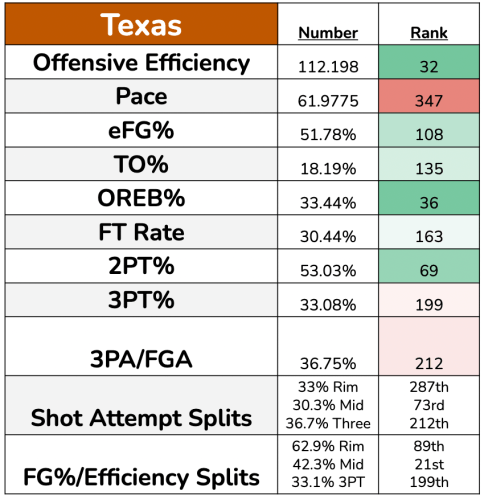
So: I think it’s worth noting the difference between the Four Factors and your eyeballs here. The stats will tell you that this is a pretty good offense. They’re slow, sure, but they’re an above-average shooting group on the whole. They hammer the boards. They’re bringing the mid-range game back. I like watching Timmy Allen, a 6’6″ wing that plays like a center at the 4. Despite a relatively weak schedule so far, the offense is almost precisely as efficient as the 3-seed version of this team last year that I genuinely enjoyed watching.

The eyeballs tell a different story. I wrote about my watchability metric CBBWAR recently; it brings Texas in at 86th nationally. This is because Texas doesn’t hit many threes, has the fewest dunks of any Big 12 team (after nearly leading the country in dunks a year ago), and…just doesn’t do anything that’s interesting? Among the five players on the roster with 20+ three-point attempts, none hit more than 36% of their threes. Four times in their last five games, they’ve hit 50% or worse on twos. They consistently hammer the boards, but the most exciting thing about this offense is that they hit a lot of mid-range twos. The leading scorer doesn’t crack 12 points per game. Hooooo-ray.

Chris Beard runs an offense that aims to generate lots of cuts to the basket via off-ball screens and motion. There’s also a good amount of post-ups, some ball screens, some ISOs, and a genuinely crazy amount of possessions that go down to the final second. Before we get there: the actual players.

Timmy Allen (Utah transfer, 11.9 PPG) is the one player I do genuinely find watchable and interesting. He’s the 6’6″ small-ball 4 that plays like a 5 yet is sized like a 3. Allen takes about two threes every three games, a very low rate for a starting power forward in today’s game. (Of the 234 6’6″ players averaging 16+ MPG in America, Allen ranks 210th in three-point attempt rate, per Torvik.) More than maybe any other player in the sport, Allen is extremely talented in knowing where and when to cut to the basket; only six players in America have more points off of cuts this year, per Synergy.

Marcus Carr (Minnesota transfer, 11 PPG) and Courtney Ramey (9.3 PPG) comprise the starting backcourt; they’re paired together because they have fairly similar skill sets. Shot Quality ranks both as being very good at creating their own shots and I’d say normal play-by-play data backs that up. 38% of Carr’s makes and 61% of Ramey’s are unassisted. Carr is the main ball-handler on the team and can be expected to pull up off the dribble pretty frequently:

While Ramey’s the best shooter Texas has to offer, coming in at 36% on threes and an astounding 48% on all catch-and-shoot attempts. He was at 44% on catch-and-shoots last year, so I feel pretty safe deeming him a legit, scary threat from downtown. If only he took more than four a game from deep.

The fourth and fifth players to highlight are intriguing because both keep bobbing in and out of the starting lineup. Andrew Jones takes more threes than any other Texas player but is a 33% shooter this year and 35% for his career. For reasons I’m not sure how to explain, Jones has consistently been better off-the-dribble than in catch-and-shoot situations over the course of his career, so making him take a dribble or two is actually the worse option.

Lastly: Tre Mitchell (UMass transfer, 9.2 PPG). Mitchell’s gotten more starts at the 5 as of late, displacing Creighton transfer Christian Bishop. (Recall the note up top about all the transfers, please.) He posts up a lot and is a quality passer for a big man; the notable thing he brings right now is extra spacing due to the fact he’s a decent three-point shooter.

You might notice something among these four GIFs: only one was an attempt at the rim. That’s by design. In the to-be-expanded SEC, Texas would rank 13th of 16 in terms of rim attempt rate. They’re decent at finishing when they get there, but they have almost as many attempts from 5-21 feet as they do 0-4. In terms of pure mid-range jumpers, they average 10 a game. On Bart Torvik’s site, you can compare a team’s statistical profile to those from previous seasons. If you boost the importance of eFG% and 3PT attempt rate, you may snicker at the results.

Ask Tennessee fans how those Marches felt.

CHART! The official Chart Guide is now as follows:

Yes: “Be afraid.” 😬
Somewhat: “They can hit this but not very efficiently.” 🤔
No: “Either never attempts this shot or is atrocious at making it.” 🥳

Texas’ defense

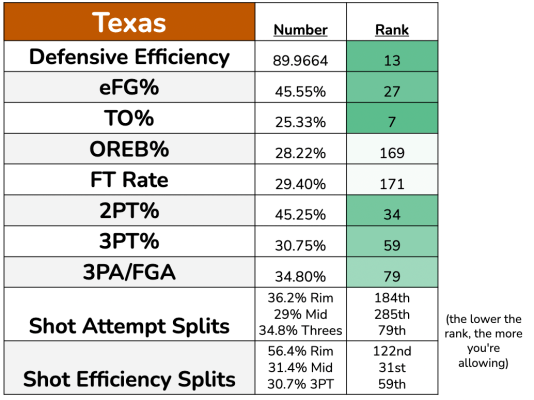
Interesting! This is the side that keeps Texas watchable: the Texas Tech defense with hand-picked transfer portal kings that forces a bonkers amount of turnovers and is excellent at forcing bad shots. The stats graphic spells it out pretty well: terrific at defending twos and threes, good at defending the rim, generally good all around. I like that. There is a problem, however:

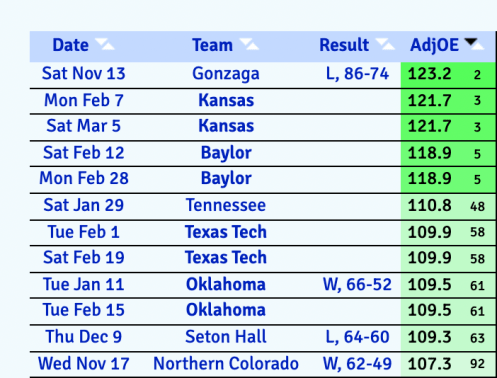
That graphic encapsulates every Top 100 offense on the Texas schedule. Something you’ll immediately notice: just four games against Top 100 competition, two of which were losses. Something else: Tennessee is the second-best offense Texas has played. Please think about this edition of Tennessee basketball and speak that out loud. Tennessee is the second-best offense Texas has played. God almighty.

Unfortunately, all efficiency numbers are adjusted for competition, and those seem like useful proof that Texas is smashing the weak schedule it’s been given. (Texas’ offensive SOS ranks 185th on KenPom, which is like playing Missouri, the 181st-best offense, 20 times.) Texas promotes relatively low-variance games by not giving up many three-point attempts and instead forcing a lot of non-rim twos. The same principles that aided Beard at Texas Tech are still helping him here:

The difficulty with playing this defense is that you’re likely to see a variety of ball-screen coverages depending on personnel. Texas will ice to the sideline whenever possible, but as evidenced above, they’ll switch when it makes sense and hedge a ball screen to push you away from the perimeter. Rarely, if ever, will you see a drop coverage employed; I would think they’d learn a lesson from what Arizona did against Tennessee that proved to be a fatal flaw in the Wildcats’ game plan.

Aside from the tons of turnovers, I do genuinely think Texas makes the shots against them at the rim difficult. As much as you can be moderately unlucky in game-to-game rim FG%, Texas probably deserves better results than the middling number you see in the graphic. No one player blocks tons of shots aside from backup Dylan Disu (Vanderbilt transfer), but the backcourt doesn’t get exploited by faster guards terribly often. When they do, the system itself does a great job of making life difficult.

On a lot of possessions, Texas simply doesn’t allow you many places to go that are statistically reasonable or efficient. They’ve been terrific at guarding the perimeter, both by 3PT% and by them allowing an average of just 12.5 catch-and-shoot attempts per game, the lowest average in the Big 12. They allow nearly as many off-the-dribble jumpers as they do catch-and-shoots, which is quite impressive. They’re still struggling with defensive rebounding at times and they do foul a bit, but for the most part, this is a really tight top-to-bottom unit.

The few teams that have experienced success against Texas since the Gonzaga game have either gotten hot from deep (Oklahoma State 8-for-17, Iowa State 10-for-23), rode the wave of Texas having a bad offensive night (Kansas State), or both. For what it’s worth, the hyper-aggressiveness of this defense has its holes. Synergy rates Texas as being in the 45th-percentile at defending cuts to the basket, which is interesting. While Texas doesn’t give up many threes in general, the ones they do give up are open, both C&S (55/45 Guarded/Unguarded) and off-the-dribble (Shot Quality gives an expected hit rate of about 31% on these threes; Texas currently sits at 25.5% allowed). If Tennessee can get the Regression Devil on their side, it could be a happy reunion for Rick Barnes.

Lastly: opponents are shooting 62.2% from the free throw line against Texas. Considering free throw defense is not a thing, I doubt that’ll last.

How Tennessee matches up

I think the obvious hope here is that Tennessee doesn’t fall back into a wave of mid-range jumpers like this defense wants to force. The good news is that the defense most like this is Texas Tech’s, which was a game where Tennessee got 90% of their shots at the rim or from three. The bad news is that Texas Tech is called the Act of God Game on this site for a reason. If Tennessee’s willing to forget that, they can create pressure in the paint the same way Texas does offensively: lots of penetration by Tennessee’s deceptively quick guards that ends in a cut to the basket.

Having a quality paint penetrator like Kennedy Chandler will help with this. I wouldn’t be shocked if Chandler has his own excellent game, but given his penchant for turnovers, I also would not be shocked to see him struggle. The team will go over the Texas Tech film to prepare for Texas, and a thing in Tennessee’s advantage is that Texas is simply not nearly as switchable or as tall at all five positions. Still: they force a ton of turnovers for a reason.

The other side of this equation is that you’re going to have to generate a lot of catch-and-shoot threes. Texas has done an excellent job of ensuring these simply don’t happen often this year, but Tennessee just got done getting off 21 catch-and-shoot attempts against a Florida team. The only side to toss up more C&S attempts against Florida this year: Alabama. Tennessee is deeply committed to the three, and in a road game where some amount of positive variance is needed to win, you’ve gotta get shots off.

An interesting stat to note: per CBB Analytics, of the 17.5 three-point attempts Texas allows in an average game, just 5.2 (or 29.7%) come from the right corner or right wing. 7.8 (44.6%) are from the left corner or left wing. This is likely by design; Texas wants to keep you out of the middle of the floor, and Tennessee has to be creative with where they place spot-up shooters. If Tennessee can find a way to keep getting Santiago Vescovi (or the other obvious shooters) open on the left side of the floor, they could get the extra juice they need to steal one on the road.

Defensively, Tennessee could have a similar concern in directionality. Texas has guards who are pretty good at driving the right half of the court and a frontcourt that can clean up the mess with an offensive rebound or a well-timed basket cut. Most annoyingly, if you keep them out of the paint, the odds they’ll nail a mid-range jumper are higher than anyone else on Tennessee’s schedule. So: pick your poison.

My first instinct is that Tennessee’s got to scheme a way to make Texas feel indecisive when driving. I’m still of the opinion that making the right players take mid-range jumpers is a perfectly fine strategy, and if Ramey or Carr want to take those ~40% shots instead of ~53% ones at the rim, do your thing. Still, Timmy Allen and crew are going to try to get Tennessee’s frontcourt out of sorts early with a basket cut every third possession. Tennessee has been very good at defending these this year, but Texas will try them more often than anyone else on the schedule. If Tennessee shuts a couple down in the first five minutes, Texas may ease up on how often they go to it.

Beyond that, this is a Texas team that has some quality shooters but no lights-out shooter on it. All of Jones, Ramey, Carr, and Mitchell are threats in the mid-range and from deep, but you’re not drawing the Kellan Gradys of the world here. The best and most proven strategy with Texas has been to make them take a lot of jumpers in half-court offense. They’ll hit a decent amount, but it beats letting them get to the rim or the post. As crazy as this sounds, I think I’m fine with the mid-range jumpers. Here’s why:

  • 2021-22 Texas, mid-range jumpers (per Synergy): 86-for-200 (43%), or 0.86 points per shot
  • 2021-22 Texas, threes: 133-for-402 (33.1%), or 0.993 points per shot

No matter how you slice it, it’s 13 points worse per 100 shots. The only player I genuinely don’t want to see pulling up from 17 feet is Marcus Carr. Everyone else: have at it. It’s less-damaging on the whole than threes.

Starters + rotations

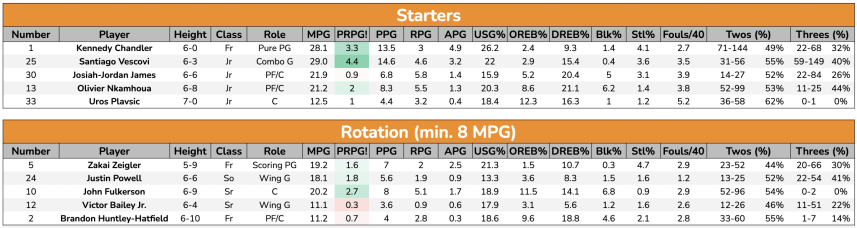
Metric explanations: Role is algorithmically-determined by Bart Torvik. MPG is minutes per game. PPG/RPG/APG/Fouls/Twos/Threes are what you’d guess. USG% is the percentage of possessions a player uses on the court. OREB%/DREB% are your available rebounds usurped. Finally, PRPG! is Bart Torvik’s Points Over Replacement metric; the higher the better. If you’re on mobile, zoom in; if on desktop, right click -> Open Image in New Tab.

Three things to watch for

  • How many extra possessions can Tennessee create? I wouldn’t be surprised if turnovers are a stalemate or are slightly in favor of Texas. The more interesting thing is rebounding. Texas’ DREB% on missed threes: 263rd. Tennessee’s OREB% on missed threes: 44th.
  • Can either team crack 60% at the rim? These are both excellent two-point defenses; if either tops 60% down low I would be mildly surprised.
  • Threes. Obviously. Texas is 11-1 when their opponent shoots 35% or worse from deep; Tennessee is 9-1 when they simply crack 30%.

Key matchups

Timmy Allen vs. Josiah-Jordan James. This will be Allen vs. Nkamhoua to start, but JJJ is a near-identical body match for Allen and Tennessee’s been running with JJJ at the 4 more frequently as of late. Allen’s main source of points are cuts to the basket and rebounds; it would be ideal for JJJ to shut one of those valves off.

Marcus Carr vs. Kennedy Chandler. Carr has dropped 20+ twice in conference play, while Chandler hasn’t dropped 20+ since December 4. The points are only one part of this. Chandler must force Carr into tough, low-expectancy shots while avoiding the turnovers that have become unfortunately common on the other end.

Courtney Ramey vs. Santiago Vescovi. Hope you like threes! Ramey’s goal will be to get up 4-5 threes in this one, but Vescovi taking 9-10 genuinely should happen.

Three predictions

  1. Tennessee blocks more shots than Texas;
  2. Multiple times this game, you will be annoyed by a Texas player hitting a mid-range jumper;
  3. Texas 64, Tennessee 61.