Located in lovely Montgomery, Alabama is Alabama State University. There probably isn’t much you know about it if you know about it. It’s an HBCU most famous either for being the place 2 Chainz played basketball at, or maybe it’s Tarvaris Jackson, or, hopefully, Ralph David Abernathy. Maybe you know them because of the famed Magic City Classic. You probably don’t know about the basketball team; that’s not a surprise, considering they haven’t made the NCAA Tournament since 2011.
As part of my duties here, I am supposed to educate you about the basketball team a college has. However, I like advertising other stuff, too. In this instance, I find it much more important to tell you about the MIGHTY MARCHING HORNETS.
Alabama State’s marching band is one of the most beloved, well-respected, and flat-out wonderful bands you will find in this world. They are full of swagger, relentless play, and I’ve spent hours watching their walk-ins on YouTube. You know of the Human Jukebox, the Sonic Boom of the South, the Ocean of Soul, obviously. But you must know about the Mighty Marching Hornets.
Alabama State’s marching band has performed in the Rose Parade, a 2 Chainz music video, Billy Lynn’s Long Halftime Walk, several NFL games, and they go to the Battle of the Bands – a real thing that sounds absolutely incredible – every year. Their danceline, called the Honey Beez, was asked to perform on America’s Got Talent. It is, uh, a slightly different experience than the Pride of the Southland Band, no disrespect intended.
The Fifth Quarter isn’t something that makes much of an appearance in high-major athletics, but it’s everything to these band members. After football games, Alabama State and their opponent march out, attempting to one-up each other with what they perform. Buddy, is it ever good stuff.
Will the Mighty Marching Hornets be on display in Knoxville tonight? Unfortunately, no; the band only performs for SWAC home games. The Alabama State Hornets, a basketball team that’s less explosive, sure will, though. They are coached by Lewis Jackson, they’ve made the NCAA Tournament four times, and they scheduled like crazy this year. Prior to Tennessee, they’ve played Gonzaga (lost by 31) and Houston (28); after, they’ll play VCU, Kansas State, Oregon, and several others. They won’t play a home game in the 2019-20 season until January 11, 2020. Tennessee simply happens to be another march, in and out, like it will be most nights.
If you would like to jump ahead to a certain page, click below.
I think I’ve always been impressed by the Murray State basketball program. I don’t know if I could pinpoint the exact time when I became aware of their existence and success; it’s as if they just appeared there one day, everyone agreed they were good, and that was that. And it’s a correct assumption! In the history of Ken Pomeroy’s ratings, which now date back to the 1996-97 season, just twice have they finished the season ranked outside of his top 200…and they went 13-7 in conference play in both seasons.
It’s not as if Murray, Kentucky is the exact spot you’d have in mind for a mid-major power. Murray’s closest population center of serious note is Nashville, just under a two-hour drive away. The roster isn’t stacked with overlooked Kentucky kids from a basketball-loving state; only two players on the team call Kentucky their home, with one of them a serious contributor (Jaiveon Eaves). It’s a national roster of sorts, with 14 players from nine different states. Murray State is the OVC’s patchwork quilt, an assembly of varied parts that, for the most part, works in collective 12-14 seed anonymity.
Almost on accident, Murray State ended up with the #2 pick in the 2019 NBA Draft. Ja Morant was a high school also-ran that only ended up being discovered because a Murray State assistant checked out the #2 gym at a tournament. He went from that to taking Murray State to the Round of 32 for the third time in the last ten years.
Now, Morant is gone and Murray State is rebuilding…or so you’d think. What a lot of people don’t know about Murray’s 2019-20 team is the following:
Three of five starters return.
Five members of Murray’s eight-man rotation are back.
Their top two scorers departed, but their third-through-eighth highest scorers have returned.
All in all, it could be a lot worse for Oak Ridge’s very own, Matt McMahon. This is McMahon’s fifth season as the head of the Racers after a playing and coaching career at Appalachian State with one year at UNC-Wilmington in between. Tim Kaine – not the former VP candidate, but rather McMahon’s assistant – is also from Oak Ridge. Casey Long, another assistant, played at Chattanooga with Director of Player Development Ronrico White. The staff as a whole has a distinct Tennessee flavor to it. Now, they get to visit the home of the best basketball program in the state. As is the case seemingly every year, chances are the team they’re bringing with them is pretty solid.
WHAT THEY BRING
Offensive fluctuation with a lot to be answered
Here’s what I know about the 2019-20 Murray State Racers so far:
In an exhibition against Martin Methodist, KJ Williams took 17 shots. No other player took more than nine.
In Saturday’s outing against Southern University, Tevin Brown took 10 shots, while three others took seven or eight. No one else took more than four.
And that’s about it. When a team is forced to replace their top two scorers and rebuild around a group where no player scored more than 11.8 points per game the previous season or made more than four field goal attempts per game, it’s hard to draw huge, correct answers off of 80 minutes of basketball. What I can tell you is that even without Morant, Murray has largely ran the same offense for the last three-ish seasons of McMahon: lots of transition play with a focus on ball-screen sets in the half-court.
Transition/primary break offense is largely based on what you’re doing on the defensive end; if Tennessee does a good job of getting back, all I can tell you is that they’ll have to make sure Murray isn’t spacing the floor to its extremes like they’re used to. Let’s focus on the half-court game.
Ball-screen offense heavy on continuity sets
To start, you’re going to have to know about college basketball’s most popular play: the continuity ball screen. If I had to guess, I’d estimate at least 75% of Division I teams run this with fair frequency in some form. (Watch the first 90 seconds or so to get the gist of it.)
Murray State, unsurprisingly, counts themselves among said group. Here’s Morant and Leroy Buchanan running this last year:
Obviously, things aren’t going to look the exact same in 2019-20 for Murray, but a good amount of the philosophy will still remain. Murray offers the benefit of two legitimately very good post players in Darnell Cowart and K.J. Williams, both of whom could give Tennessee some serious issues down low. Before those two, let’s talk about the shooters off of these motion sets.
Tevin Brown (90 of 242, 37.2% in 2018-19):
Jaiveon Eaves (24 of 66, 36.4%):
I don’t know how much Brion Whitley, a 21-of-45 shooter in 2018-19 will play, as he was held out of the Martin Methodist and Southern games due to injury. However, the first two are certainly worth watching and guarding. Brown hit 5 of 9 threes against Marquette in Murray’s Round of 64 demolition; Eaves was less prolific, but you can’t dismiss a 36.4% shooter. Neither will have the benefit of the massive gravity Morant drew, however. I guess you can tell I’m hedging my bets here, and I am; I genuinely don’t know exactly what this offense looks like with this many points to be absorbed.
Murray, KY, home to Big Boy Records
On the scale of Chunk to Chonk, Darnell Cowart is OH LAWD HE COMIN’:
What a CHONK. Darnell Cowart is a 6’8″, 280 pound round boy, and this is after leaving junior college at over 300 pounds. To be a 280-pound post player having lost weight is pretty incredible. Sadly, I don’t have much to go off of for 2019-20 footage just yet, as they’ve held him out of play for all but 11 minutes thus far due to injury maintenance. Here’s one of his two baskets this season:
Hopefully he takes the floor at Thompson-Boling, as he possesses an excellent post-up skill set that should give Tennessee’s fledgling frontcourt quite a bit of practice.
On the other hand, there’s KJ Williams:
Williams is a 6’10”, 245 pound sophomore who took over a starting role last year in his first season with the Racers. He was hyper-efficient – 69.8% FG% – and remains hyper-dangerous.
Murray loves running him out as the roll man in ball-screen sets or in backdoor cut plays that also work for Cowart. Neither is an elite defender, so you can get to them on the other end…but both will do quite a bit of work on you on the offensive end. Like I said earlier, it’s worth noting that Williams took almost double the shots of any other Murray player in their exhibition. It wasn’t quite like that against Southern, but there’s a good chance their offense will feature him heavily this season.
Man-to-man defense that limits three-point attempts at the expense of post-up struggles/DREB issues
If you asked me to design a man-to-man defense for the average college basketball program, I’d probably toss in a few elements of what Murray State does. Matt McMahon’s squad has come in 6th and 4th the last two years in opponent 3PT%, which is traditionally not a stat that repeats itself. However, it helps when you’re well above the national average in preventing threes in the first place. Even when you get one off, Murray is usually pretty good about closing out on it:
However, there’s areas where you can crack the Murray egg. Remember what I mentioned earlier about Cowart and Williams being two exploitable players on the defensive end due to a lack of mobility? Neither is terribly efficient defending on the inside:
Also, just once under McMahon – actually, just once in the last 13 seasons – has Murray State ranked in the top 100 of defensive rebounding percentage. I know they were weak opponents, but Tennessee pretty much demolished Eastern New Mexico and UNC Asheville on the boards. They should be able to do similar work here, and it actually feels like an area where Yves Pons could be of massive use:
HOW TENNESSEE BEATS IT
Work it inside and make the Big Boys earn their keep
In a perfect world, Matt McMahon would give both Cowart and Williams 30+ minutes per game each. Instead, he barely got Cowart over 20 per game last season and had to hold Williams to 18. Why? Because Cowart committed 5.2 fouls per 40 minutes and Williams 4.1. In one of Murray’s five 2018-19 losses, Cowart went for 14 and 13 in just 23 minutes. It was as dominant of a per-minute showing as you’ll see, and yet, Cowart only got 23 minutes due to a four-foul outing. On the flip side, Williams was able to hold himself to just three fouls against Marquette and he went for 16 points in 24 minutes. Any amount of foul trouble you can get here is a huge bonus.
As such, Tennessee’s gotta go to the rim early and often, whether that’s with a post player:
Or with a guard:
Those aren’t and-ones like I’d prefer to use, but Tennessee has just one and-one through two games and it was a transition play, so we have what we have and that’s that.
Don’t give up on the perimeter entirely
Like I noted, I really do like what Murray does on defense, and I think there’s something to be said about their three-point defense. That said: they ranked right at the national average in terms of our beloved Guarded/Unguarded catch-and-shoot splits, with 58% of three-point attempts guarded, per Synergy. Also, it’s not as if they ranked #6 and #4 in preventing three-point attempts, but #90 and #80. I think it will be very hard to run out a third-straight top 10 3PT% defense season. If Tennessee’s patient and reverses the ball around the perimeter or uses their inside-out game, they should be able to find several open looks from downtown:
Crash the boards
Buddy it’s simple. Do I need to spell this one out?
A disclaimer: I do think Tennessee should only send three to the boards in this game instead of my preferred four-man rush. Murray State gets out in transition more than almost anyone in Division I basketball, and Tennessee needs to be prepared for McMahon’s initial rush. However, there’s no reason for Tennessee not to get quite a few offensive rebounds against this group. They may be thin, but they’re lanky and athletic and most of ’em can jump pretty well.
Stuff pick-and-rolls, whether at the rim or on the perimeter
Obviously, things will look a little different in 2019-20, but in half-court offense, Murray got over 42% of their field goal attempts at the rim last season, per Hoop Math. Tennessee’s rim defense has been very solid so far, and I’d hope to see a little more of this against pick-and-roll ball handlers:
On the perimeter, Tennessee’s defense was pretty excellent against UNC Asheville; the Bulldogs went 5-of-20 from three. Our Guarded/Unguarded split gave Tennessee an 8-of-14 (57.1%) success rate, but it felt better than that on rewatch. Tennessee’s been pretty excellent about closing out on spot-up opportunities like this one:
Get back in transition; don’t allow easy baskets
Murray loves to run; neither of Tennessee’s opponents really have so far. That said, Tennessee had at least a little practice against both. Tennessee forced UNC Asheville to play a 71-possession game, which would’ve been one of their four fastest games in 2018-19. Asheville went for 21 points on their 18 transition possessions (1.167 PPP), per Synergy; they went for 42 points on their other 53 (0.792 PPP), which is a large split. Tennessee got burned a few times:
However, on other possessions, they got back and defended quite well:
Tennessee needs far more of the latter and less of the former in order to attain the successful defense I know they’ve got in them.
LINEUP NOTES
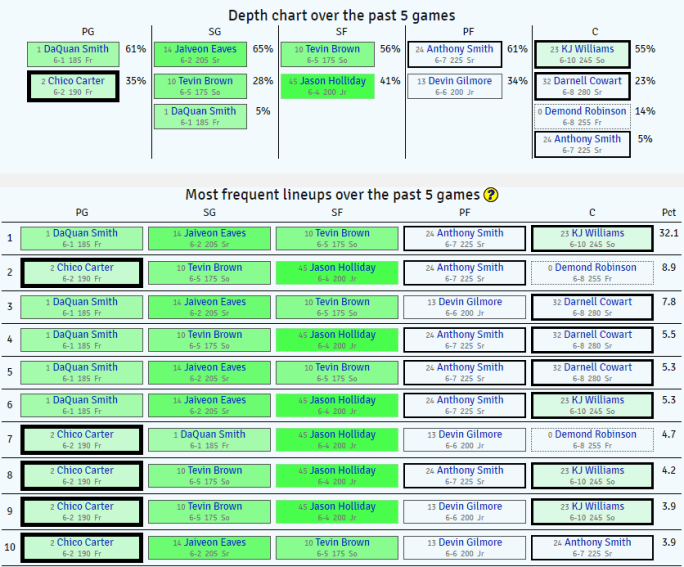
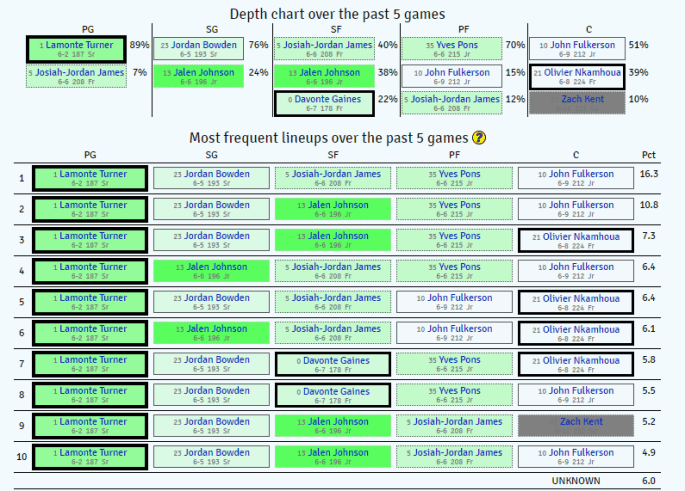
A small twist this year: I’m posting the lineups for each team too, not just the starters/depth chart section. It’s a little longer, but provides way more context for most common lineups.
Murray State:
Again, this can change, but the first game against Southern made it seem pretty clear: Smith/Eaves/Brown/A. Smith/KJ Williams.
Murray played Williams and Cowart together in the starting lineup last year, and I suppose that could change for 2019-20, but it mostly appears that they’re waiting out Cowart’s recovery.
FWIW, Anthony Smith has taken 75 of his 77 field goal attempts from inside the arc in college. KJ Williams took a three against Southern and missed it, which now means he’s attempted six career threes. Barring a surprise outburst, Tennessee can pretty much know Murray will have three perimeter shooters and two interior players. Sort of a throwback Tuesday, if you will.
Tennessee:
Turner/Bowden/James/Pons/Fulkerson are the starters until further notice.
Against UNC Asheville, Tennessee gave no individual lineup more than 6.5 minutes of play; Barnes clearly took the opportunity to experiment and figure things out to its fullest extent. When your tenth-most-used lineup still got two minutes of use, you’re clearly still trying to get a rotation and its lineups solidified.
I don’t know if Drew Pember will be available for this game. If not, expect Tennessee to stick with the eight-man rotation it had against UNC Asheville with Zach Kent as the ninth.
KEY MATCHUPS
Josiah-Jordan James (and maybe Jordan Bowden) vs. Tevin Brown. Brown led Murray State in shot attempts against Southern and was expected to be the likely scoring leader on the team this season. He’s predominantly a three-point shooter but likes to get to the rim as well. Tennessee can’t commit many fouls here with a short rotation.
John Fulkerson/Yves Pons vs. KJ Williams/Darnell Cowart. There’s no easy solution here; I would’ve thrown in Nkamhoua too, but his 224 is not a super-muscular 224. Either of Williams or Cowart will have at least a 30-pound advantage on their Tennessee counterpart; I think the Vols have to be willing to double-team in the post and force the ball out of the hands of these two.
Asheville: it’s a good American city. Think of all the great things you can do there: eat good food, go to excellentbreweries, see a quality concert every now and then. Sometimes, it feels like it gets lost in the shuffle of larger Southeastern cities; indeed, it’s far smaller than I initially thought (estimated population of 92,000, per Wikipedia), and it ranks out as just the 108th-largest metropolitan area in the United States.
And yet: I’d take Asheville over all but four cities in this list. It’s a very pleasant downtown to visit, and pound-for-pound, it might be the most purely enjoyable visit in the Southeast, considering relatively minimal traffic and the lower population. It’s a city that punches well above its weight class and can be counted on to beat a few of the bigger guys out there.
For a while, its basketball program at the University of North Carolina at Asheville mirrored the city’s progress. From 2007-08 to 2017-18, the Bulldogs of Asheville finished with a winning record in the Big South every season, made the NCAA Tournament three times, nearly pulled off a 16-seed stunner, and, for the better part of this run, was the program to beat in the Big South under a pair of talented head coaches (Eddie Biedenbach and Nicholas McDevitt).
McDevitt left for Middle Tennessee in 2018; behind him came Mike Morrell, a 36-year-old from Elizabethton, TN. If you want a true started-from-the-bottom guy, it’s him: Morrell played at Milligan College, began his coaching career at King University, and only breached Division I because of a relationship with Shaka Smart. Morrell bears some amount of responsibility for the following Guys You Know: Troy Daniels, Treveon Graham, Briante Weber, Isaiah Taylor, and Jarrett Allen.
Now, Morrell is in the midst of a program-wide teardown operation. Last year, UNC Asheville posted a 4-27 record – 4-0 against a pair of non-D-Is plus USC Upstate, 0-27 against everyone else, including a D-II loss – while playing the youngest lineup in America. Upon Morrell’s arrival at UNCA in April 2018, his two best players immediately transferred out, followed by valuable backup Drew Rackley. This was after the team he inherited graduated three starters and its sixth man. Any time a team loses its eight best players, things are going to be, uh, challenging.
Morrell’s hope and prayer is that his full-on youth movement in 2018-19 pays off in 2019-20. KenPom sees a program that realistically can’t be any worse, spotting them 293rd after a 347th-place run last year; Torvik, 241st after 344th. The benefit of last year’s awfulness: other than Donovan Gilmore, every UNC Asheville scholarship player from 2018-19 returns, and they get to add a pair of transfers in Jax Levitch (Fort Wayne) and Lavar Batts (NC State). The assumption here is that the worst days are over and, in Morrell’s true Year One, the program will at least be a mid-level Big South foe. Alternately, this could still be a really bad team with a long, long way to go. We’ll see.
AFTER THE JUMP: Hey did you know their coach is a Shaka disciple
If you’d like to jump to one of the following, click below.
Welcome back for another long season of Show Me My Opponent. My hope is that this year’s editions retain all the positives of last year’s work and build on the areas that could use improvement. This offseason was spent attempting to learn as much about basketball as possible; now I get to apply it to the team I cover most deeply.
This first edition is about an exhibition game. It is not a game that counts towards Tennessee’s regular season record. It is against Eastern New Mexico University. Here are the things I would like for you to know about Eastern New Mexico University:
It is located in Portales, New Mexico, which is indeed Eastern New Mexico. (Drive 35 minutes east and you arrive in Texas.)
Every single sports field the school uses, and I kid you not, is named after greyhounds: Greyhound Stadium, Greyhound Arena, Greyhound Field. Quality synergy.
On the actual basketball side of things, the Greyhounds went 13-17 last season, going 10-8 in Lone Star Conference play. It is nice that they play in the one conference in America proud enough to honor our country’s best cheap beer. Anyway, ENMU actually played three D-1 teams: UTEP, New Mexico State, and Grand Canyon. Only the UTEP loss (66-59) was close; the other two were monstrous blowouts (92-65 to NMSU, 95-64 to Canyon) that were never in doubt. Of those three teams, only NMSU ranked in the KenPom Top 100, which is where Tennessee will be.
Unfortunately for the Greyhounds, they’ll be rebuilding just like Tennessee is. Five members of their ten-man rotation were seniors, meaning they’ll have to replace a ton of offensive and defensive production. Only one or two starters (depending on head coach Tres Segler’s decision) from 2018-19 will start against Tennessee. It’s a team in flux that’s taking its first-ever trip to Knoxville; normally, that doesn’t end to well. Be kind to them; the greyhound is a good, useful dog.
WHAT THEY BRING
A solid-ish point guard
Devin Pullum is Eastern New Mexico’s only returning double-digit scorer. He was also the Greyhounds’ leading scorer last year, despite tossing up just 12.7 PPG. On the whole, the Greyhounds are a pretty democratic group: eight players averaged 5.8 PPG or more, but none topped Pullum’s 12.7. This is despite Pullum not being a terribly efficient shooter:
Pullum shot just 38.1% from the field – 43.8% on 162 twos, 31.1% on 132 threes. To be fair, though, it’s not as if anyone else around him was lighting it up; of players who attempted at least 30 threes last year on ENMU’s team, Pullum wasn’t even in the bottom two of efficiency. On the whole, Pullum ranked in the 42nd-percentile nationally in Synergy’s efficiency metric. However, he will present an interesting enough threat as a pick-and-roll handler for Tennessee’s perimeter defense:
And, in ENMU’s ball screen-heavy offense, he’s one to watch as a guy that can create gravity and space for his surrounding players:
On the whole, Pullum is about the only prominent returner that can create his own shot; that’s why he’s getting these words. If nothing else, he represents a practice run for Tennessee’s P&R defense that was either great or terrible depending on the game last season.
A couple of other dudes
Here is Isaiah Murphy:
And here is Darius Sawyer:
Together, they represent the only other 6+ PPG scorers returning from last year’s ENMU team. Murphy averaged 7.9, Sawyer 7.1; this would be like having to rely on James Daniel returning from the 2017-18 team for a rebuilding year. (Which might have been good. Who knows.) Sawyer appears to be a decent rebounder, as he got 35 points off of putbacks last season. Murphy spent a little bit of time as a ball-handler in ENMU’s ball screen offense, but largely, he’s a guy that operates out of spot-up looks and in transition. He is somewhat efficient at the basket, if you’re curious.
Man-to-man defense that’s replacing a lot
I had to give the asterisk-type thing there. ENMU was a decent defensive team last year, ranking in the 64th-percentile on Synergy and holding opponents to a 50.6% eFG%. (That would’ve ranked exactly 0.1% above the D-I average.) ENMU, to my eyes, doesn’t do anything super special; 95% of the time they ran a man-up defense, and the other 5% was mostly wasted effort in a porous zone. They could reasonably give Tennessee a zone for fun in this one, but nothing statistically suggests it’s a worthwhile endeavor.
Anyway, the stats. ENMU guarded about 53% of catch-and-shoot attempts in half-court, which isn’t terrible (the national average is 58.4%) but also not ideal. Considering they’re replacing so much, and considering neither Pullum nor Murphy ranked above the 54th-percentile in individual defense, I can’t imagine they’ll have fewer of these plays:
ENMU was also not the most ideal interior defense you’ll find. Synergy has them as ranking in the 26th-percentile in cut defense and the 10th in post-ups. Within 4 feet of the rim, opponents shot 55.9%; this was a pretty poor rate for Division II. Both of the quality D-I games they played last year resulted in the opponent getting a considerable amount of offensive rebounds and a lot of quality looks at the basket:
Also, if Synergy’s ratings are a reasonable reflection of the players’ defensive abilities, ENMU lost their only two rotation members to hit the 60th-percentile or higher in individual efficiency. If Tennessee struggles to score at all, please adjust your expectations for the November offense downwards drastically.
HOW TENNESSEE BEATS IT
The game starts at 7 PM Eastern Time and lasts for about two hours
Look: I know Tennessee’s replacing a lot. I know that there’s a lot in flux. I know that the November/December Tennessee basketball team is likely going to struggle to find its way. (Maybe not, who knows.) I also know that they’re drawing a Division II team who lost half of its rotation and most of its offensive production in Game One. An average Big Six team should beat Eastern New Mexico on an average night by 30+ points. Even a bad one should win by 25+. It’s also a team with no player taller than 6’7″ that got demolished on the boards by New Mexico State and a bad UTEP team last year. That means you should get to see plenty of this:
And this, against a poor interior defense:
And, hopefully, this against a perimeter defense that doesn’t love guarding threes:
What we’re looking for here is a fun, clean game that results in no injuries and you spend zero time thinking about if this is a win or a loss. Any sort of 25+ point win is fine; we can probably live with a 20+ pointer, too. Defensively, Tennessee needs to show…well, not much, but a general resistance to pick-and-roll implosions. Less dumb plays, more aggressive blow-ups of ball screens. I think that’ll bode well for early games if they do so.
Also a lot of newcomer playing time
I can’t wait to see what Josiah James + friends do in this game. Practice reports have suggested the offense will run through James, which is both an exciting and scary thought; even the best freshmen are prone to horrific nights. That said, James clearly has the most potential of anyone of the roster. He, Olivier Nkamhoua, and whoever else gets to come off the bench should have a fun night playing into their new roles. I’ll have GIFs of their play for next week’s UNC Asheville game; until then, you’ll have to pretend we all know what they look like shooting a basketball.
LINEUP NOTES
Eastern New Mexico:
ENMU started eight different players last year, and only one who started more than half the games returns: Isaiah Murphy. I think he slots in at the 2? Pullum, who was last year’s sixth man, will be the starting point guard, surely. Darius Sawyer is the 3. I have no idea who’s starting in this frontcourt but my guess is Deng Kuany (3.5 PPG, 2.7 RPG in 12.1 MPG 2018-19) and Jose Serrano, a JUCO guy.
I assume Segler will play as many dudes as he can. No clue on rotations at all.
Tennessee:
Uh…ah…Turner/Bowden/James/???/Fulkerson?
I genuinely have no idea who’s the fifth starter here. Is it Pons? Is it Fulkerson with Plavsic (depending on eligibility) starting at the 5 in a three-shooter lineup? Does Nkamhoua start? Is Jalen Johnson a factor here? I’ll take a stab and say Pons gets the first start simply by way of system familiarity; I don’t expect that to hold all season long.
I think Tennessee probably has a fairly set eight-man rotation to start: the four starters listed above, Pons, Nkamhoua, Jalen Johnson, and Euro Plastics. For games like this, they may add Davonte Gaines or Zach Kent to the mix. I’d imagine they redshirt Pember if at all possible. Obviously, the walk-ons will get a couple minutes in this one.
KEY MATCHUPS
Devin Pullum vs. Tennessee’s Perimeter Defense. This is the only 10+ PPG scorer returning, so yeah. Tennessee needs to show that it can handle solid, workable guards early on in ball screen sets; if Pullum gets to 20+, it feels like a bad omen for the much more talented guards on Tennessee’s November slate.
Tennessee Newcomers vs. General Working-Out-The-Kinks. They’re gonna look sloppy. It is what it is. Don’t freak.
My Brain vs. HIT YOUR FREE THROWS. John Fulkerson, Yves Pons, etc.: please don’t do the thing that makes me go bonkers.






 Stats by Will
