When the Seagulls Follow the Trawler, It Is Because They Think Sardines Will Be Thrown Into the Sea

This is the eighth in a series of weekly recaps surrounding the 2021-22 Tennessee men’s basketball season.

January 5: #18 Tennessee 66, Mississippi 60 (OT) (10-3, 1-1 SEC)
January 9: #21 LSU 79, #18 Tennessee 67 (10-4, 1-2 SEC)

I. Cantona/LaBeouf

In 1995, Eric Cantona, Manchester United striker, entered possibly the most consequential press conference of his career to-date. Two months earlier, Cantona was sent off for a harsh foul on a Crystal Palace player. On his way to the tunnel, a Palace supporter flew down the stairs to yell all sorts of obscenities and, by some interpretations, racial slurs against Cantona. The striker reacted how those of us who were not popular in middle school dreamed of reacting: driving his boot through the guy’s chest.

Cantona would be taken to court by the fan, and for a brief moment, it appeared that Cantona would have to go to jail for the crime of doing what I’d imagine 99.9% of people who’ve played higher-level sports dream of doing to certain fans. Alas, Cantona got out of it mostly scot-free. In his first press conference after the ordeal was finished, Cantona settled in to give his thoughts on the last two months of his life. In 15 seconds, he achieved something beyond anyone’s wildest dreams.

When the seagulls follow the trawler, it is because they think sardines will be thrown into the sea. 18 words, 15 seconds, one infamous sentence. Cantona left, because he had nothing left to say. Why would he?

18 years later, in a completely different setting, American actor Shia LaBeouf settled in for a press conference in Germany surrounding the film he was in, Nymphomaniac. (It is not a good movie.) Everyone my age or slightly older knows LaBeouf as a former child actor that starred in Holes, Even Stevens, or even Disturbia, a variety of teen-friendly things that made sense at the time. No one really knew much of LaBeouf’s backstory; they just knew him as the guy from Holes and whatnot.

LaBeouf’s appearance in this movie, and at this festival, was during a strange time. LaBeouf was too old to be in the teen-friendly movies he’d grown up in, but perhaps too young in some aspect to tackle lead roles in the Academy Awards bait we collectively pretend is superior. He’d been forced into taking some weirder roles to keep his career going. LaBeouf fidgets in his seat, but has the glass of water nearby. 18 years apart, in a different country, LaBeouf offers the same 18-word statement.

I bring this up because the moments for Cantona and LaBeouf were different before and very different after. Cantona received a ban for the rest of the 1994-95 season, but he finished his career out with United by winning Premier League titles in 1995-96 and 1996-97, scoring a combined 34 goals along the way. He received the Footballer of the Year Award in 1995-96, the same year United won the FA Cup. Cantona used his Seagulls Moment, which could’ve ended his career entirely, to instead turn his twilight years into a grace note.

LaBeouf didn’t get banned from Berlin’s film festival. What happened after was, at best, a lot of uncomfortable gawking. The next day, LaBeouf showed up with this outfit to the premiere of Nymphomaniac.
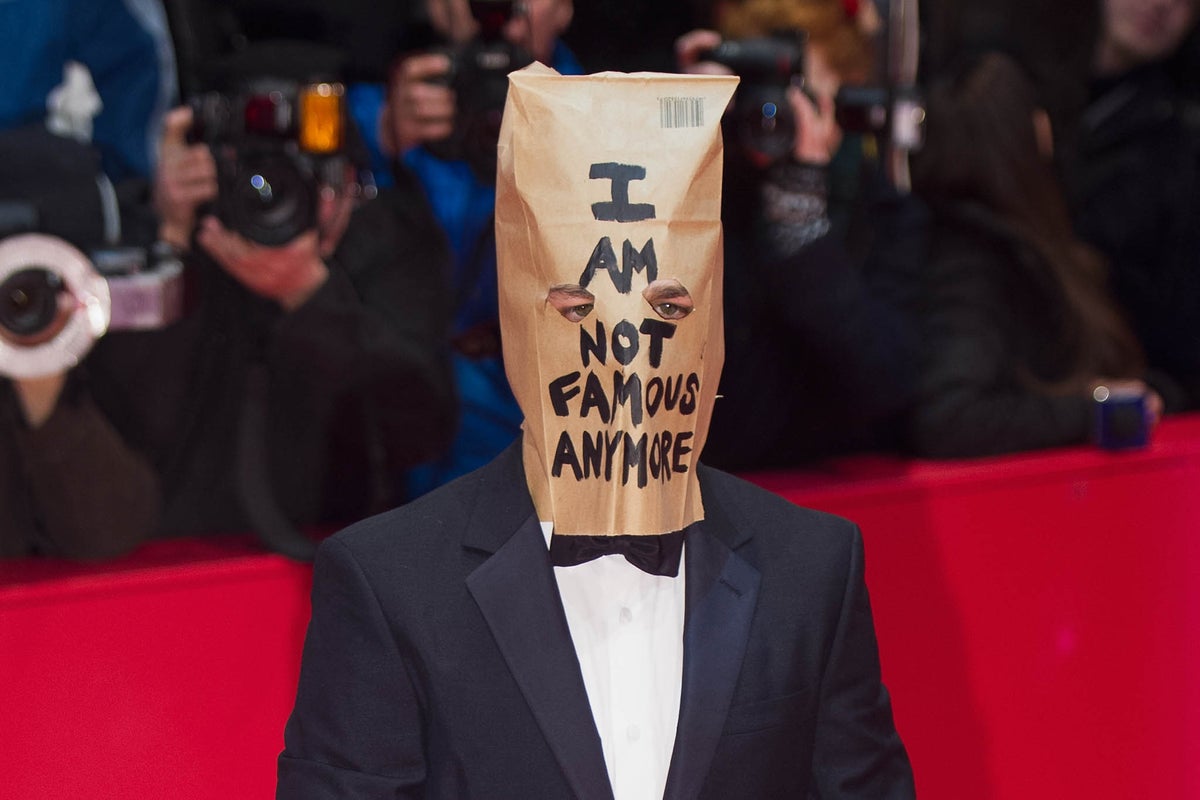
What followed that was one of the most public patterns of bizarre behavior a famous person has uncorked. LaBeouf turned the paper bag into an art exhibition titled #IAMSORRY, where you could visit him in a room for the right to watch him cry silently behind the bag. LaBeouf would go to a Broadway play and get kicked out. LaBeouf leaves jail and heads to an audition for the movie War Dogs, alongside war criminal James Corden. He watched all of the movies he’d been in and streamed it for all to see. LaBeouf protests the inauguration of Donald Trump by setting up a livestream of a wall that says HE WILL NOT DIVIDE US. Finally, that livestream ended in LaBeouf taking the flag on the road to, of all places, Greeneville, Tennessee.

That was merely three years of LaBeouf’s life, and it’s a lifetime of bizarre stuff. He’s recovered somewhat in the public eye now, but, well, he’s always finding ways to screw it up.

I am not insane enough to draw a 1:1 comparison to Tennessee men’s basketball and Shia LaBeouf. It is merely a somewhat-interesting metaphor to keep myself going as things never change and I wonder what the point of this is. What I would offer is this: the 2021-22 Tennessee basketball team sits at a Seagulls Moment. They have offered it up to fans out of pure frustration and the idea that things will somehow change by doing the exact same thing, over and over. Whether this season goes the way of Heroic Cantona or Villainous LaBeouf, well, we’ll see.

II. Variance

I feel that we’re at this Seagulls Moment because I, personally, have turned into one of the crypto people that keeps spamming “Buy the Dip.” I do not spend my money on cryptocurrency because I think Matt Damon should be jailed for his same-commercial-airs-14-times-every-day crimes, but whatever. I keep wanting to Buy the Dip on Tennessee basketball because, as we’ll cover later, the team appears to be more or less precisely what we thought it would be two months ago. They opened the season 13th in KenPom; today, they sit 14th in KenPom. They’ve yet to lose a game they were not favored to lose and have yet to win a game they were not favored to win.

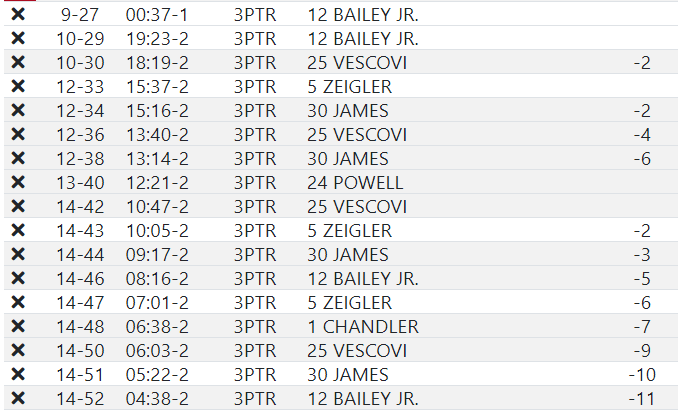
It is all going according to plan, but I’d argue we all have a very real reason to be frustrated. Here’s how Tennessee’s three-point shooting breaks down this season:

  • 50% or better: 1 game (7.1%)
  • 40-49%: 4 games (28.6%)
  • 30-39%: 1 game (7.1%)
  • 20-29%: 6 games (42.9%)
  • 19% or worse: 2 games (14.3%)

If Tennessee basketball were following a natural bell curve, you would see this break down as something more like 1/3/5/4/2 or whatever. They’ve probably been unlucky to have as many poor shooting exhibitions as they’ve had, but in general, they’ve been unlucky to not have more average performances. I mentioned the goal recently of even being the 40th-best offense in college basketball; here’s what the 40th-best offense (Ohio) did in 2020-21.

  • 50% or better: 3 games (12%)
  • 40-49%: 5 games (20%)
  • 30-39%: 11 games (44%)
  • 20-29%: 5 games (20%)
  • 19% or worse: 1 game (4%)

Look how normal that is. That’s a perfectly normal bell curve! Ah, how nice it must be to achieve such things. I guess this is me entering the Black Pit of Negative Expectations somewhat, but, well, could you blame anyone? It’s season 7 of Rick Barnes, who I genuinely like and would recommend as a head coach, and Tennessee is staring down their sixth season of failing to finish in the top 100 of effective field goal percentage (eFG%). Only twice have they finished in the top 200 in 3PT%. So, yeah, the variance we’re feeling is unusual and it’ll probably fix itself in due time…but I cannot blame the person who says “so what?”

III. Fear

That nothing will change and everything will remain the same. It’s rational, no?

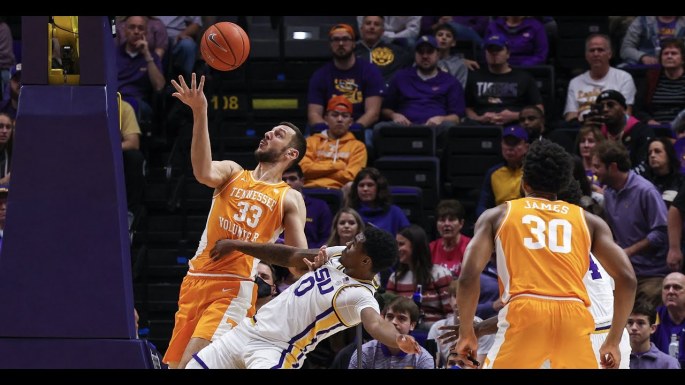
I voiced my desire for Tennessee to finally shorten their rotation against LSU on Saturday because teams simply do not play 10 guys in March; Tennessee responded by giving 10 players (none of them Brandon Huntley-Hatfield) at least six minutes of on-court action. Maybe that’s unfair, because against Ole Miss only eight players got 6+ minutes, but it lends its hand quite nicely to the continued frustration I’ve felt. Why is Justin Powell, an objectively superior player to Victor Bailey, not taking all of Victor Bailey’s minutes? Why doesn’t Powell have the same mental green light from three as Bailey despite being a superior shooter? If it’s not Powell, why not Jahmai Mashack, whose per-minute stats are far above Bailey’s? Why is Josiah-Jordan James still starting when his offensive numbers are the worst on the entire team? Why can’t John Fulkerson string two good games together? Why does Brandon Huntley-Hatfield appear to give about 13% effort on defense? Where is Quentin Diboundje, who cannot possibly be worse than a couple of the guys getting playing time?

We’re 14 games in and many of the questions I’d had preseason are either still unanswered or the answers haven’t left me very satisfied. That’s where the fear comes in: what if this is it? What if this, a basketball team that oscillates wildly between Actually Good and Completely Unwatchable, is what we’re left with? What if the answers they’re giving us are the best they really can provide? And that is a scary thing to consider.

IV. Expectations

Two months ago to the day, Tennessee sat 13th on KenPom to open the season. They were projected to have the sixth-best defense and the 25th-best offense. Right now, they’re 14th, with the defense being a bit better than anticipated and the offense being worse. So why does this feel as unusually bad as it does? Is it because Saturday’s loss to LSU wasn’t nearly as competitive (prior to the final couple of minutes) as everyone had hoped? Is it because Tennessee is failing to hit threes yet again? I mean, I don’t know, I guess everyone has a different answer…but everyone wants an answer.

The first question is this: do we adjust our expectations for March downward? As usual on the NCAA Tournament, I’d prefer to punt here. Barely nine months ago, a UCLA team that had lost four games in a row and entered the field of 68 outside the top 40 in KenPom proceeded to get red-hot from mid-range and make the Final Four. In 2019, an Auburn team that ranked 14th in KenPom entering the Tournament nearly lost to a 12 seed, then proceeded to get hot from three and make the Final Four. In 2018, well, you already know.

So I’d prefer to not make some sort of overarching statement on March odds yet without seeing who’s in Tennessee’s bracket. All you can control in terms of strength of schedule is your Round of 64 opponent; everything after that is whether you get a lucky break or not. The Loyola team that made the Final Four in 2017-18 had the 68th-best offense in America, while the Kansas State team they beat in the Elite Eight to get there was 60th-best. It really, genuinely doesn’t matter right now.

The second question: do we adjust our expectations for the season downward? Well, I’d argue this one could be more fair. Before the season began, Tennessee ranked as the #1 team in the SEC by KenPom because they were simply the least-questionable, sitting at 13th overall. Today, there are three SEC teams in the top 10 while Tennessee is basically what everyone imagined they’d be. Tennessee can’t control that, but you’re certainly staring down a scenario where 12-6 is a good-enough regular season that nonetheless gives you a 4 seed in the SEC Tournament. The February schedule is far more favorable (Tennessee will be favored in all of their final 10 SEC games), but the odds of a regular season title are dwindling with each frustrating road loss.

If you like regular season championships, Kentucky on Saturday is a must-win game. That’s as nicely as I can put it.

V. Obligation

Before, during, and after Saturday’s game, I felt a mixture of dread and obligation to keep going. This is my fourth full season doing these previews. When I started doing these previews full-time for the 2018-19 season, it was not something I anticipated doing in perpetuity. Tennessee had an excellent basketball team that year; it seemed natural to provide the local market with previews of every game. That team turned out to be the most fun Tennessee basketball team of my lifetime. I didn’t necessarily see that coming entering the season, but it made me want to keep going.

You can deal with weak or underwhelming seasons, I guess. But it’s becoming harder to deal with what feels like the exact same storylines and game flows every time out. You could design a decent-enough Mad Libs replica with it. Tennessee is [UNDERWHELMING] because they need to [MAKE MORE SHOTS] and stop [LOSING FOCUS OFFENSIVELY]. That joke sentence could have been shared in 2016-17, 2019-20, 2020-21, and now 2021-22.

To be frank, I feel like the people who were hoping Trump would press the Iraqi Dinar revaluation button. It’s me and Donna295728194, both hoping for something to happen, both probably knowing it won’t, and both eventually being asked by media members to understand why we think this way.

The point here is that I’m going to be completely honest with you all: I’m getting a little tired of writing about the local basketball program. When you write the same article a hundred times over, it gets old. At the same time, though, I feel extremely lucky that I have a following that cares about this stuff, enjoys the breakdowns, and (mostly) seems interested in learning more about how to view basketball through a statistical lens. Plus, at the end of the day, it’s just a game. It’s just college sports. In theory, it should be the least-serious thing I could possibly write about, and it probably is.

So: that’s where I’m at. I’m going to keep going. To quote Courtney Barnett, I’m writing; it’s the only thing that I know how to do. Let’s collectively hope it gets better.

Obligatory Post About How Losing Shorthanded to Alabama is Okay But It Raises the Exact Same Questions Yet Again

This is the seventh in a series of weekly recaps surrounding the 2021-22 Tennessee men’s basketball season.

December 29: #19 Alabama 73, #14 Tennessee 68 (9-3, 0-1 SEC)

Ah, this is how I know it’s basketball season. Not the first loss; not the second; not even the big wins. Not the upsets. Not the amazing buzzer-beaters that make up year-end YouTube videos. Nope: it’s the close, crushing loss when your team is shorthanded that somehow finds the only way imaginable to leave you annoyed and angry.

The staring into the middle distance, the “why didn’t Rick Barnes do this? Why did he do that?” feeling, the wondering why you stayed up until 11:20 PM when you have a 6:45 AM alarm. It’s all back, baby! College basketball! Didn’t you miss it? Didn’t it give you the life you thought you were missing? Or am I simply late to the party on realizing that, in some way, I also have developed Football Mindset?


Objectively speaking, losing by five points to the #19 team on the road when you’re down two of the team’s three best players is not a bad result. Even though neither site adjusts for absences, even the metrics sites are fairly impressed by Tennessee’s efforts; Bart Torvik’s Game Score metric gave Tennessee an 88, which is a good result even before you consider Tennessee led for 28 of a possible 40 minutes. For large portions of this affair, Tennessee controlled the flow of the game, dominated defensively, and forced Alabama into difficult threes that sort of exposed the Alabama Problem: if you stop the flow of points in the paint, you slow down the offense as a whole.

All of that is good and fine. Tennessee held its ninth-straight opponent under one point per possession, which is a streak that’s now a game short of the KenPom-era program record of 10 consecutive sub-1 PPP games (2013-14). They won the turnover battle again. They got to the free throw line a lot. In the absence of Kennedy Chandler and John Fulkerson, Santiago Vescovi and Olivier Nkamhoua stepped up and played very good, very useful games. (Honorable mention to Zakai Zeigler, who wasn’t great on offense but held up much better than I would’ve anticipated on D.)

Again, objectively speaking, Tennessee put up a really good effort against what I anticipate is one of the 20 or so best teams in America in Alabama. Tennessee had multiple chances in the final minute of this game to tie or take the lead and simply didn’t come through; you can imagine that a full-strength Tennessee gets better shots throughout the game and potentially comes home with a surprise road W. We’ll never know, because I guess COVID will never end.

The problem is that it’s hard to be objective when the game unfolds in two particular ways:

  1. Tennessee leads by six points with four minutes to go;
  2. Tennessee spends the vast majority of the final 20% of this game with Victor Bailey, Jr. on the court instead of Justin Powell.

The first point here is a catch-22. At the start of the game, I would have adored any scenario that ended in “Tennessee leads by six points with four minutes to go” because that felt pretty unlikely even with a full-strength roster. Tennessee was certainly aided by what was an outlier of a poor shooting night from Alabama, sure, but they were winning the shot volume battle and seemed to win many of the 50/50 plays. You could easily talk yourself into the ‘toughness’ cliche.

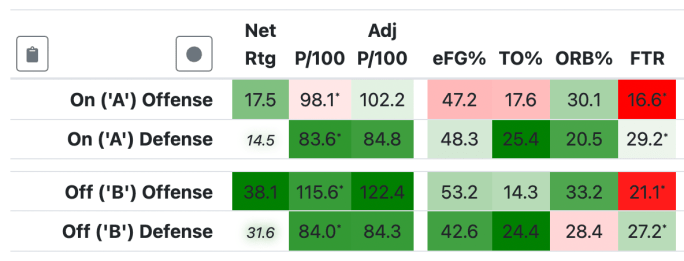
The second is the one that’s going to be talked about the rest of the season. The first image here is Victor Bailey’s 2021-22 On/Off numbers:

The second is Justin Powell’s.

For reasons that I cannot entirely parse, Bailey was the player who got the majority of the run down the stretch of this game as Tennessee’s offense seized up and Powell sat on the bench, quietly watching. To the credit of local media, Rick Barnes was asked to rationalize his choice. I can’t say I’m pleased by the answer.

Justin Powell is not a good on-ball defender. I have half a season of Auburn data and half a season of Tennessee data to say that’s almost certainly the truth. The defense is inarguably worse with him on the court; even though I do not think much of this is Victor Bailey’s doing, the defense is basically break-even with Bailey out there. Whatever, fine, you get your little nitpick win.

But when it comes to the actual effect on the team on the court, Justin Powell is, by any objective measure, the superior option to Victor Bailey. Want to use Net Rating? The team is 15 points better with him on the court over 100 possessions than it is with Bailey. Want to talk offense? The offense is 21 points better with Powell. Three-point shooting? Powell 42% (43% for his career), Bailey 23% (35% career). Individual defensive impact? Bailey and Powell are almost the exact same: a 2.9% Stock% (steals + blocks) for Bailey, 2.6% for Powell. Player that literally just played 26 minutes against the #8 team in America in a win? Justin Powell.

I think this is what sticks. Tennessee played better than I anticipated. They held down Alabama’s offense more than almost any other team has. They forced some surprising guys (Jahvon Quinerly being the main example) into foul trouble. They led for almost three quarters of the game. But you’re sitting there with a 63-57 lead, four or five minutes on the clock, and somehow it never seems to cross anyone’s mind that the lone available guy on the roster who can hit a dagger three to actually bring home the win isn’t on the court.

(Sidebar: I think I’ve had my fill of Tweeting negative things about individual players online. I cannot imagine Victor Bailey, Jr. feels very good today; there is literally zero reason whatsoever for me or anyone else to pile on relentlessly. I say something about Bailey (or Plavsic) (or JJJ) (or anyone at this point) and the replies are a mess of pure garbage. No más. I should’ve remembered the golden rule: Never Tweet.)

So here we are: Tennessee blows a winnable game in a situation where I’m objectively supposed to feel okay but subjectively feel annoyed yet again. Bart Torvik tracks the average lead of every game in America; per his website, this is the 18th time in the Rick Barnes tenure Tennessee has lost a game they led the majority of, with ten of those coming since the start of 2018. Bruce Pearl, the guy everyone will not let go of, has done that just three times in the last four seasons. Every single season, somewhere between two and four times, Tennessee will lose a game that most agree they really should’ve won.

On the flip side, Tennessee has won fourteen games since 2015-16 where they’ve trailed the majority of the way. (Perhaps you remember the 2020 win at Rupp Arena before the world ended.) When that happens a couple of times this year, it will feel nice. Until Tennessee figures out a way to stop losing these winnable games, these affairs will continue to feel uniquely unsatisfying even when they shouldn’t.

I feel like I’m repeating myself but this is a loss that really doesn’t mean all that much because it is one game in a 35ish-game season and Tennessee literally just beat a top ten team at home. I wrote a whole thing about how Tennessee should be pleased to get out of December with just two losses in the month; they did exactly that. Both losses were close, coin-flip things. They did exactly what the average top 10-15 team should have doneYet, somehow, like always, I find myself frustrated and wondering why X decision didn’t happen or why Z decision did.

In retrospect, I should have remembered one of my favorite images:

Whatever happens, happens. I can’t control it, therefore it is what it is. On to the next one.

Heartwarming: Geriatric Kingsport Man Listens to Death Metal For First Time

This is the sixth in a weekly-ish series of two-game recaps of the 2021-22 Tennessee men’s basketball season.

You spend your entire semi-professional writing career online and you’re gonna make some mistakes. One of them was saying Tennessee needed to deploy a bunch of ball-screens against Arizona, which they did, and then they proceeded to score all of 5 points on 18 ball-screen possessions, per Synergy. Another is seemingly any time I have tweeted about poor Uros Plavsic. The latest is thinking that we were probably all-the-way done on ever seeing something like this again.

I know that Twitch bans streamers for saying a word referring to white people now, so use your imagination, but look at this doofus. Almost no one that looks like this is going to be a quality college basketball player. It does not matter that he is a tall, goofy white guy; it matters that on every play, John Fulkerson looks like he is forcing all of his power and strength into the next dribble. Has there ever been a normal photo of Fulkerson playing basketball? I have done approximately three minutes of research and the initial answer is “no, don’t think so.” I mean look.

John Fulkerson has never appeared in a normal basketball picture because John Fulkerson is not a normal basketball player. He never has been. What else do you say of a sixth-year super-senior, a player who had twice as many offers from Big South conference members (4) as he did Big Six offers (2)? How else do you describe a player who willingly fades into the background to share the spotlight with the younger, higher-potential members of Tennessee’s roster, yet seems to know exactly when it’s his turn to come to the forefront?

Part of it is that, after six years, you sort of come to believe that he will somehow return for a seventh season, then an eighth. You think you’ll always see the slow post-ups, the shot fakes, the fadeaway shooting method that sees Fulkerson release the ball at an angle that would make every YouTube shooting coach cringe. You think he’ll continue to be there on the nights where you wonder “why is John Fulkerson still so important to this?” And then you see all the little things he does, the little quirks that open up Tennessee’s offense or provide as a shut-off valve defensively.

On March 5, John Fulkerson will take the court for the final time as a Volunteer at Thompson-Boling Arena. I do not feel it is hyperbole to say that, alongside Admiral Schofield’s Senior Day, it will be the saddest, most bittersweet moment a significant segment of the fan base has experienced since Chris Lofton’s final three at home. I know this because every time I attend a game, I look at all the little children who have procured the #10 jerseys. The young ones that are somehow allowed to wear shirts that say Fulk Yeah. (Do you use that language around your mother?!?) The crowd that, every time Fulkerson’s name is announced, explodes in a roar significantly louder for Fulkerson than for any other starter.

For this weirdo sixth-year senior to still be here and still finding baffling ways to draw 13 fouls from one of the best defensive teams Tennessee will play all season is just…I mean, it is. It is, and there is no more making sense of it. Fulkerson is Fulkerson; if he does this again, consider it icing on the cake.


The other thing is that Tennessee held Arizona to 21 points in the first half, their worst output of the entire season, because the defense is an absolute wrecking ball and oh Tony Basilio if you think I didn’t hear your segment about how the defense wasn’t good I’m right here buddy.

What you’re seeing there is Oumar Ballo, a player who had blocked 13 shots and had zero of his blocked entering last night, get his stuff stuffed by Olivier Nkamhoua. It seems obvious that Nkamhoua is always going to draw complaints from Tennessee fans; I guess I get it. The guy still is not a terrific offensive player, and the hopeful comparisons of Grant Williams seem pretty far away. But: as discussed in the episode about bias, Nkamhoua has improved immensely year-over-year. He’s always been a good defender, but we’re looking at a guy who somehow quietly ranks 5th in the SEC in Block Percentage when he’s on the court.

That little graphic above is from last night. The ON is Olivier Nkamhoua. When Nkamhoua was on the floor for 35 defensive possessions for Tennessee, Arizona scored just 26 points. They made just 38.9% of twos with him out there. We’re 11 games into Nkamhoua’s third year. I don’t think he’ll ever be Grant Williams. He may not even be Kyle Alexander. But he could be a silent ringleader of the Death Metal Defense.

I think when you hold the nation’s #1 scoring offense 18 points below its average and become just the second team all season to not only hold them below 1.1 PPP, but 1 PPP, you’re precisely as good defensively as everyone is hoping for. The difference between the Yves Pons defenses and the post-Pons era is one where Tennessee somehow is even better at forcing bad shots and is replacing the supreme shot-blocker with a trio of wrecking balls. Fulkerson, Nkamhoua, and Josiah-Jordan James all rank within the top 100 nationally in Block Percentage; no other team has three players in the top 100. They are as violent as your typical metal album pretends it is.

To be fair to the metalheads, death metal (and black metal, the only sub-genre I can somewhat stand) is not really about death. I do not come away with the impression they’re serious about it. It’s mostly about face paint.

All of these guys, as serious as they appear to be on the outside, are playing music as an excuse to paint themselves. Seemingly 80% of all bands are in it for the paint; try a Google search on this one. And hey: I applaud it. It’s bizarre. It’s funny. It’s creative. It looks very sweaty and very uncomfortable, and it does not make any sense to me that it works the way it does, but it works, and I find that wonderful.

In some weird fashion, this is how I think of the Tennessee defense. In the preseason preview I wrote a whole thing about how I was kind of concerned we’d see an equal stepback on defense as we saw a step forward offensively. That clearly hasn’t been the case. Tennessee shot kind of terribly for a big stretch of last night’s game; the free throws really did push them over the top. But there wouldn’t have been that all-too-familiar please bring this home, you young men, I am overly reliant on this win to feel okay feeling without an amazing defensive performance.

“But they gave up 52 in the second half!” Yes, and they gave up 21 in the first half against a team that averages 91 points per game. Arizona only got off six unguarded catch-and-shoot threes out of 27 total three-point attempts in this game, per Synergy. No team had held Arizona below a 32.4% OREB%; Tennessee held them to 29.4%. Only one team had forced Arizona to turn it over on 20% or more of their possessions in the last 10 games; Tennessee hit 22.6%. Tennessee saw a frontcourt averaging 30 points per game and said “we will play these riffs in your face, silly men.” Tubelis and Koloko, who everyone was rightfully afraid of, combined for almost as many fouls (9) as points (10).

I do not know what the rest of the season holds, because I am not an oracle. But I do know that right now, this baffling collection of old and young talent, all of which I did not expect to gel together the way it has on this end of the court, is the best defense I have ever seen at Tennessee. They have held eight consecutive opponents (four of them Top 100 teams) below 1 PPP; only the 2013-14 Vols can say they’ve topped that at 10, and those Vols did not start the season completely shutting down all competition like these Vols have.

They are imperfect. They are flawed. They are a college basketball team. They are also a truly fun group of misfits, young men, Google Image Search heroes, and, because of course they are, anime nerds. Let’s see where the rest of this goes. For now, Christmas: surely every metalhead’s favorite holiday.

The Sublime Object of Spartanology

This is the fifth in a weekly-ish series of two-game recaps of the 2021-22 Tennessee men’s basketball season.

December 11: Tennessee 76, UNC Greensboro 36 (7-2)
December 14: Tennessee 96, USC Upstate 52 (8-2)

Not to complain or anything about the extremely non-intense gig I have, but these games are becoming sort of rote. Drawing long-lasting conclusions from a pair of blowouts over teams that likely won’t come close to the NCAA Tournament in any aspect is difficult. These are fun to attend, which I’ll cover later, but…yeah. Not much to be said here beyond the obvious, which is that Tennessee looks the part of a borderline top 10 team (via KenPom) and appears to be almost exactly what I thought they would be six weeks ago. The recaps from here on out will be more excitable, simply because this concludes (beyond a couple of dire SEC sides) the Quadrant 4 portion of Tennessee’s schedule.

For help in attempting to make this interesting, and for the first time in the history of my website, I’ve called in two outside writers. These are two people humans “intellectuals” that will help tell you the story of what just happened, along with the story of what’s to come.

First up is Slavoj Žižek, Slovenian philosopher and ‘foremost exponent of Lacanian theory’.

I emailed Mr. Žižek and asked if he’d be interested in covering a pair of relatively stress-free, meaningless games that the University of Tennessee men’s basketball team played in. While I was unable to confirm that Mr. Žižek watched the two games we sent him, and was also unable to confirm that he has watched any basketball game in his 72 years of living, I feel pleased with his response. Now, his response appears to simply be three paragraphs plucked from a February 2021 piece on, of all things, the band Rammstein, with certain references changed to be about “Tennessee men’s basketball team” and their opponents. I’ve accepted it and was honored for him to reply. Slavoj!

“Friedrich Jacobi, the German philosopher active around 1800, wrote: “La vérité en la repoussant, on l’embrasse,”– in repelling the truth, one embraces it.

The fascination with total catastrophe and with the end of our civilization makes us spectators who morbidly enjoy the disintegration of normality; this fascination is often fed by a false feeling of guilt (Tennessee men’s basketball team as a punishment for our decadent way of life, etc.). Now, with the promise of the Tennessee men’s basketball team and the spread of new variants of UNC Greensboro men’s basketball team and USC Upstate men’s basketball team, we live in an endlessly postponed breakdown.

Notice how the time-frame is changing: in spring 2020, Tennessee men’s basketball team authorities often said “in 2020-21, it should get better”; then, in the fall of 2020, it was two months; now, it is mostly half a year (in the summer of 2022, maybe even later, things will get better); voices are already heard which place the end of the Tennessee men’s basketball team fans in 2022, even 2024… Every day brings news – Tennessee men’s basketball team works against new variants, or maybe they don’t; the John Fulkerson is bad, but then it seems it works quite well; there are big delays in the supply of three-pointers, but most of us will still get three-pointers by summer… these endless oscillations obviously also generate a pleasure of their own, making it easier for us to survive the misery of our basketball lives.

The Rammstein conceit that “we have to live till we die” outlines a way out of this deadlock: to fight against the NCAA Tournament, SEC Tournament, Memphis, Arizona, Alabama looming in the distance not by way of withdrawing from life but as a way to live with utmost intensity. Is there anyone more ALIVE today than millions of Tennessee men’s basketball team fans who with full awareness risk their mental-well being on a game-by-game base? Many of them died, but till they died they were alive. They do not just sacrifice themselves for us in exchange for our hypocritical praise. Even less could they be said to be survival machines reduced to the bare essentials of living. In fact, they are those who are today most alive.”


An eternal thinks to Slavoj for taking time off from researching Hegelian dialectic and eating two hot dogs to provide us with these words.

Next up, we have an even more special guest, a football-shaped feline who has learned how to type on a keyboard just in time for Tennessee battling two opponents with cat-related mascots. Please welcome in Cedric, our family cat and either a pest or precious depending on who you ask.

Cedric, as far as I know, has no concept of what basketball is or how it is played. However, he does have a concept of cats and cat-like behavior, which is why it is important to bring him in shortly before Tennessee plays the Memphis Tigers and the Arizona Wildcats. Seeing as Cedric somehow has the same stripes as the awful Memphis home court, and seeing as he is supposedly a descendent of some form of wildcat, he is the foremost expert at this website on both. Cedric, we would love to hear your thoughts on Tennessee’s next two opponents.

“Meow! Meow meow meow. Meeeeeeoooooowwwww. MEOW. Feed me. Please. Meow!”

Excellent! Thank you for that observation, Cedric. Please do not wake me up at 5:30 AM tomorrow.


Look: the actual basketball upshot of two games against two bad teams is genuinely very minimal. If you’re a coach or particularly invested observer, you can squint at a few bullet points for each.

UNC Greensboro:

  • In the first half of this game, Tennessee completely shut down what UNC Greensboro wanted to do with regards to backdoor cuts and screening actions. After halftime, until the second media timeout, UNCG were able to find some openings in Tennessee’s defensive coverage. After that second media timeout, Tennessee once againneutered what UNCG wanted to do over the final 12 minutes, allowing just eight points. That’s the hallmark of a good defense: you start well, the opponent adjusts, then you adjust to the opponent’s adjustments. Mike Schwartz and crew are doing a fabulous job.
  • Tennessee’s ball screen defense was just about perfect: 14 points allowed on 28 ball-screen possessions, per Synergy.
  • As I assumed they would based on pregame expectations, Tennessee was able to use penetration to create scaldingly wide-open shots. 21 of 32 catch-and-shoot threes were considered unguarded by Synergy, and even the 8-for-21 (38.1%) hit rate Tennessee produced here is fine.

USC Upstate: 

When the run of scoring looks like that, it’s why I invite Mr. Žižek (who is obviously not a college basketball guy, but presumably is at least aware of Luka Doncic, a fellow Slovenian) and my cat to do coverage. These games are just there to be there. You learn little and feel less, but they do give USC Upstate scholarship money and they also provide 40 minutes of fan service for little kids to be able to understand why basketball is cool. At the game last night, there was a family of six next to us and none of the kids knew or cared what USC Upstate’s KenPom ranking was or why they were so bad defensively. They only cared that Tennessee was scoring a bunch and making cool plays. I am fine with that and I like it.

I’ve noticed a fair amount of super-online Tennessee fans now being afraid of Memphis after the Tigers’ somewhat-surprising victory over #6 Alabama. I get it; everyone would prefer if they were dead and done. But it’s also probably nice that Memphis is playing a much better defense than Alabama (though any rational observer would note Alabama’s offense is better than Tennessee’s) and is also not playing at home. You cannot live in fear forever; we have to live ’til we die.

Aside from Missouri and Georgia, there are no more irreparably abject opponents on the schedule. The real college basketball season ends now. Let’s enjoy it.

The Bias Chart

This is the fourth in a weekly-ish series of two-game recaps of the 2021-22 Tennessee men’s basketball season.

December 4: Tennessee 69, Colorado 54 (6-1)
December 7: Texas Tech 57, Tennessee 52 (OT) (6-2)

Firstly, thanks for the kind words on yesterday’s post. If you have my brain, there are certain ideas you feel you are legally required to get out of your system. That was one, and it meant more to me than nearly every other piece of writing I have published has.

In the process of waiting to hit the Publish button, I spotted this on Twitter dot com:

And again, if you have my brain, this instantly became the next post about Tennessee’s men’s basketball team.

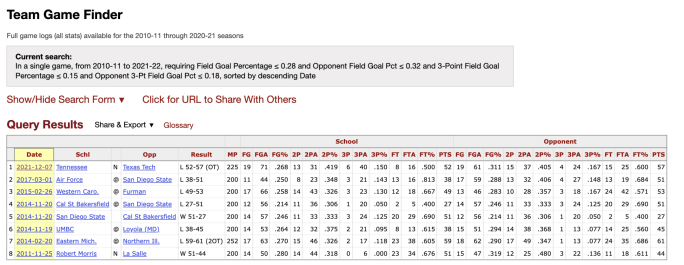
After spending Sunday evening catching up on Saturday’s Colorado fixture, which I didn’t see a second of in real time, I wish I’d been able to do the same with Tuesday’s Texas Tech affair. Games like that are so bad that I spend an alarming amount of self-indulgent time looking up stats like this:

Or attempting to see the last time a pair of high-major basketball teams were this incompetent on the court offensively and realizing it is possibly the single worst game between two good teams in recent memory.

The Act of God Game is something that overshadows everything that came before it. The working title of this post was the Milhouse Games, because in one (Colorado) just about everything went as correctly as it reasonably could have and in the other (Texas Tech) it was a pure disaster on the level of Kirk van Houten (Milhouse’s father) revealing his racecar bed. But because Act of God is more recent, it completely, totally overshadows everything that came before.

That’s #15 on the chart, Recency Bias. All of us are guilty of this, but it feels perhaps the most prevalent it’s ever been. A hyper-reactionary society addled by apps and satiated by the latest seven-second videos is going to be this way, and I include myself in it. After Colorado, you could have easily convinced me Tennessee was well on their way to being one of the eight best teams in the sport; after Texas Tech, I am worried I won’t want to watch another Tennessee game for a month.

The Bias Chart is helpful in many ways, but it somehow seems like any and all of its 20 labeled biases apply to this season just eight games in, and perhaps how I have personally covered the team thus far. Let’s see just how many ways I can put myself in a mental pretzel.

1. Anchoring bias.

People are over-reliant on the first piece of information they hear.

Well, yeah, it came first, so of course I am. Tennessee began this season by setting a program record for made threes in a game while taking the second-most three-point attempts in a single game, too. Prior to Act of God, they hadn’t breached 30 in any game since. Tennessee is taking more threes this season, but it’s in a sense of attempting to get 24-28 threes off each game rather than 40 like Rick Barnes hinted at. That’s fine, but when the first memory you have is of the team taking 46 against Lenoir-Rhyne and 40 against Tennessee-Martin, it will naturally feel a little disappointing. Then again, maybe we would like to never see a three-pointer after Act of God.

2. Availability heuristic.

People overestimate the importance of information that is available to them.

This is important because studies in the NBA – which has a larger sample size – show that offensive rating doesn’t stabilize until 13 games in (624 minutes of basketball), which converts to about 15.6 games of college basketball. Tennessee’s offense, thanks to two turd performances and a third wobbly one against Colorado, looks like another bad offense. Yet the performances against North Carolina and ETSU would suggest a very good offense. What if we are overestimating eight games’ worth of knowledge? I certainly have been.

3. Bandwagon effect.

The probability of one person adopting a belief increases based on the number of people who hold that belief.

Groupthink, in other words. I am naturally not one to stray too far from what smarter writers say about basketball; that has left me in a place where I don’t want to say anything out of line. Also this is about Tennessee basketball’s stinky offense again sorry.

4. Blind-spot bias.

Failing to recognize your own cognitive biases is a bias in itself.

This is about the threes, which I have pushed for for years without realizing until this summer that three-point attempt rate has almost no correlation at all to a better offense. The lack of mid-range attempts does, but replacing them with threes doesn’t immediately give you a better offense. Better, more consistent shooting regardless of the spot on the floor gives you a better offense. I do think Tennessee should take a lot of threes, because based on the careers of various roster members, they have more shooting options than the average high-major team. But as we’ve seen, that alone isn’t everything.

5. Choice-supportive bias.

When you choose something, you tend to feel positive about it, even if that choice has flaws.

I call this one “writing about the Tennessee men’s basketball program for five seasons.”

6. Clustering illusion.

This is the tendency to see patterns in random events. It is key to various gambling fallacies.

Also known as the “hot hand fallacy.” The hot hand is partially a truth in the NBA, but only for certain players; think the Damian Lillards and Stephen Currys of the world. It is all randomness otherwise. This is how the same team that did this against top 20 competition on a neutral floor:

Can be the same team that did this barely two weeks ago against top 50 competition on a neutral floor.

If you just watched the North Carolina game, you would believe Tennessee’s offense is one of the ten best in America. If you watched Act of God, you would believe Tennessee and Virginia will be competing for the 2021-22 Sickos Team of the Year Award. The truth most likely lies somewhwere in between.

7. Confirmation bias.

We tend to only listen to information that confirms our preconceptions.

The preconception any non-biased observer has of Tennessee basketball is that it’s a program that wins a lot of games by way of tough defense and, uh, attempting to not get out-shot rather than attempting to out-shoot. Through seven games, Tennessee had done a terrific job of getting rid of preconceptions, eschewing mid-range jumpers at a significant rate for more threes and slightly more attempts at the rim. All it takes is one Act of God to erase all of the good vibes that was producing, even when the Act of God statistically shows you got 90.1% of your shot attempts at the rim or from three.

8. Conservatism bias.

When people favor prior evidence over new evidence or information that has emerged.

go to a game, wait for the first dry streak from three, listen to the people seated around you, then get back to me

9. Information bias.

The tendency to seek information when it does not affect action. More information is not always better. With less information, people can often make more accurate predictions.
As the Information Guru here this bias personally offends me, which is why I am obviously very much a sinner in its eyes. But, like…this one seems as if it doesn’t really apply to Tennessee? All of the information heading into this weekend pretty much played out: a great rim defense forced a bunch of bad attempts at the rim, didn’t give up many points inside the perimeter in general, and made life crazy difficult on both opponents. They’re clearly very good, and I don’t know what good waiting for two Quadrant 4 opponents will do.

But if you just look at that bolded part, it makes sense. If I simply did not know that Tennessee played Texas Tech in a college basketball game, I would be this guy.

Alas, because I Investigated, I am this guy.

10. Ostrich effect.

The decision to ignore dangerous or negative information by burying one’s head in the sand, like an ostrich.

NEVER HEARD OF IT!

11. Outcome bias.

Judging a decision based on the outcome – rather than how exactly the decision was made in the moment.

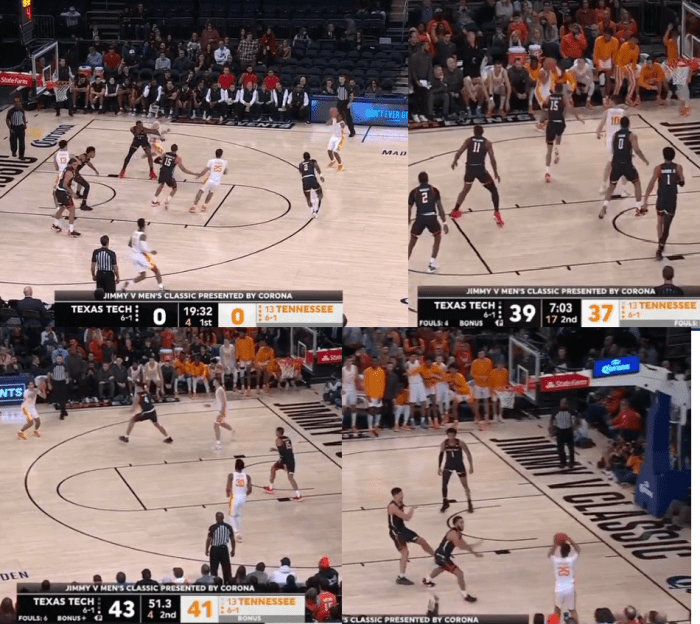
Here are four screamingly wide-open shot attempts.

The shooters attempting these four shots, prior to last night, were a combined 38-for-100 (38%, obviously) on threes this season. Considering that Synergy’s numbers have consistently shown wide-open catch-and-shoot threes to be worth about 3% more than the average three-point attempt, we could take a reasonable guess that these players would be expected to hit 1.64 of these four attempts. The odds of all four missing are 12%, just in this small sample size. All four shots have no defender within five feet. All three shooters have made at least three threes in a game this season.

None of the shots went in. In fact, Tennessee did not make a single open catch-and-shoot three, per Synergy. (They credit Texas Tech as guarding 26 of 33, which seems really generous based on how it looked to me.) That doesn’t mean that these shots shouldn’t have happened. They were right to shoot the threes, because a lot of them were open.

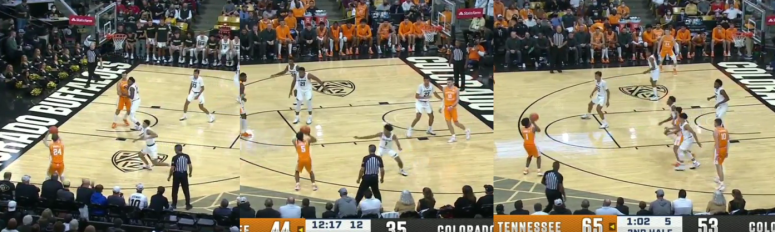
Just like they were right to attempt all of these against Colorado:

Despite none of those going in, either.

12. Overconfidence.

Let’s not do this one plea-

Some of us are too confident about our abilities, and this causes us to take greater risks in our daily lives.

Fine.

I am confident that Tennessee has a roster of good shooters. Of the ten members of the current rotation (yes, ten), nine have hit a three in a college uniform and six have hit at least one per game this season. That’s pretty darn good. No other SEC school currently has more players with 6+ made threes. Tennessee has had three bad performances and five wonderful ones from downtown.

And yet: do you think they might’ve been a little too confident in the concept of shooting over the opponent? Colorado was much happier to let Tennessee take threes than to allow them to keep murdering them at the rim. Texas Tech was great at the rim, but Tennessee barely put any pressure on it in the final 10 minutes of regulation and, per StatBroadcast, recorded zero points in the paint from the 11:49 mark of the second half to the 2:01 mark of overtime. That’s unacceptable even if you are killing it from three. If Tennessee does want that confidence to not feel misplaced, this cannot happen again.

13. Placebo effect.

When simply believing that something will have a certain effect on you causes it to have that effect.

14. Pro-innovation bias.

When a proponent of an innovation tends to overvalue its usefulness and undervalue its limitations.

Time for you to take a wild guess as to what this is about.

In my own self-importance, I’ve violated the “don’t send excessively mean tweets about individual players” rule of mine a few times this season. Almost all of them have been about Uros Plavsic, the 7-footer that I instantly groan whenever I see him enter the court and count the seconds until he exits. The sad thing is that many, many Tennessee basketball fans are in the same boat. And truth be told, they probably should be. Those numbers for his career hold true. For 2021-22 specifically, adjusted for opponents and for 3PT luck, it instantly makes me feel like an ass.

The team is effectively just as good with him on the court, with almost no serious change in shot selection, as they are when he’s off. The defense is significantly worse, but Plavsic is genuinely useful as a screener and does not usurp many possessions of his own. I think that he is an openly bad rebounder for his size – of the 62 7+ footers playing at least 8 minutes a game in CBB, he ranks 59th in defensive rebounding percentage – but I’m going to be real here for a second. If multiple Big Six schools have watched Plavsic play and offered him a scholarship, even if one of those schools was coached by Bobby Hurley (a bad basketball coach!), there’s talent to be had.

Re-running the numbers for Brandon Huntley-Hatfield based on the second half of this tweet made me feel worse.

BHH’s numbers are currently that of a superior rebounder and less porous defender. But Tennessee’s still a worse defensive team with him on the court – far worse at the rim – and he doesn’t make up for it as much offensively.

The story is not as simple as this, though. Evan Miyakawa’s Bayesian Performance Rating (BPR) has Huntley-Hatfield as worth about five points more per 100 possessions. Traditional Box Plus-Minus gives Huntley-Hatfield a 3.6 points per 100 edge. Even Torvik’s Box Plus-Minus, an updated version of the original, pushes Huntley-Hatfield out in front by 3.1 points per 100. By any measure you look at, Huntley-Hatfield should be getting more of Plavsic’s minutes.

But I still feel bad. I still feel like I’ve been far more rude to Plavsic online than any sort of writer decorum calls for. So: I apologize, Uros Plavsic, for the rudeness. You do have some amount of value, and it is not your fault specifically that the lineups they include you in drive me nuts. Tennessee is almost exactly as good with one of these two players on the court (+24.8 per 100) as they are without either (+25.1). It doesn’t matter as much as I claim it does.

15. Recency bias.

The tendency to weigh the latest information more heavily than older data.

  • Against Colorado and Texas Tech: 12-for-64 on threes (18.8%)
  • Against the other six opponents: 61-for-160 (38.1%)

Here’s the thing: literally no team ever is going to shoot 19% from three for an entire season. Tennessee entered this season with four players who have posted a season of 38% or better from three and added Kennedy Chandler and Zakai Zeigler to that roster. By pretty much any measure you choose, Tennessee has the most shooting it has had since the 2006-08 Bruce Pearl teams. The 2006-07 team, which had Chris Freaking Lofton and eight total players with 18 or more made threes, posted seven games with a 25% hit rate or worse from three.
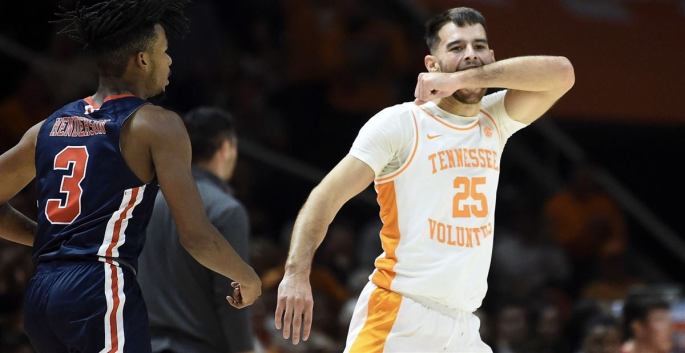
It is a long season. College basketball is a goofy sport where there are no rules about what basketball you use at which venue. Don’t give up yet.

16. Salience.

Our tendency to focus on the most easily recognizable features of a person or concept.

The example provided in the Bias Chart is being worried about dying at the paws of a furious lion ripping your torso to shreds rather than the much more statistically likely thing, some doofus missing a red light and turning your car into a museum exhibition. You could run this one any number of ways, but what if we have zoomed in too far on Olivier Nkamhoua’s obvious, goofball mistakes while failing to notice he has taken a legitimate step forward?

Olivier Nkamhoua, 2021-22:

  • Third on the team in scoring
  • Second on the team in blocked shots, #9 overall in the SEC
  • Team leader in rebounds, #8 overall in the SEC in total rebounding percentage
  • Second-lowest Defensive Rating among rotation members
  • Team leader in 3PT%, minimum 10 attempts
  • Team leader in midrange FG%, minimum 10 attempts
  • Fifth on the team in PORPAGATU (aka Value Over Replacement)

You get the point. This is one of Tennessee’s best players and a deserving starter for now; if Josiah-Jordan James ever gets things fixed, I’d be open to Nkamhoua being a sixth man to relieve the rotational backlog, but I would prefer to not hear something as absurd as “I’d rather see Plavsic” in my mentions going forward.

17. Selective perception.

Allowing our expectations to influence how we perceive the world.

(looking around at America) Can’t figure out how this one fits in sorry

18. Stereotyping.

Expecting a group or person to have certain qualities without having real information about this person.

In the season preview, I said this about Zakai Zeigler:

“The problem with Zeigler is going to be an obvious one when you hear his height and weight: 5’9”, 167. Zeigler was a late add to this year’s team, so he didn’t even get a summer in the weight room; I would be very worried about how well he can hold up in ball-screen defense as well as isolation situations. That’s going to put a hard cap on his playing time potential against any non-Quadrant 4 opponent.”

What is the wrongest you have ever been, and were you this wrong?

I have enjoyed the Zakai Zeigler Show so much that I advocated for a crowdfunded statue midway through the first half of Act of God and that somehow doesn’t feel ridiculous to imagine. Zeigler is simply the most exciting non-star (for now) Tennessee has maybe ever rostered, a player that is going NASCAR speeds from 40:00 to 0:00 and never, ever stops. At one point during Tuesday’s game, Zeigler was matched up with a player eleven inches taller with him and kept that player from scoring. I love this player and want him here forever.

19. Survivorship bias.

An error that comes from focusing only on surviving examples, causing us to misjudge a situation.

A Barnes-era example: having a complete outlier of a midrange FG% (nearly 47%) in 2018-19 and believing it validates taking 15 mid-range jumpers a game rather than correctly seeing it as a huge outlier. (It appears this has mostly been fixed, though, so no need to harp.)

A this-week example: if Santiago Vescovi hits that wide-open three to give Tennessee a 47-44 lead, do we start talking about how tough or full-of-heart or whatever crap Tennessee basketball is because they went 5-for-32 from three in regulation instead of 4-for-32? Or do we correctly call this the Act of God game and move on with our lives?

Finally,

20. Zero-risk bias.

Sociologists have found that we love certainty – even if it’s counterproductive.

This one closes with “eliminating risks entirely means there is no chance of harm being caused.” It is fundamentally antithetical to the sport of basketball, a game where your goal is to only miss half your shot attempts. Even the very best college basketball teams will miss six out of ten threes. You have to get used to a lot of clanks. That’s the risk. The upside is immense when it works; when it doesn’t, you do feel a bit stupid.

I would advise that Tennessee not slide back into the warm certainty of mid-range jumpers. This team has about 2.5 players that should be allowed to take them; everyone else, rim-and-threes. Am I committing myself to my own brand of zero-risk bias by claiming this is superior? Of course. That’s how we get to do this entire chart again.


The point of this post is that Tennessee played two basketball games and played utterly terrific defense in both. They’ve played eight games of basketball and have held the opponent below 50% at the rim in seven of them. That is a fabulous rate that every team in America would kill for. Yet two outlier shooting games have killed the offense’s own narrative. You can’t expect anyone to shoot 20% or worse every time out against good opponents, just like you can’t expect anyone to shoot 50% or better every time out against the bad ones.

It is what it is. Saturday begins a new week and a new opportunity. Might as well re-invest; after all, many have called this blog Stats by Ostrich Effect for a reason.

If you like the format of these or want to see changes, let me know at statsbywill@gmail.com.

September Heisman

November 26: Tennessee 80, Tennessee Tech 69 (4-1)
November 30: Tennessee 86, Presbyterian 44 (5-1)

This is the third in a weekly-ish series of two-game recaps of the 2021-22 Tennessee men’s basketball season.

This could just be My Personal Lived Experience than something that’s actually happened, but I have to imagine at least some of the people who read this website are familiar with the idea of the September Heisman. Every single college football season, a player comes out of nowhere to string together 3-5 amazing games, leading observers to deem this person the Heisman Trophy favorite. Sometimes, these guys actually put it together for a full season, but when was the last time you thought about the names Kenny Hill, Case Keenum, Denard Robinson, or Geno Smith if you weren’t a fan of one of the teams involved?

I think about the September Heisman more than ever these days despite watching less college football than ever before. Every first month of the college basketball season brings some surprises, but none are more potent than the preseason-unranked team that starts the year on fire and threatens to upend everyone’s expectations. This year’s team: Arizona.

I don’t mean this as some sort of obnoxious self-promotion; it’s more just that I posted it and it’s easy to refer to. Anyway, two things are notable here: an average of 6 out of the 10 best November teams actually finish in the top ten each season, and with that, about 1-2 every season finish 30th or worse, i.e. an 8 seed or lower. Plenty a September Heisman has existed in basketball seasons past. Remember how future 7 seed Clemson defeated Purdue, Maryland, and Alabama in the first month of the season last year? Or how Nebraska climbed as high as #13 in KenPom in 2018-19? Of course you don’t, because you aren’t a fan of those teams. They ended the season precisely as unmemorable as most believed they’d begin it.

The track record of the teams that do play great basketball in November is generally pretty good; a 58% correlation to end-of-year success is better than a coin-flip. But it’s still barely better than a coin-flip.

  • All of the last four national champions were top 10 teams in November…
  • …but five of the 16 Final Four teams were outside of the top 10.
  • 18 of the last 25 KenPom top 5 end-of-year teams were top 10 teams in November…
  • …but only 10 of the last 25 KenPom 6th-10th end-of-year teams were in the top 10.
  • 22 of the 40 teams in years where NCAA Tournaments were held got to at least the Sweet Sixteen…
  • …but 18 of the 40 didn’t, with eight not winning a single game and three missing the NCAAT entirely.

Basically: if you’re Final Four good, you can be roughly 69% (nice) confident that you’re that way in November. But that’s why I keep insisting this is a long season. 31% aren’t that good in November. Only 40% of the back-end top 10 is. Even 28% of the end-of-year top five weren’t one of the 10 best teams in America at the start of the season. Through one month of play, with all preseason baselines removed, Tennessee ranks 27th on Torvik’s site. Considering they’re four spots higher overall on KenPom, I would imagine Ken’s no-baseline ratings probably have Tennessee somewhere around 18th-23rd. That’s fine; Tennessee is a very good team who played one objectively bad game, one shaky one, and three great ones.

It’s a long, long journey with a lot left to play for. Gotta live with it and love it.

Tennessee 80, Tennessee Tech 69

Don’t do this again. Please. The energy at halftime was a resounding “oh come ON” from a crowd that simply wanted to go home and either eat leftovers or finally dig their way out of the ham and turkey spiral. Who can blame them? Even if Tennessee had won this game by 20+, I beg of you: never, ever schedule a Black Friday afternoon game again. It was stupid before tipoff, and it only became dumber as the game progressed.

Small sample size! When two teams enter as such:

  • Tennessee Tech: 41% FG% Midrange, 27% FG% Threes
  • Tennessee: 37% FG% Threes

And have a performance as such:

  • Tennessee Tech: 11-19 Midrange (58%), 6-14 Threes (43%); +9.5 points above expected based on shot locations, per Haslametrics’ estimations
  • Tennessee: 6-23 Threes (26%); -4.9 points below expected based on shot locations

Then part of me just wants to say “burn the tape” and move on. You don’t play the game on paper, but if you did, Tennessee wins this by roughly 20-25 points, which was the pregame expectation, if Tennessee Tech has anything other than a total outlier shooting day. The fact Tech immediately followed this by shooting 43% on midrange and 31% on threes against Chattanooga hammers it home. Burn it, move on, whatever.

A profoundly stupid game with two frontcourt takeaways. Olivier Nkamhoua and Brandon Huntley-Hatfield brought this one home, combining for 30 points and 8 rebounds. Normally, I am not getting over the moon about anything when you’re playing Tennessee Tech, but you watch some of the stuff Nkamhoua did in this one:

And you’re like, oh yeah, that’s why he got all the preseason hype.

A word about rebounds. Tennessee allowed Tennessee Tech to rebound 35.5% of their missed attempts, which is moderately annoying and representative of something that’s bugged Tennessee in the past. I would be less perturbed by this if it wasn’t a historical pattern for Tennessee and Kentucky wasn’t a team they played every single season.

Parking praise. My fears about how difficult it’s become to park for Tennessee games – based on my most recent experience of the 2019-20 season – have seemingly been assuaged. This will undoubtedly change when Tennessee plays a good team at home, but all four home games I’ve attended (including the exhibition) have resulted in zero trouble finding a spot within half-a-mile of the arena. All for free, too!

Tennessee 86, Presbyterian 44

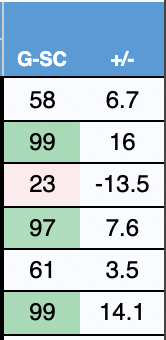
A pattern emerges. It’s all of six games in, but see if you can notice an odd/even pattern by way of Bart Torvik’s Game Score metric:

I would prefer that this goes away and Tennessee begins ransacking bad teams with regularity as they did in this one.

Ransacking. The first eight or so minutes of this one brought a legitimate fear that we were in for another obnoxious over-shooting performance by a bad opponent; the 32 minutes that followed proved it was not the case.

  • Presbyterian’s first seven possessions: 8 points (1.14 PPP)
  • Presbyterian’s next 55 possessions: 36 points (0.65 PPP)

Presbyterian took a lead to make it 10-8 six minutes in; Tennessee finished the half on a 37-11 run and slowly sucked the life out of a Quadrant 4 opponent for really the first time all season. (ETSU is Quadrant 3.)

Why do this? Presbyterian’s offense was precisely as excruciating to watch as the scouting report suggested. Numerous times in the first half, they failed to get any offensive actions started until 15-18 seconds had elapsed from the shot clock. Tennessee had something to do with that because they were denying a lot of off-ball movement, but the Blue Hose seemed totally unhurried. In some aspect, I respect that they’re willing to show up, make the game go by as quickly as possible, and collect their $90,000 or so check.

In another, I mean, you gotta play decent basketball. Presbyterian’s entire philosophy appears to be “in the last 10 seconds of the shot clock, we either feed the post or run a ball screen to get up a late-clock low-efficiency shot.” I am sure this team will win some games in Big South play because everyone does, but this is the single most inept offense I have seen in Thompson-Boling Arena since poor Alabama State came to town in 2019.

1 hour, 42 minutes. Per KenPom: the fastest Tennessee game since at least 2018-19 by a full five minutes, and possibly the fastest Tennessee has played in a decade. I reached out to Tennessee SID Tom Satkowiak to see if he has anything on this front and will edit the post if so.

I would like to propose a starting five. The great news for Rick Barnes is that four of these five players already start! Let’s make one little tweak for everyone: Chandler/Vescovi/Powell/Nkamhoua/Fulkerson. Right now, per Bart Torvik, these are the five best players on the team. Would anyone disagree with that statement? I certainly don’t. When Josiah-Jordan James returns, you can figure out if he should start over Powell or Nkamhoua, but for now, that’s my favorite five. Per Hoop-Explorer.com, this lineup somehow only has 15 possessions together. I’d like to make that at least 15 possessions a game.

If you like the format of these or want to see changes, let me know at statsbywill@gmail.com.

Catch Me on the Rebound

November 20: Villanova 71, Tennessee 53 (2-1)
November 21: Tennessee 89, North Carolina 72 (3-1)

This is the second in a weekly-ish series of two-game recaps of the 2021-22 Tennessee men’s basketball season.

Two things happened this weekend. The first is that Tennessee escaped the Mohegan Sun Casino, a place that indirectly killed Howie in Uncut Gems, at 1-1 with a loss to a legitimate top 5 team and a 17-point win over a top 5 blue-blood brand. (More on their quality later.) The realistic expectation for Tennessee in this multi-team event was to get at least one win out of the weekend, and they did just that in the manner that the metrics mostly expected. (Though a net point differential of -1 from the weekend is a hair underwhelming in the sense that +5 or so was the KenPom guess.)

The second is that midway through Tennessee’s second game of the weekend, I realized why it even felt mildly relaxing to sit through a pair of high-profile blowouts, one good, one bad.

The average college football game is outwardly expanding in a way that would make 2004 Morgan Spurlock blush. The most recent figure given is 3 hours, 24 minutes, which is nearly a half-hour longer than NCAA statistics say it was in the 1990s. The initial guess here would be “quarterbacks pass more,” which, yes, true, but the average number of incompletions in a given game in 1996 was 23. It’s 20.9 and dropping in 2021. Every first down stops the clock, but that can’t be all of it.

It’s the ad breaks. Per a 2017 Wall Street Journal study, the NFL offers viewers 63 minutes of commercials per game. That’s for a sport with games 15 minutes faster than college football, with much more regulated and precise TV windows and far fewer four-hour affairs. The average Tennessee football game this year has lasted 3 hours, 38 minutes, and even if you remove the obvious outlier of the Mississippi game that number is still 3 hours, 33 minutes. It’s a looooooong time investment even if you aren’t at the game.

Tennessee basketball has played four games so far, all four of which have been on an ESPN product of some sort. Average game time: 1 hour, 55 minutes. No game has cracked the two-hour mark, though the East Tennessee State affair did hit 1:59. You could almost play two basketball games in the same amount of time it takes to play one football game.

This is not demonizing college football viewers or super-fans; like what you like and love what you love. Me, personally, the sensation of watching a 1 hour, 49 minute sporting event that required zero Liberty Mutual commercials and only one truly egregious ad break on ESPN of all channels was wonderful. This could be yours, college football fans! (Just kidding. I know which sport’s the money maker.) Of the ~30 or so college basketball games I have consumed thus far, they have featured a blissfully low amount of car commercials. Even the Car Fox has only made one appearance. I’m doing the “hope this works” prayer circle meme but for this streak of non-commercialized goodness to continue.

Villanova 71, Tennessee 53

Ya ran into a buzzsaw and it is what it is. There are many overly-breathy monologues one could scribe about Tennessee’s nasty offensive performance on Saturday; I think a key one is “the other team played out of their minds defensively.” Of Tennessee’s 30 catch-and-shoot attempts (as listed by Synergy), 28 had a defender within four feet at the time of the shooting action. Tennessee was still unlucky to not hit more than four threes, but, man. The odds of that happening again, particularly with how Florida of all teams appears to be the only other SEC side with a chance of finishing in KenPom’s top 10 defenses, feels low. Sometimes you just gotta tip your cap and move on.

That being said: there were some encouraging things, all of them on defense. Tennessee kind of quietly forced Villanova – a very, very efficient offense – to go 11-for-25 at the rim and 17-for-43 on twos. That’s really good considering you are playing Villanova and not, y’know, ETSU.

Villanova had to take a bunch of difficult shots and attempted more mid-range twos than Tennessee did. If Tennessee even had a bad offensive game, something like 65 points, it wouldn’t feel as stupid as it does.

We have to talk about turnovers again. To Tennessee’s credit, they rebounded well the next day and didn’t have such issues, and along with that, they hadn’t turned it over on more than 16% of possessions in a game before or since. But this has become an oddly annoying Tennessee thing: against the first Actually Good team you play, you lose your brain for stretches of time offensively. These are Tennessee’s PPPs and TO%s against the first Top 40 opponent of the last three seasons:

  • 2021-22: 0.799 PPP, 26.3% TO% versus Villanova
  • 2020-21: 0.869 PPP, 23.3% TO% versus Colorado
  • 2019-20: 0.8 PPP, 29.5% TO% versus Florida State

Considering this didn’t really happen that often prior to 2019-20, I can chalk it up as a blip, but when you’ve built up anticipation for these games and your offense rates out as Violently Clogged Toilet it’s really frustrating.

More drives, more aggression. Tennessee’s offense briefly got out of the mud in the second half when Kennedy Chandler and Santiago Vescovi became notably more aggressive. Vescovi displayed more driving aggression than he had since early in his freshman year; Chandler got unlucky on some rollout layups that made his performance look worse than it was.

Tennessee drove way more the next day against a worse North Carolina defense and they looked unstoppable. I’d also like to note here that Tennessee, excluding the Villanova game, has gone 1.272/1.244/1.204 PPP so far. I’ll freak out about this if it happens against Texas Tech or someone.

Long season! Long season. This is reductive, so whatever, but it does feel like there’s a significant carryover of Football Mindset to basketball season. Every game matters; every loss is bad; (insert team) no longer looks like a Final Four contender, etc. I think every game matters some but no regular season loss is really that important as long as you get something useful out of it. Even this Villanova blowout proved to be somewhat useful because Barnes and staff saw the benefits of more guards on the court. 12 games =/= 30+ games.

Tennessee 89, North Carolina 72

Zakai Zeigler is the Vibes Guy. To the point that I have finally committed to memory it’s Zeigler and not Ziegler. In terms of random emergency late-stage recruits you can grab before a season starts, it’s really hard to beat a hyper-aggressive point guard who is tiny but fast and shoots the ball well out to 30 feet. Visions of Auburn’s Jared Harper have flashed in my brain and I can no longer resist them.

Good Powell, bad Powell. Justin Powell got his first start thanks to Josiah-Jordan James receiving the flu, which is somewhat better than the fate Howie met in Uncut Gems but not by much. I think Powell has to play 20-25 minutes a night but you’ve just gotta get used to the drawbacks: 8 points and a generally good offensive day, but not much a difference-maker defensively and frequently picked on. Through four games, once adjusted for luck, Tennessee is precisely as good when Powell is on as when he’s off, because while the offense is five points better per 100 possessions with him out there the defense is five points worse. This is annoyingly right in line with last year at Auburn; I think that should probably explain why he won’t get 30 minutes a night.

Tennessee Tri-Guard Terror. For the first real stretch of time all season, Tennessee went to a three point guard lineup with Chandler/Zeigler/Vescovi; it was pretty wonderful. Tennessee scored 1.148 PPP over 29 possessions and outscored North Carolina by 4 with the lineup; the reason that wasn’t more is North Carolina went 4-for-9 on threes with them in the game despite most of those being well-guarded.

I would like to see Tennessee continue to try this lineup, and even instituting Powell as one of the 4 would be nice. So far, lineups with three of KC/ZZ/SV/JP have outscored opponents by 27 points over 95 possessions; this weekend, that number was 14 points over 67 possessions. (All other lineups: -15 across 75 possessions.)

If something is all holes, can it still be described as porous? Watching the North Carolina interior defense was a mix of humor and baffle, because I cannot believe a preseason top 20 team is this bad at figuring stuff out.

Tennessee finished 23-for-31 on attempts within 4 feet of the rim, per Synergy, and no opponent since Loyola (MD) has had any issue at all scoring on these guys. I don’t get it.

Pronunciation concerns. Fran Fraschilla elected to be this week’s Main Character for Tennessee fans after claiming he was on the end of mean tweets re: his pronunciation of Santiago Vescovi’s last name. To be fair to Fran, apparently after two full years of Vescovi being with Tennessee, he just now decided that vess-CO-vi isn’t right and it’s actually VESS-co-vi. Fine by me, whatever.

But I kind of couldn’t believe how hung up Fran got on this? He first called Tennessee fans “idiots” for arguing with him as play-by-play guy Jon Sciambi audibly grew uncomfortable, then proceeded to use the second half over-pronouncing VESS-co-vi to the point that he started messing up his own pronunciation of the name, eventually landing on Vess-Kew-Vi a couple of times and some sort of hybrid vescavee that sounded as rushed as it looks once. I would prefer if this is not a feature of Tennessee’s future games because, shockingly, I like when they talk about the game.

If you like the format of these or want to see changes, let me know at statsbywill@gmail.com.

Revolution Rock

November 9, 2021: Tennessee 90 – 62 Tennessee-Martin (1-0)
November 14, 2021: Tennessee 94 – 62 East Tennessee State (2-0)

This is the first in a weekly-ish series of two-game recaps of the 2021-22 Tennessee men’s basketball season.

I’m still working out how to do these in a manner that makes sense; the goal with these recaps is to essentially replace how I’ve been starting out the How Tennessee Matches Up section in game previews in recent years. Those had sort of become half-recaps half-previews, which achieves 0% satisfaction and doesn’t fulfill the needs of either a recap or a preview. This is an attempt to keep those as separate as possible. I can acknowledge the past without obsessing upon it.

In some ways, that’s how it felt to be in Thompson-Boling Arena last Tuesday. I hadn’t been there for a non-exhibition game since March 2020; I’d attended two public sporting events (Hurricanes-Predators Game 6, as well as a Memphis football game) in the 18 months since. Being near others again in an environment that was promoting joy and excitement felt as wonderful as I’d hoped. Tennessee’s less-than-perfect performance was excusable, simply because it’s like seeing an old friend after a long time apart. One or both of you is gonna stumble a few times; that’s where forgiveness comes in.

Maybe that’s where this starts: happiness with a little bit of forgiveness mixed in. I can forgive the first game jitters, I can forgive some of the fan behavior, I can even forgive it taking longer than normal to produce a popcorn-and-hot-dogs order because it was just a happy place to be. At its best, this is basketball, and basketball is generally always where I’m hoping to be.

Right, yes, the recaps, which start with

Tennessee 90, Tennessee-Martin 62

This felt…fine? Like, think about it this way: Tennessee-Martin hit some shots they normally don’t, shot about what you’d expect from everywhere else, and those shots happened at the same time as Tennessee’s one true cold streak of the game. Was it annoying? Sure. It also meant absolutely nothing by game’s end; if Tennessee had kept the starters in until 0:00 they would’ve won by 35 or more. Speaking of which…

Fan Complaint #1 of 2021-22. You can be too negative online. I would know. Many years of Sports Frustrations have led me to realize I talk about the stuff I dislike more than my likes; I’ve been attempting to combat that lately, but it’s a process. Attending games in-person again helps. Seeing people I know helps. Being able to write these previews and reviews in anything other than COVID times helps. It all feels a lot better than it did in 2020 and it’s nice to report that.

But at some point I think I’m gonna break, and last Tuesday threatened that quite harshly. I attended Tennessee’s home opener and sat in the lower level one section over from the students; probably 15 different times during the night I heard this one guy scream “THIRTY FIVE AND A HALF”. 35.5 is how many points Tennessee was favored by over Tennessee-Martin; I know this because you can’t not know the spread of seemingly any sporting event these days. That’s fine, because it’s useful context. What is decidedly not fine is hearing THIRTY FIVE AND A HALF belched from the gullet of red-faced brain matter into the 71-degree circulated air.

Who wants this? Who needs this? Maybe this is because I haven’t attended a full-capacity sporting event that you can legally bet on in Tennessee since it became legal but it felt kind of overwhelming. THIRTY FIVE AND A HALF screams. Two guys high-fiving because the two teams met an arbitrary number of combined points that represented the over. THIRTY FIVE AND A HALF guy again, because apparently his entire row bet on it as well but blessedly weren’t vocal about it. Maybe I am too old at the ripe age of 28, but I swear there was a time where you just…attended games? And rooted for your team? And generally didn’t care too much about the final margin, unless you love KenPom Time? Maybe this is just something that I, Will Warren, must get used to. It’s plausible that I am the problem here because I don’t bet for reasons I’d prefer to keep private, but…am I?

SEC Freshman of the Year Kennedy Chandler. In some ways, Chandler’s real college debut was nothing surprising; he was basically as excellent as he was against Lenoir-Rhyne in the scrimmage. Maybe writers who cover schools that have done the one-and-done thing for a while are simply used to this. But man: 20 points and 4 assists right out of the gate against anyone just does not compute for me. I don’t have a scale for true freshmen at Tennessee that matches this.

Your minutes leader: Olivier Nkamhoua. On most nights I think this will be Josiah-Jordan James, but on a night where JJJ was simply off, Nkamhoua was pretty great on the boards (14 of ’em) and posted a two steal/two block outing for the first time in his career.

40 threes. 40 threes! Imagine saying that even a month ago: a Rick Barnes basketball team attempting 40 threes. I’m not sure that if the 2020-21 team had played a four-overtime game, they would’ve topped 30.

Tennessee 94, East Tennessee State 62

A little wobble, then hammering down the accelerator. Tennessee jumped out to an early lead, held onto it for most of the way, but did briefly allow ETSU back into it with a 9-2 run that turned a 24-11 lead into 26-20. Tennessee was only (only) a 16-point favorite per KenPom; 26-20 about a third of the way in converts to an 18-point win, but like all rational people, I prefer not sweating to sweating. Apparently, so does Tennessee; 26-20 was 50-23 in record time.

Olivier Nkamhoua Rating: I’m Allowing a Little Bit of Trust But I Need Some Time. You and me, buddy, we go way back to when Rob Lewis at VolQuest said you were the next Grant Williams. This game certainly looked like Grant Williams to me. But I need more than one game against an overwhelmed ETSU team, even if I and most thought said ETSU team would provide a good test. It’s going to take several weeks to get used to Olivier Nkamhoua, Shooter.

The Fulkerson/Nkamhoua lineup is…agreeable. Until it isn’t. Hoop-Explorer says that the shooting splits with both on the court (27 possessions) against ETSU went 36 Rim/20 Mid/44 3PT; all other lineups against ETSU and UT-Martin are 42/17/41. I’m fine with it for now and it obviously worked, but 1) I’m gonna guess that a 50% OREB% is not sustainable; 2) Nkamhoua will need to average over 2 threes per 40 minutes for the spacing in this lineup to work correctly against SEC competition.

5-out basketball has arrived. I’m not totally convinced Huntley-Hatfield has been given a green light on threes yet; he did hit his only attempt against Tennessee-Martin but other than that, jumpers have been basically non-existent. Fulkerson’s not gonna shoot a three. Neither is Plavsic. So it gave me a little spark of joy to see this, even if this possession ended in a turnover:

All ten feet are outside the three-point line. I feel like you could count the number of possessions this happened on in 2020-21 where Pons wasn’t at the 5 on one hand, maybe two. I don’t believe it to be a coincidence at all that, of the 19 possessions so far where Nkamhoua is at the 5, Tennessee’s taken 14 shots and precisely one was a mid-range attempt.

Doberman defense, again. I mentioned in the preview for this game that I was a little underwhelmed by Tennessee’s defensive performance against UT-Martin. This was a nice reminder of the potential they’ve got. ETSU posted 0.82 PPP and spent almost the entire game taking well-guarded threes; 10-for-32 feels pretty fair for the shot quality they generated. The general desire for an offense from a stats viewpoint is for >80% of your three-point attempts to require zero dribbles and >50% of your catch-and-shoots to be deemed Open by Synergy; ETSU’s numbers were 69% and 45% and I thought the latter was pretty generous. It’s a good way to turn a potentially stressful affair into a surprising laugher.

BONUS: Early returns promising. Rick Barnes talked a big game this offseason about how much Tennessee was going to take threes this year. This game was less special in this regard (23 attempts), but I guess it’s a sign of how quickly narratives can shift that 23 three-point attempts felt disappointing. Tennessee only took 23+ threes in six of 25 games last season; for 23 to feel a little light is nice. This is also nice, but very early (look at #17):

I hope we’re seeing a sudden late-career philosophy shift here and would like to believe it. I also have watched Rick Barnes have the same shooting splits at Tennessee consistently for six seasons, so forgive me if my current feelings here are “let’s see it in January.”

If you like the format of these or want to see changes, let me know at statsbywill@gmail.com.