
2019-20 Tennessee Basketball Preview: Offense

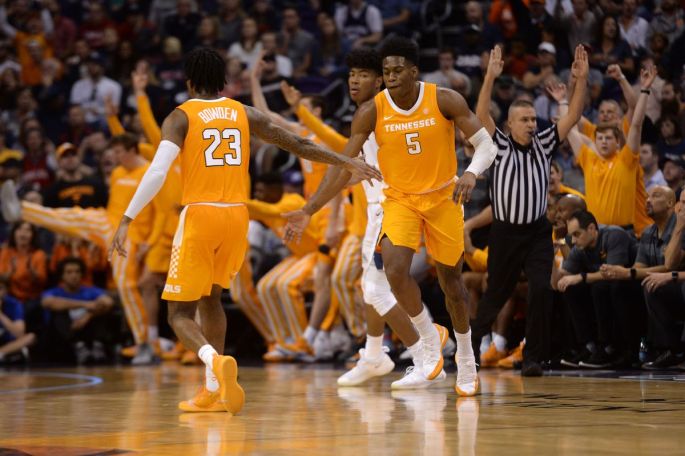
Hey, I don’t know if you know this, but basketball is coming back. Thank God. It is returning, and all is right with the world again. Tennessee basketball is also coming back, but it’s going to look a lot different.

Gone are Grant Williams to the Boston Celtics, Admiral Schofield to the Washington Wizards, Jordan Bone to the Detroit Pistons, and Kyle Alexander to…well, we’ll see. All four were excellent players for Maybe the Best Team in School History last season; all four are near-impossible to replace. Collectively, they represent 2,077 of Tennessee’s 3,035 2018-19 points, 870 of their 1,391 rebounds, 140 of their 199 blocks, I think you get the point. It’s going to be tough, and that was before the team lost D.J. Burns (redshirted) and Derrick Walker (might as well have) to transfers.

New are a bunch of young dudes. Josiah James is the headliner, a five-star from South Carolina that can play three different positions and likely will have the most shot attempts on the team. Behind him are Oliver Nkamhoua (a 3/4-star that we don’t know a ton about), Drew Pember (local from Bearden), Davonte Gaines (string bean from New York), and Uros Plavsic (Euro Plastics). How much do we know about these kids? Well, a few things. No one knows for sure what, exactly, they are until the lights come on and they’re playing in front of crowds of 20,000 or greater. That’s the fun of youth.

There’s two previews; you are reading the Offensive preview. This one exclusively focuses on what each contributor, both confirmed and potential, can bring to the table on the offensive side of the game. Because there’s so much changing on this team, I’ll venture to guess that some of these predictions will be wrong. Surprise! I’ll also guess that this is as good and detailed of a preview as you’ll find in the Knoxville market. Nothing here is, or ever will be, clickbait. Let’s get into it.

AFTER THE JUMP: Who’s back of the week
Building a Better Basketball Offense, Part 6: Attacking a Zone

If you want to strike fear into the minds of impressionable young people, from my experience, you say two words: zone defense. It’s so scary! A normal man defense is simple, and your average motion offense can break it with varying regularity. The second you throw something different at your average high schooler and collegian, they become terrified. Zone defense is so…not normal! It actually requires our team to slow the game down a little bit and look for a shot, and we can’t take the first open shot we see. That’s not exactly what a lot of players want to hear.

What’s funniest about all of this is that it’s statistically easier to score on your average zone defense. Per Synergy, which includes offensive rebounds as separate possessions, the average man offense in Division I this past season scored 0.877 PPP. The average zone offense? 0.923 PPP. That’s a full 4.6 points more per 100 possessions – nothing frightening about that at all, right? (There’s some obvious sample size disclaimers here, before I go any further. Teams play more possessions against man defense than they do zone, so the first sample will obviously be larger than the second.) If it’s easier to score on, then why can’t we stop being scared of zones?

The answer has several different factors, of course. Generally, a team that runs a lot of zone defense is going to be much tougher to break than a mostly-man team that breaks into a zone for a few possessions per game. They simply run it more often and are more comfortable in their system; therefore, they know the weak spots of it and know to pay close attention to them. Plus, the zone defense is open to greater variance. On average, teams take 4.5% more threes per game against zones than they do man defenses. It doesn’t lead to any greater success – 34.3% hit rate against zones versus 34.2% against man – but it does allow for higher variance, both good and bad.

Another key stat here: offensive rebounding. Zone defenses give up about 3.9% more offensive rebounds than man defenses do. That might not seem giant, but on average, that’s an additional offensive rebound for every 25 opportunities. Considering you have around 30-40 chances in any given game, an additional two points could be massive in a close game. Plus, the biggest one of all: Assist Rate. Teams get over 10 more assists per 100 possessions against zones versus man. Why? The zone defense requires you to pass the ball. In theory, you could certainly run isolation plays and pick-and-rolls to the basket in it, but they’re a rare sight against teams like Syracuse.

The following three teams have a variety of ideas for attacking zones. They don’t necessarily change their entire offense to do so. All three are excellent at passing the ball, looking for open shooters, stretching the zone, and finding weak points to attack. A high-end zone offense requires patience, fearless players, and confidence in your ability to get the same type of shots you’d get against a man defense. If your team has struggled with breaking down zones in the past, let these programs be your inspiration.

To skip ahead to the section of your choice, please click one of the following below: