Blog

Local Basketball Team Plays Game, Does Thing

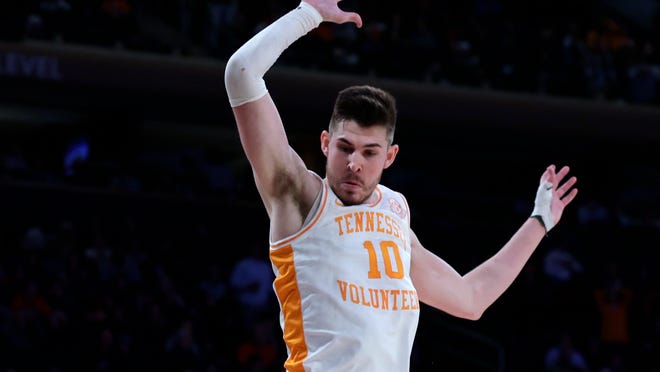
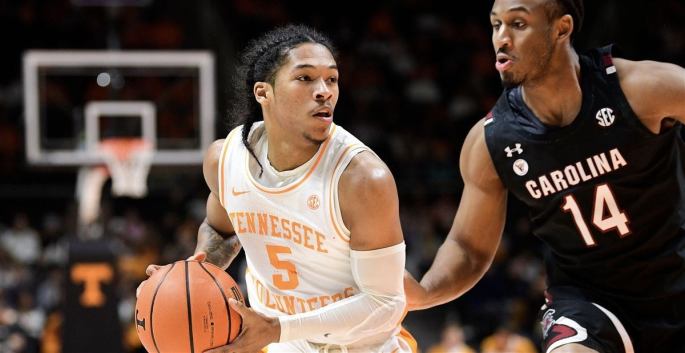
January 11: #22 Tennessee 66, South Carolina 46 (11-4, 2-2 SEC)
January 15: #18 Kentucky 107, #22 Tennessee 79 (11-5, 2-3 SEC)

EDITOR’S NOTE: Normally these come out on Mondays, but my weekend became a lot more free because a family member has COVID (with mild symptoms) and I am quarantining in a bedroom watching my cat stare at birds. So, here’s the recap.

Well, here you go.


The great thing about somehow managing to produce the program’s best-ever defensive performance against an SEC opponent in the KenPom era (2001-pres.) followed hilariously by the literal worst defensive performance against any opponent is that it pretty much blows up whatever narrative you want to run with. Tennessee’s only hope to go far in March is defense? Defense just got Hamburger Hilled by a team that had zero wins over top 25 teams. Tennessee puts up 11 threes on a Kentucky defense that only gave up 10+ once prior to that game? Doesn’t matter because you lost by 28. Kentucky hit a billion jumpers after years of not doing so? Feeds into the narrative of one head coach being willing to make changes.

When everything is nice and tidy and narrative-friendly, you get something easy to write about, like…I don’t know, last weekend. Or most weekends. Tennessee has gotten pretty good at running out the same narratives, the same supposed “issues,” the same public criticism of basketball players. The only fun twist on this one is that they did at least cover the KenPom spread against South Carolina, so that was nice. I guess. They also had some bench players have good offensive moments against Kentucky, and that’s always cool. I like when guys who don’t get much shine get an opportunity to do so and take advantage. Maybe this leads to a Brandon Huntley-Hatfield renaissance, which would be really exciting. I mean, I doubt it, but it would be exciting.

I don’t know. People seem to like my writing on Tennessee basketball, so consider this a post about Tennessee basketball. Might as well keep doing it.


The positive side of this is that Tennessee’s February still looks relatively tidy. Sure, they just got carpet-bombed by a ruthless man who saw that he was tired of losing last year and did something to fix it, but that doesn’t change the fact they’re currently going to be favored in nine, and possibly ten, of their final 10 games. The prospect for a great run to the finish to rescue what’s been kind of a sad start to SEC play is certainly there.

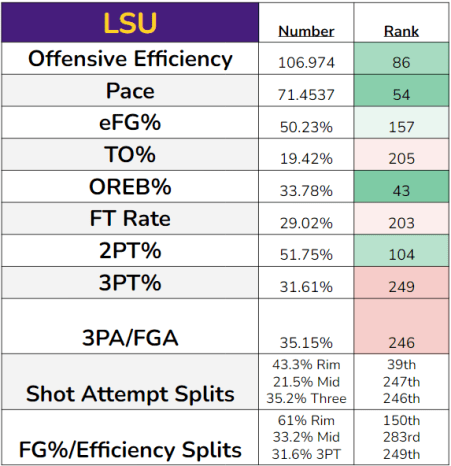
And, along with that, Tennessee does have some upside to play out the back half of this month with. They’ll get LSU and Florida at home and should be favored in both, while a road win at Vanderbilt suddenly will count as a Quadrant 1 victory if they make it happen. The road Texas game is more a luxury than a necessity (though Chris Beard seems to be struggling in a similar fashion to Tennessee), but if they finish this month going 3-1 over the next two weeks with any three wins of the possible four, they’ll add no less than two Quadrant 1 victories to their resume.

And as annoying as I’m sure it is to hear this, Tennessee’s most likely outcome is indeed 3-1. 2-2 is slightly behind that, but 3-1 is the expectation. Tennessee, as of the time of writing, still sits inside the KenPom top 15. They’re still a pretty good team. Even pretty good teams receive a destruction or two from time to time for the simple reason that they’re closer to the 40th-best team than they are the 5th. That’s kind of the nature of college basketball: on your best nights, everyone loves you; on the worst, you look like road kill that keeps getting hit by various distracted dads driving home from the CVS.

So, sure, lots of season to go. That’s nice. Tennessee will probably still finish this season as either the 4 or 5 seed in the SEC Tournament. I would personally prefer to be the 4 because playing either Missouri or South Carolina to make the quarterfinals is pretty much completely pointless, but I guess it’s not a huge deal. You beat one or the other by 18 and you move on to the next round.

And then you can get to March, where Tennessee is probably a 4 or 5 seed (yes, I’m being serious). You’re probably favored to win one game, then the second is a coin-flip. Maybe you make the Sweet Sixteen and maybe you don’t. We’ll see. That’s a couple of months away. All you can control is the present.

The present is this: Tennessee is 11-5, below .500 in the SEC, and just got ran off the court by their only real basketball rival. They are objectively a good basketball team, but when you lose by 28 to Kentucky and couldn’t pull off a single great road win when you had three huge road opportunities, fans are gonna skip right past the first seven words of this sentence and revisit “11-5, below .500 in the SEC.” I am writing this on Saturday; Tennessee probably won’t be ranked on Monday. Whatever, who cares, it’s the AP Poll. Tennessee can do the thing they usually do where they leave Vandy devastated after a close win on Tuesday and attempt to make things right on Saturday.

There’s still two months left of basketball to fix how this feels. The problem is that a healthy amount of people who follow me online see “there’s still two months left of basketball” and are feeling their eyeballs roll back in their heads, because it means you still have to watch this very-flawed team play basketball. I guess I’m still in the “wait until March” camp, but when the head coach has literally the third-most underwhelming NCAA Tournament resume of any active HC, I’m not sure what there is to wait for.


In October, my imagination was that this Tennessee men’s basketball team was one of the 15 or so best in college basketball and would probably make the Sweet Sixteen. At the same time, I imagined the Nashville Predators were no more than either the worst playoff team or the best non-playoff team in the NHL.

The Predators spent this offseason tearing up a good bit of the fabric that made up the 2017 Stanley Cup Final participant, easily the most successful team in franchise history. Ryan Ellis, very good defenseman they’d invested millions of dollars in, was shipped to Philadelphia for scraps. Viktor Arvidsson, Energizer Bunny, went to LA for a couple of picks. Franchise cornerstone Pekka Rinne retired. Calle Jarnkrok was extracted via an expansion draft. Nashville’s big offseason investments were a new backup goaltender and a couple of depth pieces.

On paper, the team they assembled was marginally worse than the one that just barely squeaked into the playoffs in a 56-game season. I personally expected very little; even a playoff bid was likely to result in a whooping at the hands of Colorado or whoever. I have watched this team for 20 years now and feel like I’ve got a decent bead on which way the wind is blowing. Nashville was firmly committed to making sure there was no wind of any kind. They were simply hoping to keep being a fringe playoff team when a lot of people (me included) simply wanted a rebuild.

Three months later, I am quite pleased that their ultimate decision was “let’s keep going.”
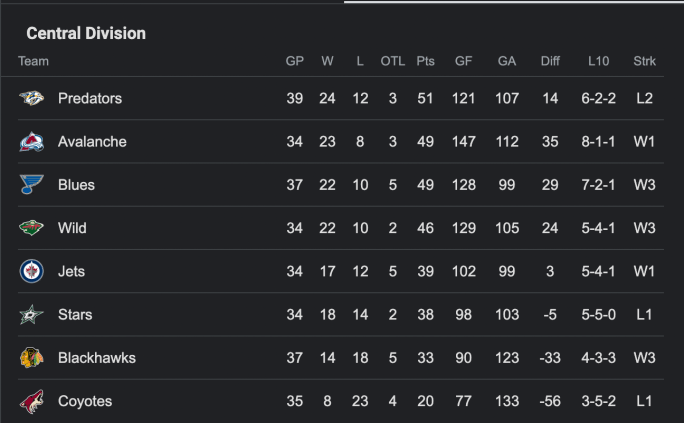
The Predators are on pace for 107 points. Whether that holds remains to be seen – I’m personally expecting 100-102 – but even a 101-point season would be enough to be a top-three divisional finish in every year and a top-two divisional finish in many. The NHL’s shift to the first two rounds being almost entirely inter-divisional (with wild card series being the variable in this mix) means that Nashville, as long as they finish in the top three, receive the pleasure of facing someone they’ve already faced a bunch in the regular season.

Juuse Saros is an every-night watch, stopping approximately 87 shots every time he takes the ice. Tanner Jeannot leads all rookies in goals and fights won. Filip Forsberg is at a crossroads in his career with regards to his time with Nashville, but he’s scoring like crazy. Matt Duchene appears to care. Roman Josi remains amazing. Alexandre Carrier is a delight. Mikael Granlund is enjoying his second wind. Most players on this team are players I feel positively about; even Luke Kunin, who hasn’t played up to expectations, had a couple of goals against Colorado. I look forward to watching every Predators game like a teacher looks forward to summer. It’s 2.5 hours of comfort, win or lose, and the wins feel better and better every time.

This is a long way of saying that I checked my sports calendar for the week ahead and saw this on Tuesday:

And my first thought was “alright, Bally Sports it is.”

Both of these seasons are very long. Right now, Nashville is overperforming wildly according to my own expectations. Technically, Tennessee is essentially right in line with what I expected in October, but the path they’ve taken to get there has caused more frustration than relaxation. These two narratives could completely flip come April, and considering Tennessee basketball has led to more monetary income than the Nashville Predators have, I guess I would be fine with that.

But maybe, just maybe, Tennessee uses that 9 PM tip on a Tuesday in a nightmarish arena to make things right. Maybe the Predators beat a mediocre Canucks side, too. That would be nice, because I would like to keep pace with the Avalanche and Wild. They’ve got a bunch of COVID games to make up, while Nashville doesn’t. Plus, Bridgestone Arena has normal dimensions that don’t rile me up every time I look at it.


The good news about that list of the most underperforming NCAA Tournament coaches in college basketball is that Tony Bennett is on it. Bennett’s appearance is aided by a few different early exits, but everyone knows the most famous one to a 16 seed. The cool thing about Bennett and Virginia is that they saw what happened, fixed several things about their offense, then turned into a machine that utilized all of their built-up good luck to bring home a national championship for the first time in 35 years.

Jamie Dixon is the other. Undoubtedly, Dixon underachieved at Pittsburgh given what he could’ve done in March, but he made an Elite Eight and was one layup away from Pittsburgh’s first and only Final Four since 1941. He had a long, sustained run of excellence at Pittsburgh, and the best argument for his continued employment as their coach despite the March issues is that Pittsburgh’s been utterly horrid since he left.

March is a very strange month where a lot can happen. To get to March, you have to complete January and February first. What’s happened so far can both be in line with expectations and a little disappointing because you know this roster could’ve beaten either Alabama or LSU. (No one was beating Kentucky if Kentucky is shooting that well on mid-range twos and threes. Tennessee had a bad defensive day, but it wasn’t that horrible; Kentucky really did get lucky on several shots.)

Tennessee has a huge week ahead. Vanderbilt is one thing; LSU is another. If the next recap is about a team that went 2-0, I imagine it will be happier and you might have fewer deviations from the topic at hand. If it isn’t, get ready for a 2,000-word article where 1,400 are about the 50+1 ownership model in German football, because writing about that is pretty interesting and fun. The Seagulls Moment has passed; Tennessee now has to put up or shut up. For the sake of this blog, it would be nice if they did the former, not the latter.
Show Me My Opponent, 2021-22: Kentucky, Part One

GAME INFORMATION
OPPONENT #18 Kentucky (13-3, 3-1 SEC, #9 KenPom)
(9-16, 8-9 SEC 2020-21)
LOCATION I-75 Exit 108 Meijer
Lexington, KY
TIME Saturday, January 15
1 PM ET
CHANNEL ESPN
ANNOUNCERS Dan Shulman (PBP)
Jay Bilas (analyst)
SPREAD KenPom: Kentucky -5
Torvik: Kentucky -3.6

In a just world, this game would come on, like, February 5. Some sort of scenario where Tennessee is given an extra three weeks to learn how to play collegiate offense; some sort of thing where Kentucky loses to Auburn and Kansas and enters a game against Tennessee with quality numbers but relatively underwhelming results. Even as of the time of this game, Kentucky will only be a 4-5 point favorite once the odds are released, so you could pretty much call this a weighted coin-flip that lands in Tennessee’s favor 3-4 times out of 10. If this game were on February 5, or February 12, or February Whatever, you could talk yourself into those odds being 4-5 times out of 10.

That is not the case, because the games are played when the games are played. Tennessee has to find enough offense to win at Rupp Arena for the fourth time in five years while simultaneously sustaining excellent defense against a top-10 offensive unit. God help ’em.

Kentucky’s offense

I’m of two minds about this unit. On one hand, watching Kentucky upsets me irrationally because their on-paper shot selection is horrific. They take more non-rim twos than all but seven teams in America; only 61.7% of their shots are at the rim or from three. I hate it very much, especially when you’re converting an insane 76.1% of your attempts at the rim. On the other hand: they are converting 76.1% of their attempts at the rim, and even LSU and Duke (the two best rim-protection units they’ve played, both losses) only managed to hold UK to a 57% conversion rate down low.

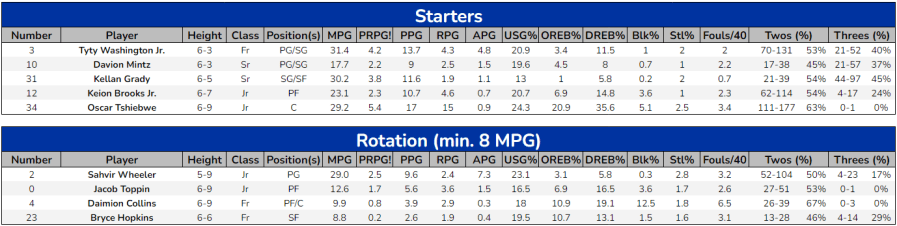
Kentucky’s solution to what’s plagued them offensively in years past – a poor half-court offense driven by stagnant shot selection – has been to simply play much faster than you remember. 35.7% of Kentucky’s initial shot attempts are in the first 10 seconds of the shot clock, per Hoop-Math, which is faster than any other year on record under Calipari. (2016-17 technically has a faster average possession, but they avoided late-clock possessions more frequently.) Kentucky’s revamped backcourt is driving this Daytona method, led by star guard TyTy Washington (13.7 PPG, 4.8 APG).

Washington is on pace to be a low-end lottery pick in the next Draft, and I’d call it fairly deserved. He doesn’t lift up a ton of threes (52 in 16 games), but he makes enough to make you respect him (40.5%). The real Washington killer, though, is his mid-range game; he’s currently hitting over 50% of his mid-range attempts. This is the rare player where any sort of shot he puts up is probably a reasonable one.

The other guy who you’ll see lead a ton of offense, if he’s able to play, is Sahvir Wheeler (9.6 PPG, 7.3 APG). Wheeler suffered an injury early in the LSU game last week and he’s missed Kentucky’s last two outings. Calipari is non-committal on his ability to play in this one, and as of publication, I haven’t seen anything one way or the other. (EDIT: He’s playing.) If he plays: the basic scout here is that Wheeler is absurdly fast and a far better player overall than he showed at Georgia. He has a bunch of wonderful passes…and some poor turnovers to go with it. Wheeler is not a serious threat from three or the mid-range, but is a terror at the rim for a 5’9″ guard.

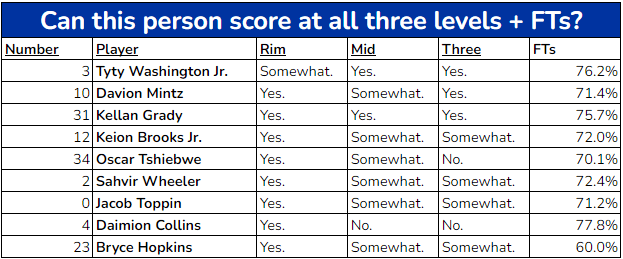
The best shooter this roster has to offer by miles is Davidson transfer Kellan Grady (11.6 PPG), a guy who doesn’t actually shoot often (8.5 times per game) but is knocking down an insane 45.4% of his three-point attempts.

Grady is the one hyper-reliable deep shooter on the Kentucky roster. Washington is good but doesn’t take a ton of them; Davion Mintz (last year’s only quality shooter on the roster) is good but very streaky; no other player on the roster outside of those three has made more than six deep attempts this season. If Grady gets the ball, clasp your hands together and pray, because he’s shooting 50% on both guarded and unguarded catch-and-shoot attempts. Hopefully, for Tennessee’s sake, he doesn’t get more than 5-6 attempts total in this one.

The elephant in the room – literally – is Oscar Tshiebwe. This is the behemoth who is averaging 17 & 15 and is the best rebounder college basketball has seen since Kenneth Faried.

It would be one thing if a 6’9″ college basketball player averaged 9.8 rebounds per game. That would be very good. That would be Tshiebwe’s number if you removed all offensive rebounds he’s getting, AKA 5.2 per game. That’s quite obviously the best rate by any player in America.

While the guards are what runs Kentucky’s transition/primary break offense, the plurality of half-court and secondary actions flow through Tshiebwe in the post. Washington, Grady, and Keion Brooks, Jr. all get theirs in the half-court, but it’s Tshiebwe who’s the main focus. He’s heavily involved in Kentucky’s ball-screen sets and is quite agile for someone his size. The real killer, beyond everything else, is his work down low.

Tennessee has to find a way to both contain Kentucky in transition and keep Tshiebwe from murdering them either down low or on the boards. That’s a tough task, and while Kentucky only has one Quadrant 1 win to date (North Carolina), it explains why they’ve gone undefeated against the weaker beings of the schedule.

CHART! “Yes” means “is efficient at doing so”; “somewhat” means “can, but not efficiently”; “no” means “rarely or never.” SPECIAL NOTE: I’ve included free throw percentages here upon request. The numbers used are a player’s career FT%, not 2021-22.

Kentucky’s defense

Most seasons, John Calipari has had to scheme his way around his personnel to find the best-fitting defense Kentucky can have. The 2017-18 team Tennessee swept had to go with a 2-3 zone for significant stretches of the season to help mask their deficiencies in rebounding and isolation defense; the 2018-19 and 2019-20 sides went all in on half-court defense and blitzed pick-and-rolls; 2021-22 has been forced (?) into running a full-court press 10-12 times a game. It’s a basic full-court man-to-man press that Tennessee runs a similar version of. You’ll see some traps from time to time, but to be honest, it’s not terribly effective.

The real concern here is that, while it’s still very good, this is the least block-heavy (51st in Block%, lowest ranking of Calipari’s tenure) and leakiest overall rim defense the ‘Kats have shown in a really long time. In some aspects, it’s like should you consider a zone?, but in others, I think I understand what’s going on here. This is the first year in forever Kentucky doesn’t employ some sort of mammoth 6’11” center with arms longer than God and the vertical of a rocket. What they have at center is Tshiebwe (elite rebounder, average shot-blocker for his size), Lance Ware (7.5 fouls per 40), and occasionally Daimion Collins (6’9″ freshman, 6.5 fouls per 40). Unlike most Kentucky teams, the path to scoring at the rim enough to make you happy really does exist.

The problem is that, well, it’s still a great overall unit. The key of each Calipari team is its ability to force and block non-rim twos, and this one is no different. Kentucky forces more non-rim twos than all but 11 teams in the nation and blocks more of these shots than all but eight, so that part is legitimate once again. The structure of Kentucky’s defense sinks inward to prevent you from getting all the way to the rim on a typical possession. I imagine it’ll come as no surprise that Kentucky forces more runners and floaters than any other SEC defense.

Add that to Kentucky’s usual ability to run shooters off of the three-point line and into nasty long twos and you have what would be a nightmare matchup for…well, a lot of schools. Again, though: the path to points exists, and it’s more realistic than you’d imagine. Synergy ranks Kentucky’s around-the-basket defense in the 83rd-percentile nationally, which is excellent but not elite; whoever’s tracking their games in StatBroadcast is also heavily underestimating the actual amount of attempts at the rim (35.3% of all shots per Synergy, 29.7% per Hoop-Math). You can score down low against them.

More important for Tennessee fans, of course, is that while Kentucky is above-average at forcing Guarded threes (57/43; nat’l average 55/45), they’re not perfect. Kentucky has played four games against Top 100 opponents so far; outside of two total outliers from Duke and North Carolina (both 1-for-13), the other three teams (Notre Dame, LSU, Vanderbilt) have all taken 22 or more threes and made between 32-40% of their attempts. In particular, I’ve noticed that Kentucky’s had some issues guarding the left corner; out of 29 catch-and-shoot threes, 16 have been left wide open.

They’ve been very lucky that of those 16, opponents have hit two.

Lastly, we’ll discuss ball-screen defense. Kentucky’s had to defend a bunch of these this year, so we have a good base to measure. Unsurprisingly, on the majority of possessions he’s been asked to defend, Tshiebwe sticks in drop coverage to force the guard to finish over the top of his huge frame. However, it’s not an all-or-nothing situation; Vanderbilt caught the ‘Kats in a sort of hedge coverage several times, and Tshiebwe often wasn’t able to recover in time. Here’s an example:

The problem here is that you’ve gotta have a guard worth respecting who handles the ball. If Kennedy Chandler can be that, Tennessee can win this game. If he disappears for long stretches as he has over the last month, well, 2-3 in the SEC is on the horizon.

How Tennessee matches up

I’m guilty of attempting to make basketball sound like the most complicated game on the planet sometimes. To be fair, it kind of is if you’re looking at it on a play-to-play basis. However, a hefty amount of games hinge on two questions:

  1. Did you hit enough threes?
  2. If not, did you make up for it by either converting at a high rate on twos or getting to the free throw line?

If you fail to answer these questions correctly, you’re gonna lose more often than not. The same questions apply defensively, obviously, but these sections always start with offense. If Tennessee wants to win this game, the strategy is very clear: you have to hit enough threes or you need to be really, really good on twos. It all comes together to needing at least an eFG% of 50% or better to win; Kentucky is just 16-16 in the last four non-COVID seasons (last year seems like an obvious fluke) when opponents crack that 50% mark.

Let’s talk threes. I talked on Monday about Tennessee’s Seagulls Moment of figuring out if they were to be a serious offense or not, and the first data point of a 66-46 win over South Carolina was…not optimal. However, there was some amount of improvement in a particularly noteworthy area: corner threes. Not only did Tennessee go 3-for-6, they changed who got those shots.

Corner three-point attempts, first 14 games (makes in parentheses):

  1. Victor Bailey, Jr.: 24 (3)
  2. Josiah-Jordan James: 20 (4)
  3. Justin Powell: 12 (5)
  4. Santiago Vescovi: 11 (1)
  5. Zakai Zeigler: 9 (4)

Corner three-point attempts, South Carolina:

  1. Santiago Vescovi: 3 (2)
  2. Victor Bailey, Jr.: 2 (0)
  3. Zakai Zeigler: 1 (1)

See how much better that looks? Unsurprisingly, when you give your actual best shooters the best shots, it works out pretty well. As covered in the defensive section, I think Kentucky has a very good defense that isn’t great because it’s not quite as scary inside as it typically is and the backcourt doesn’t have a singular, shutdown defender that covers up the gaps. You can get open in the corner on this team with fair regularity. Please put the right shooters there when it happens.

The other part of this is that Tennessee’s going to have to get creative to score points in the paint. I mean, you and I both can sit around hoping that the Ram Everything Through the Post strategy works to the tune of Fulkerson or Nkamhoua dropping 20+, but I think we all know that’s not the most logical of scenarios. I would get Tshiebwe involved in ball screens early and often to drag him out of the paint. If he hedges, Kennedy Chandler (or Zakai Zeigler) have to be ready to hit cutters to the rim.

Defensively…well, the best-case scenario really is that Tshiebwe somehow gets in foul trouble and you can remove that albatross from the floor. If he manages 30+ minutes, this is going to be a hard game to win. If he’s out there, Tennessee has to be strong in half-court post defense. Tshiebwe will move around and set screens, but at the end of the day, he’s more willing to post up than to do anything else. Single coverage on Tshiebwe is something Tennessee could do, but considering Tshiebwe is the most efficient single-coverage post player the SEC offers, I would consider doubling him early and often.

Tshiebwe isn’t a terrible passer, but he’s not much of a passer, period. He’s posted more than one assist in just three of Kentucky’s 16 games. Double him in the post, because the alternative is likely worse. Tennessee rarely doubles in the post, but Tshiebwe is a rare beast.

The secondary thing here, and one that’s unusual, is that Kentucky both attempts more non-rim twos than threes and gets to the free throw line even less than Tennessee. (How about that for a sea change?) You can probably expect 30 jumpers from various depths from Kentucky in this game, along with six or seven floaters/runners. The guys who I wouldn’t allow to get off clean looks in the mid-range are Washington and Brooks (and Grady, I guess); everyone else is free to go. If they make it, whatever, beats Tshiebwe killing you.

This is going to be a battle for 40 minutes. Your best shot is that you make enough threes, hold Kentucky to a good-not-great hit rate on twos, and stay out of foul trouble. Let’s see if that unfolds.

Starters + rotations

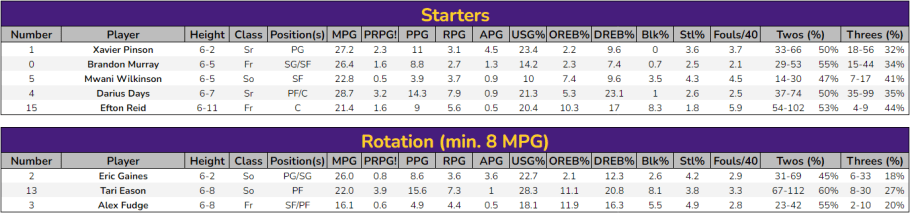
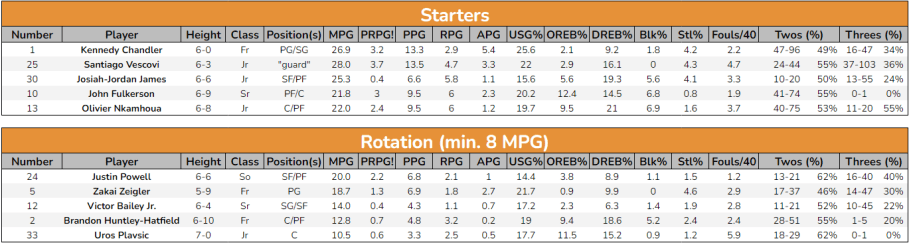
Metric explanations: MPG is minutes per game. PPG/RPG/APG/Fouls/Twos/Threes are what you’d guess. USG% is the percentage of possessions a player uses on the court. OREB%/DREB% are your available rebounds usurped. Finally, PRPG! is Bart Torvik’s Points Over Replacement metric; the higher the better. If you’re on mobile, zoom in; if on desktop, right click -> Open Image in New Tab.
Three things to watch for

  • Can Tennessee utilize a turnover advantage to overcome other deficiencies? Tennessee and Kentucky are similar turnover-avoidant offenses, but Tennessee’s defense is much, much better at forcing TOs. Tennessee really should finish with 3-4 fewer turnovers, even considering the home/away dynamic.
  • Can Kentucky make up for the TOs with OREBs? Kentucky ranks as the #2 offensive rebounding team in America; I’d say it’s deserved. That being said, Tennessee has quietly had its best season by far under Rick Barnes in terms of defensive rebounding against a pretty tough schedule.
  • Threes? Threes. Threes. Tennessee probably needs at least eight or nine to win this game, barring a Kentucky over/underperformance from deep.

Key matchups

Oscar Tshiebwe vs. Every Available Option at Center. Well, when you’re playing a Boards Behemoth who’s KenPom’s Player of the Year at this moment in time, you need everyone on board. Here’s various contributions I could see as useful: Olivier Nkamhoua features in ball-screens and various sets that draw Tshiebwe away from the boards. John Fulkerson does the Wacky Tube Man thing and draws a few fouls. Uros Plavsic…gets a tip-in? Maybe?

TyTy Washington vs. Kennedy Chandler. I’m very interested in this one because it seems like a matchup that should draw the best attributes of both players. Washington is a more skilled shooter, but Chandler’s much better at driving to the basket and grades out as the better defender.

Kellan Grady vs. Justin Powell. Technically, this is Josiah-Jordan James’ starting spot, but over the last five games (per KenPom), Powell’s gotten the plurality of minutes at the 3. I agree with the general staff consensus that Powell’s not great defensively which is why I’d totally understand the JJJ matchup here, but…I mean, Grady has similar defensive issues, too. Just shoot a basketball, dude.

Three predictions

  1. We find out how Justin Powell handles public criticism as he either takes 8 shots or 1 in 17 minutes of play;
  2. At some point late in the first half I regret not picking Tennessee even though the metrics favor Kentucky;
  3. Kentucky 72, Tennessee 68.

Show Me My Opponent, 2021-22: South Carolina, Part One

GAME INFORMATION
OPPONENT South Carolina (10-4, 1-1 SEC, #101 KenPom)
(6-15, 4-12 SEC 2020-21)
LOCATION Thompson-Boling Arena
Knoxville, TN
TIME Tuesday, January 11
6:30 PM ET
CHANNEL SEC Network
ANNOUNCERS Tom Hart (PBP)
Dane Bradshaw (analyst)
SPREAD Sinners: Tennessee -15
KenPom: Tennessee -14

Torvik: Tennessee -13.9

Well, at least this one is an early-ish tip at home. South Carolina has done the thing they always do every single year: produce fragrant garbage in non-conference play (losses to Coastal Carolina, Princeton, blown out by Clemson) to go with one decent win (UAB) before rounding into form in SEC play to somehow scrape to .500 while you attempt to figure out if they’re good or just playing a trick on you. Or at least I’m assuming that’s the case.

In non-COVID times, South Carolina has gone 10-8, 11-7, 7-11, 12-6, and 11-7 in their last five SEC seasons. That’s pretty good! Exactly one of those teams ranked inside the KenPom Top 50 at season’s end: the one that somehow became a good offense for four games in March. This is the exact type of program that you know isn’t a serious threat but you also know will provide you 35 minutes of frustration regardless of how good you are. Hopefully, that isn’t the case this year.

South Carolina’s offense

The nicest thing you can say about the South Carolina offense under Frank Martin is that they’re trying. What it is they’re trying for is completely lost on me, but the effort is certainly there. South Carolina Basketball: We Are Trying, I Think.

I just don’t have much new to say about an offense that’s the exact same slop it’s been for all 9.5 of Frank Martin’s seasons in Columbia. It’s the least-watchable offense in the SEC by miles, which is a remarkable achievement when you share a conference with Texas A&M, Georgia, and Mississippi. Every year, South Carolina finishes somewhere in the 200s in eFG%, somewhere among the bottom 100 in 3PT%, and never above-average in 2PT%. Martin started to push the pace offensively a few years ago, which has led to more points because there’s more possessions, which is not efficient offense. The new plot twist this year is that they’re turning it over on 22.3% of all possessions, which is a hilariously bad matchup for a Tennessee defense that forces turnovers in bunches.

This year’s leading scorer, by way of being the oldest guy on the team, is Erik Stevenson (11.8 PPG). Stevenson is one of three players on the roster with more than seven made threes this season, which is nice. I wouldn’t call Stevenson good at creating his own shot – he’s currently posting a cool 28.1% eFG% on off-the-dribble jumpers and only has 17 rim makes this year – but he can at least shoot, which is something. Most off-ball screens the Gamecocks run are for Stevenson.

Other guys of interest: Jermaine Couisnard is somehow still here. Couisnard comes off the bench, but is second on the team in scoring at 10.8 PPG and is the most efficient three-point shooter at about 38%. That’s useful on a team that doesn’t take or make many threes. The problem is that Couisnard remains a turnover machine, almost touching a 29% TO% as an individual this season. The guy can shoot, but if you ask him to dribble at all, it’s a huge win for your defense.

There are three other players worth noting. Wildens Leveque (10.5 PPG) would be my main reason to watch this team on a nightly basis if I had one. Leveque is very much not a jump shooter and isn’t good at creating his own shot, but he’s been hyper-efficient at the rim (83.7% on 43 attempts) and is really good at knowing when to cut to the basket. James Reese V (9.8 PPG) should probably be Just a Shooter because he’s sitting at 38% from three, and the danger with him is that he’s equally solid in catch-and-shoot and pull-up situations. Devin Carter (8.6 PPG) uses more possessions than anyone not named Stevenson, but is posting a 41.4% eFG% and is 11-for-46 on everything that’s not a layup or dunk.

Allowing anything more than 0.9 points per possession/65 total points to this offense would be genuinely disappointing. They take more midrange twos than any SEC team that isn’t Kentucky, do not shoot particularly well on anything that’s not a layup…get them out of there. Enough. No more.

CHART! “Yes” means “is efficient at doing so”; “somewhat” means “can, but not efficiently”; “no” means you can be mad. SPECIAL NOTE: I’ve included free throw percentages here upon request. The numbers used are a player’s career FT%, not 2021-22.

South Carolina’s defense

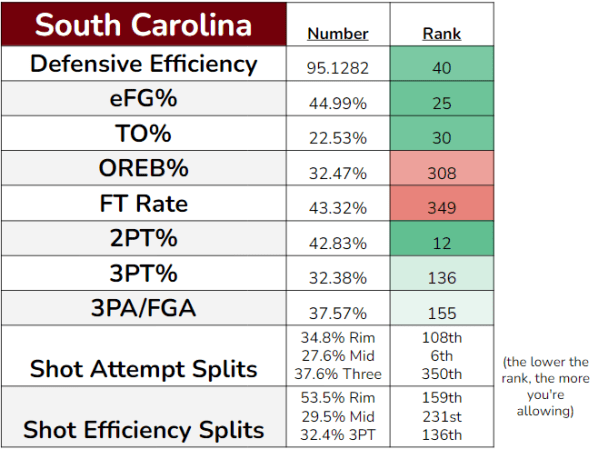
Unfortunately, this unit appears to be very good. South Carolina kind of took a year off of playing their usual hard-nosed defense a year ago due to COVID, but this year, it’s back in full force. Like the offense, the patterns are pretty much always the same: a healthy amount of blocked shots, lots of forced turnovers, but little in the way of defensive rebounding and an insane amount of fouling.

Starting down low and working our way out: the rim. Synergy ranks the South Carolina defense in the 98th-percentile in around-the-basket defense, and play-by-play stats have them 32nd-best nationally, precisely one spot behind Tennessee. Carolina has a somewhat-swap-heavy defense that spends most of its time in man but can bust its way to a 2-3 zone look at times:

I wouldn’t be shocked to see this simply because we already saw it for about 10-15 possessions last year when the two played. Anyway, the rim protection is pretty legitimate. Carolina’s best shot-blocker is Keyshawn Bryant, who comes off the bench, but they play a wide variety of guys at the 4 and 5 (literally nine different guys have logged significant time in the last five games in the frontcourt), all of whom seem fairly capable at making life difficult. The most fearful, by my standards, is Leveque.

The problem is that Leveque, Bryant, and nearly everyone in the frontcourt foul like crazy. The Gamecocks commit more fouls than all but nine teams in college basketball. The odds of you getting to the free throw line increase immensely if you get an offensive rebound, post up any of their bigs, or produce a well-timed basket cut.

So yeah, no wonder they play a billion guys down low. South Carolina’s been excellent at stuffing twos, but when you foul as often as they do, the risk/reward of this gets a little fuzzy. Frank Martin’s defense is hyper-aggressive for 40 minutes every single night. This produces a ton of turnovers, particularly in ball-screens and in isolation, but it leads to a lot of reaching, jumping, overexcitement, etc.

This is why they should build a Mike Schwartz statue at Thompson-Boling Arena. Tennessee is also hyper-aggressive, but they foul half as often. South Carolina is a whirling dervish of feast-or-famine. When it works, great; when it doesn’t, well, you’ll be pleased to know they have a poor Guarded/Unguarded rate (51/49) and have gotten torched from three by a few teams.

This is a defense that wants to produce variance. Whether or not this is upsetting to you probably depends on whether you’ve watched the last three Tennessee basketball games.

How Tennessee matches up

Well, it’s an offense predicated on generating open threes that does seem to generate them well but is doing a poor job of hitting them. Tennessee is shooting just 33.1% on Unguarded catch-and-shoot threes, per Synergy; the national average is generally anywhere from 36% to 38% depending on the season. Tennessee is going to get a lot of chances to take them in this game. Here is my proposal: start giving the right players the right shots.

As of now, here’s how Tennessee’s players rank in catch-and-shoot attempts this season, per Synergy:

  • Santiago Vescovi: 89 attempts
  • Josiah-Jordan James: 61
  • Zakai Zeigler & Victor Bailey, Jr.: 48
  • Justin Powell: 39
  • Kennedy Chandler: 33

So: 109 of Tennessee’s catch-and-shoot attempts have gone to three guys. Those three guys have combined to convert all of 23 of those, or 21.1%. Stop giving Bailey and James chances to take these shots. Instead, why not feed Powell, Chandler, or even Olivier Nkamhoua? Heck, I’d hear out Zeigler, who’s at least 15-for-48. This, more than anything else, would seem to keep the games from being quite as frustrating.

Tennessee will also have to score at the rim this game, and while I’m fine with post-ups against this team, it would be useful to just keep accumulating drives and cuts. Get the experience now, worry about other stuff later. This should theoretically serve as a get-right game. Maybe I’m being too hopeful, but hey, it’s all I can do at this point. In particular, I would get Chandler rolling downhill as frequently as possible in this game. It worked to open up the offense against Ole Miss, and I think it could do similar work here. Plus, with how foul-happy Carolina is, it could serve as a chance for Chandler to rack up easy points.

Defensively…I mean, let South Carolina take any and all of the mid-range jumpers they want to take. That should just be it: run them off the three-point line, ice them before they get to the paint. They’ll take shots at the rim and from three because literally everyone does, but as long as you limit the easy attempts, this really shouldn’t be a difficult job.

The more exciting part of this: the turnovers. No one left on Tennessee’s schedule is anywhere close to South Carolina in terms of how many turnovers they commit on a per-possession basis. Tennessee forces a ton of turnovers in isolation and in ball-screens; South Carolina turns it over a lot in those same situations. I’ve already mentioned Chandler on offense, but this seems like a great chance for him to show out defensively. I’d personally be quite disappointed if Chandler couldn’t find his way to at least two steals in this one. Really, three or four could be on the table.

Get right, get back on track, get out alive.

Starters + rotations

Metric explanations: MPG is minutes per game. PPG/RPG/APG/Fouls/Twos/Threes are what you’d guess. USG% is the percentage of possessions a player uses on the court. OREB%/DREB% are your available rebounds usurped. Finally, PRPG! is Bart Torvik’s Points Over Replacement metric; the higher the better. If you’re on mobile, zoom in; if on desktop, right click -> Open Image in New Tab.

Three things to watch for

  • Can Tennessee own this game in the first ten minutes? Tennessee, per Synergy, is shooting a disgusting 27% from three in the first ten minutes of games this season. They’ve lost the theoretical first quarter seven times in 14 games. They’ve outscored opponents by just 2.2 PPG in the first 10 minutes of games while beating them by 12 PPG in the final three quarters. Enough. Show up and play like you want to be there.
  • Can South Carolina win a Four Factor? Tennessee is superior in all four: eFG%, TO%, OREB%, and even FT Rate. If Tennessee doesn’t win TOs + OREBs by 7 or more, I’ll be surprised.
  • Who are Leeds signing in the January transfer market? I would like Nico Dominguez from Bologna or similar. Whatever it takes to stay up and keep the PL money coming.

Key matchups

Wildens Leveque vs. either Olivier Nkamhoua or John Fulkerson. I would not be shocked to see Fulkerson on the bench to start this one, frankly. Nkamhoua is a better strength matchup, but Fulkerson will be better at forcing Leveque to the bench with foul trouble. Either way, this is a guy that won’t take up many possessions but will post a few dunks. You can’t let him scare you at the rim on the other end, either.

Erik Stevenson vs. … uhhh…someone at the 3? Tennessee’s starting spot also seems unsettled here, and again, I would rather see Justin Powell get minutes than Josiah-Jordan James right now. Regardless of who gets the nod, Stevenson is SoCar’s main driver of possessions and Tennessee cannot let the guy get loose from three.

Three predictions

  1. Tennessee adds to The Discourse™ by attempting 25+ three-pointers;
  2. Tennessee and South Carolina combine for 35+ free throw attempts;
  3. Tennessee 76, South Carolina 60.

When the Seagulls Follow the Trawler, It Is Because They Think Sardines Will Be Thrown Into the Sea

This is the eighth in a series of weekly recaps surrounding the 2021-22 Tennessee men’s basketball season.

January 5: #18 Tennessee 66, Mississippi 60 (OT) (10-3, 1-1 SEC)
January 9: #21 LSU 79, #18 Tennessee 67 (10-4, 1-2 SEC)

I. Cantona/LaBeouf

In 1995, Eric Cantona, Manchester United striker, entered possibly the most consequential press conference of his career to-date. Two months earlier, Cantona was sent off for a harsh foul on a Crystal Palace player. On his way to the tunnel, a Palace supporter flew down the stairs to yell all sorts of obscenities and, by some interpretations, racial slurs against Cantona. The striker reacted how those of us who were not popular in middle school dreamed of reacting: driving his boot through the guy’s chest.

Cantona would be taken to court by the fan, and for a brief moment, it appeared that Cantona would have to go to jail for the crime of doing what I’d imagine 99.9% of people who’ve played higher-level sports dream of doing to certain fans. Alas, Cantona got out of it mostly scot-free. In his first press conference after the ordeal was finished, Cantona settled in to give his thoughts on the last two months of his life. In 15 seconds, he achieved something beyond anyone’s wildest dreams.

When the seagulls follow the trawler, it is because they think sardines will be thrown into the sea. 18 words, 15 seconds, one infamous sentence. Cantona left, because he had nothing left to say. Why would he?

18 years later, in a completely different setting, American actor Shia LaBeouf settled in for a press conference in Germany surrounding the film he was in, Nymphomaniac. (It is not a good movie.) Everyone my age or slightly older knows LaBeouf as a former child actor that starred in Holes, Even Stevens, or even Disturbia, a variety of teen-friendly things that made sense at the time. No one really knew much of LaBeouf’s backstory; they just knew him as the guy from Holes and whatnot.

LaBeouf’s appearance in this movie, and at this festival, was during a strange time. LaBeouf was too old to be in the teen-friendly movies he’d grown up in, but perhaps too young in some aspect to tackle lead roles in the Academy Awards bait we collectively pretend is superior. He’d been forced into taking some weirder roles to keep his career going. LaBeouf fidgets in his seat, but has the glass of water nearby. 18 years apart, in a different country, LaBeouf offers the same 18-word statement.

I bring this up because the moments for Cantona and LaBeouf were different before and very different after. Cantona received a ban for the rest of the 1994-95 season, but he finished his career out with United by winning Premier League titles in 1995-96 and 1996-97, scoring a combined 34 goals along the way. He received the Footballer of the Year Award in 1995-96, the same year United won the FA Cup. Cantona used his Seagulls Moment, which could’ve ended his career entirely, to instead turn his twilight years into a grace note.

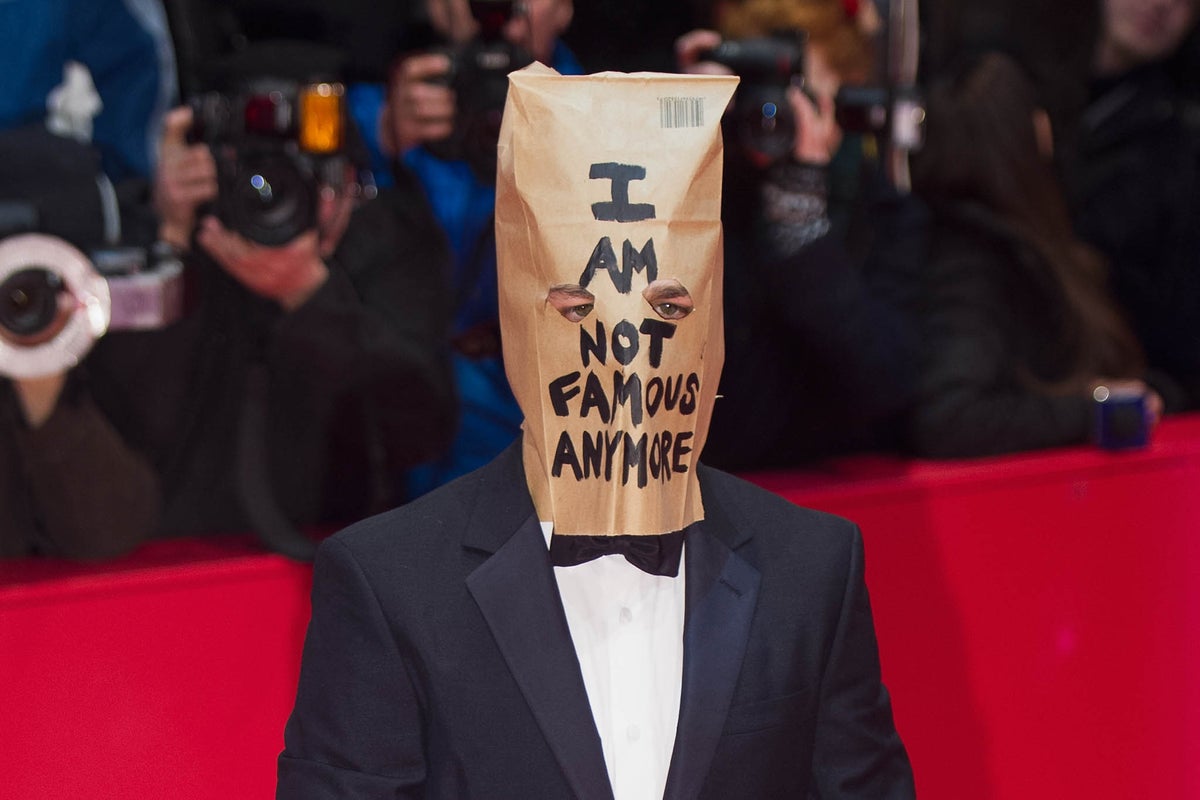
LaBeouf didn’t get banned from Berlin’s film festival. What happened after was, at best, a lot of uncomfortable gawking. The next day, LaBeouf showed up with this outfit to the premiere of Nymphomaniac.

What followed that was one of the most public patterns of bizarre behavior a famous person has uncorked. LaBeouf turned the paper bag into an art exhibition titled #IAMSORRY, where you could visit him in a room for the right to watch him cry silently behind the bag. LaBeouf would go to a Broadway play and get kicked out. LaBeouf leaves jail and heads to an audition for the movie War Dogs, alongside war criminal James Corden. He watched all of the movies he’d been in and streamed it for all to see. LaBeouf protests the inauguration of Donald Trump by setting up a livestream of a wall that says HE WILL NOT DIVIDE US. Finally, that livestream ended in LaBeouf taking the flag on the road to, of all places, Greeneville, Tennessee.

That was merely three years of LaBeouf’s life, and it’s a lifetime of bizarre stuff. He’s recovered somewhat in the public eye now, but, well, he’s always finding ways to screw it up.

I am not insane enough to draw a 1:1 comparison to Tennessee men’s basketball and Shia LaBeouf. It is merely a somewhat-interesting metaphor to keep myself going as things never change and I wonder what the point of this is. What I would offer is this: the 2021-22 Tennessee basketball team sits at a Seagulls Moment. They have offered it up to fans out of pure frustration and the idea that things will somehow change by doing the exact same thing, over and over. Whether this season goes the way of Heroic Cantona or Villainous LaBeouf, well, we’ll see.

II. Variance

I feel that we’re at this Seagulls Moment because I, personally, have turned into one of the crypto people that keeps spamming “Buy the Dip.” I do not spend my money on cryptocurrency because I think Matt Damon should be jailed for his same-commercial-airs-14-times-every-day crimes, but whatever. I keep wanting to Buy the Dip on Tennessee basketball because, as we’ll cover later, the team appears to be more or less precisely what we thought it would be two months ago. They opened the season 13th in KenPom; today, they sit 14th in KenPom. They’ve yet to lose a game they were not favored to lose and have yet to win a game they were not favored to win.

It is all going according to plan, but I’d argue we all have a very real reason to be frustrated. Here’s how Tennessee’s three-point shooting breaks down this season:

  • 50% or better: 1 game (7.1%)
  • 40-49%: 4 games (28.6%)
  • 30-39%: 1 game (7.1%)
  • 20-29%: 6 games (42.9%)
  • 19% or worse: 2 games (14.3%)

If Tennessee basketball were following a natural bell curve, you would see this break down as something more like 1/3/5/4/2 or whatever. They’ve probably been unlucky to have as many poor shooting exhibitions as they’ve had, but in general, they’ve been unlucky to not have more average performances. I mentioned the goal recently of even being the 40th-best offense in college basketball; here’s what the 40th-best offense (Ohio) did in 2020-21.

  • 50% or better: 3 games (12%)
  • 40-49%: 5 games (20%)
  • 30-39%: 11 games (44%)
  • 20-29%: 5 games (20%)
  • 19% or worse: 1 game (4%)

Look how normal that is. That’s a perfectly normal bell curve! Ah, how nice it must be to achieve such things. I guess this is me entering the Black Pit of Negative Expectations somewhat, but, well, could you blame anyone? It’s season 7 of Rick Barnes, who I genuinely like and would recommend as a head coach, and Tennessee is staring down their sixth season of failing to finish in the top 100 of effective field goal percentage (eFG%). Only twice have they finished in the top 200 in 3PT%. So, yeah, the variance we’re feeling is unusual and it’ll probably fix itself in due time…but I cannot blame the person who says “so what?”

III. Fear

That nothing will change and everything will remain the same. It’s rational, no?

I voiced my desire for Tennessee to finally shorten their rotation against LSU on Saturday because teams simply do not play 10 guys in March; Tennessee responded by giving 10 players (none of them Brandon Huntley-Hatfield) at least six minutes of on-court action. Maybe that’s unfair, because against Ole Miss only eight players got 6+ minutes, but it lends its hand quite nicely to the continued frustration I’ve felt. Why is Justin Powell, an objectively superior player to Victor Bailey, not taking all of Victor Bailey’s minutes? Why doesn’t Powell have the same mental green light from three as Bailey despite being a superior shooter? If it’s not Powell, why not Jahmai Mashack, whose per-minute stats are far above Bailey’s? Why is Josiah-Jordan James still starting when his offensive numbers are the worst on the entire team? Why can’t John Fulkerson string two good games together? Why does Brandon Huntley-Hatfield appear to give about 13% effort on defense? Where is Quentin Diboundje, who cannot possibly be worse than a couple of the guys getting playing time?

We’re 14 games in and many of the questions I’d had preseason are either still unanswered or the answers haven’t left me very satisfied. That’s where the fear comes in: what if this is it? What if this, a basketball team that oscillates wildly between Actually Good and Completely Unwatchable, is what we’re left with? What if the answers they’re giving us are the best they really can provide? And that is a scary thing to consider.

IV. Expectations

Two months ago to the day, Tennessee sat 13th on KenPom to open the season. They were projected to have the sixth-best defense and the 25th-best offense. Right now, they’re 14th, with the defense being a bit better than anticipated and the offense being worse. So why does this feel as unusually bad as it does? Is it because Saturday’s loss to LSU wasn’t nearly as competitive (prior to the final couple of minutes) as everyone had hoped? Is it because Tennessee is failing to hit threes yet again? I mean, I don’t know, I guess everyone has a different answer…but everyone wants an answer.

The first question is this: do we adjust our expectations for March downward? As usual on the NCAA Tournament, I’d prefer to punt here. Barely nine months ago, a UCLA team that had lost four games in a row and entered the field of 68 outside the top 40 in KenPom proceeded to get red-hot from mid-range and make the Final Four. In 2019, an Auburn team that ranked 14th in KenPom entering the Tournament nearly lost to a 12 seed, then proceeded to get hot from three and make the Final Four. In 2018, well, you already know.

So I’d prefer to not make some sort of overarching statement on March odds yet without seeing who’s in Tennessee’s bracket. All you can control in terms of strength of schedule is your Round of 64 opponent; everything after that is whether you get a lucky break or not. The Loyola team that made the Final Four in 2017-18 had the 68th-best offense in America, while the Kansas State team they beat in the Elite Eight to get there was 60th-best. It really, genuinely doesn’t matter right now.

The second question: do we adjust our expectations for the season downward? Well, I’d argue this one could be more fair. Before the season began, Tennessee ranked as the #1 team in the SEC by KenPom because they were simply the least-questionable, sitting at 13th overall. Today, there are three SEC teams in the top 10 while Tennessee is basically what everyone imagined they’d be. Tennessee can’t control that, but you’re certainly staring down a scenario where 12-6 is a good-enough regular season that nonetheless gives you a 4 seed in the SEC Tournament. The February schedule is far more favorable (Tennessee will be favored in all of their final 10 SEC games), but the odds of a regular season title are dwindling with each frustrating road loss.

If you like regular season championships, Kentucky on Saturday is a must-win game. That’s as nicely as I can put it.

V. Obligation

Before, during, and after Saturday’s game, I felt a mixture of dread and obligation to keep going. This is my fourth full season doing these previews. When I started doing these previews full-time for the 2018-19 season, it was not something I anticipated doing in perpetuity. Tennessee had an excellent basketball team that year; it seemed natural to provide the local market with previews of every game. That team turned out to be the most fun Tennessee basketball team of my lifetime. I didn’t necessarily see that coming entering the season, but it made me want to keep going.

You can deal with weak or underwhelming seasons, I guess. But it’s becoming harder to deal with what feels like the exact same storylines and game flows every time out. You could design a decent-enough Mad Libs replica with it. Tennessee is [UNDERWHELMING] because they need to [MAKE MORE SHOTS] and stop [LOSING FOCUS OFFENSIVELY]. That joke sentence could have been shared in 2016-17, 2019-20, 2020-21, and now 2021-22.

To be frank, I feel like the people who were hoping Trump would press the Iraqi Dinar revaluation button. It’s me and Donna295728194, both hoping for something to happen, both probably knowing it won’t, and both eventually being asked by media members to understand why we think this way.

The point here is that I’m going to be completely honest with you all: I’m getting a little tired of writing about the local basketball program. When you write the same article a hundred times over, it gets old. At the same time, though, I feel extremely lucky that I have a following that cares about this stuff, enjoys the breakdowns, and (mostly) seems interested in learning more about how to view basketball through a statistical lens. Plus, at the end of the day, it’s just a game. It’s just college sports. In theory, it should be the least-serious thing I could possibly write about, and it probably is.

So: that’s where I’m at. I’m going to keep going. To quote Courtney Barnett, I’m writing; it’s the only thing that I know how to do. Let’s collectively hope it gets better.

Show Me My Opponent, 2021-22: LSU, Part One

GAME INFORMATION
OPPONENT #21 LSU (13-1, 1-1 SEC, #11 KenPom)
(19-10, Round of 32 2020-21)
LOCATION Maravich Assembly Center
Baton Rouge, LA
TIME Saturday, January 8
6 PM ET
CHANNEL ESPN2
ANNOUNCERS Tom Hart (PBP)
Daymeon Fishback (analyst)
SPREAD KenPom: LSU -4
Torvik: LSU -4.6

Right, right. Weird weather this week…extremely frustrating mid-week performance against what should’ve been an overmatched SEC opponent at home…this follows an annoying road loss at a hated opponent…heading to Baton Rouge on a Saturday…you aren’t fooling me this time, script writers. I already saw it in February 2019.

“What did we learn, Palmer?”

I don’t know, sir.”

“I don’t [REDACTED] know, either.”


LSU’s offense

I did not expect to be writing about how dire LSU’s offense seems. Will Wade has overseen four full seasons of work at LSU; three of those ended with an offense ranked among the 12 best nationally. Wade runs a free-flowing motion offense with a good amount of ball-screens and even more ISOs. They represented a big chunk of the offense in 2018-19 and 2020-21; I figured that would be the case again this year. Not so.

LSU’s running fewer ISOs and more ball screens than ever because there is no Javonte Smart or Tremont Waters-level guard on the roster. The best player (and scorer) is Tari Eason (15.6 PPG), a Cincinnati transfer that’s a poor shooter but is relentless at getting to the paint, whether in transition or in half-court. If it makes sense, Eason is like a co-#1 option in transition but a co-second banana in half-court; the guy just rim-runs and is crazy dangerous when LSU picks up the pace.

The problem with Eason being your leading scorer but your second/third half-court banana is that the role of main scoring option in the half-court falls to Darius Days (14.3 PPG), a stats darling and efficient player that nonetheless isn’t built to be the #1 scoring option. On the last two LSU NCAA Tournament teams, Days posted Usage Percentages of 17.6% and 16.1%, which helped him be super-efficient but also penned him in as a role player. If you look at his measurables – 6’7″, 245 – you may guess that Days is a bully-ball big. Not so; more than half of his shots come from three, and at 35.4% on 99 attempts/also 35.4% for his career, he’s LSU’s most dangerous shooter.

The problem is that a guy who sits at 35.4% is LSU’s best shooter. Even in an SEC seemingly dire of great shooting options (the median rank: 225th), LSU’s 3PT% rank of 250th is right in line with that of Tennessee-Martin. Only three players have 40+ attempts from deep, and none are shooting better than Days. Xavier Pinson, the Missouri transfer and final double-digit scorer (11 PPG), takes about five per game…and is barely cracking 32%. To be fair to Pinson, he’s been exceptional at pushing LSU’s offense to the rim off of the aforementioned ball screens.

In general, I do like LSU’s actual shot selection. Over 43% of their shots come at the rim; they don’t take many objectively bad shots; they’ve been unlucky on unguarded threes. Even so, you can see where this is leading to. Consider it a cascading effect: LSU doesn’t have a Javonte Smart-level guard that can pressure the rim, so teams are packing the paint and forcing LSU to finish through contact, which is leading to a lower FG% at the rim than they’re accustomed to (121st-best this year, 25th last).

Couple this with LSU being unable to generate many open threes (offensive Guarded/Unguarded of 67/33, the second-worst in the SEC) and you can see where this is going to be difficult to fix without Pinson or Eric Gaines suddenly turning into Smart or Skylar Mays.

CHART! “Yes” means “is efficient at doing so”; “somewhat” means “can, but not efficiently”; “no” means you can be mad. SPECIAL NOTE: I’ve included free throw percentages here upon request. The numbers used are a player’s career FT%, not 2021-22.


LSU’s defense

LSU’s defensive efficiency rankings the first four years of Will Wade: 136th, 59th, 179th, 124th. Pretty bad! LSU right now: Number Freaking One. It’s an exciting time where we get to play Is This Real or Are You Being Tricked by Sample Size?

We’ll start with the main difference-maker: a full-court man-to-man press that accomplishes taking several seconds off the clock and forcing a solid amount of turnovers. LSU currently presses on 28.7% of all possessions, per Synergy; that rate was barely 9% a year ago. Against higher-end competition, I haven’t seen them force a ton of turnovers prior to the half-court line, but the corner trap they enforce with Pinson and Eason here is obviously hard to get around.

Once you actually do get into your half-court offense, I would strongly advise against posting up with much frequency. LSU’s frontcourt is demolishing post-ups right now; they sit in the 96th-percentile nationally in part because they’re completely closing down driving lanes with their length and forcing a lot of bad decisions.

So: you do get up actual shots against this team. It is hard to find good ones, though. LSU is different from a lot of heavy rim-protection teams (8th in Block%) in that they really don’t force many runners; they just make you take a ton of jump shots, particularly from deep. About a third of opponent attempts have come at the rim against this team, and 18% of those attempts have been swiftly smashed into the dirt. You can score down low against LSU, but you either have to play fast or be really smart and decisive with cuts to the basket. Their ball-screen defense ranks in the 99th-percentile, and with Eason/Efton Reid both blocking shots at a high rate, well, I guess that was your accomplice in the wood chipper.

However: I do think there’s some regression coming. LSU is allowing over 47% of all shots to come from beyond the three-point arc, which is one of the highest rates in college basketball. It makes sense: a team that is murdering all two-point baskets is going to naturally force you to take deeper shots. But a couple of things stand out:

  1. LSU is allowing over 40% of all half-court possessions to end in a catch-and-shoot three;
  2. Their Guarded/Unguarded rate on these, while superior to the national average, is still just 60/40.

Over the last five seasons of college basketball, 35 teams have finished a season allowing opponents to get 46.5% or more of their shots from three. Exactly one of these teams – 2019-20 Fordham, a top 65ish defense – finished with an opponent 3PT% below 32%. LSU’s, as you can see in the graphic, is 26.7%. The last non-COVID team to finish a season forcing opponents to make less than 27% of their threes: 2007-08 VCU.

What LSU is doing from three is not sustainable. Everything else may unfortunately stick, but think of them as a top-10 defense, not the “#1 by a country mile” defense. There are cracks, and they can be exploited. Eventually.


How Tennessee matches up

If you read the last five words of the LSU defensive section – they allow lots of threes – and immediately groaned, I understand you and see you. BUT! Consider this a get-right opportunity of…some sort.

The good news is that Tennessee has been well above the national average in generating truly open catch-and-shoot threes. Almost half (49.3%) of Tennessee C&S attempts are deemed as Unguarded by Synergy, and it feels real. For Tennessee to only be hitting 34.1% of these, 2% below the national average, is…well, bad luck.

Take a look at who’s on the roster. Santiago Vescovi’s only hitting 31.4% of his open threes. Josiah-Jordan James: 13.6%. Victor Bailey, Jr.: 13.6%. You may have opinions on all three, but none of them are that poor of shooters. The general process of finding open threes is working; just ensure the right guys keep taking them.

You’ll get a ton of deep looks in this one. The problem is that you have to take two-point attempts, too. Tennessee will probably take a few mid-range shots here, and as long as it’s not Victor Bailey or James (or, honestly, Kennedy Chandler) taking them, I can’t say I’ll be upset. Still: Tennessee badly needs to generate offense at the rim to keep pace.

LSU has only had 2.5 games (Penn State, Auburn, and the first half of Texas State) where they’ve even looked somewhat wobbly on defense. In those three games, the opponent had a point guard that was constantly applying pressure in the paint and forcing LSU to double them inside. Was it always efficient? No, but it generally worked. For Tennessee to win this game, Kennedy Chandler has to get at least 10 points in the paint. That’s as simple as I can make it.

The defensive scout here is moderately easier: LSU will want to use ball-screens to either get Pinson going downhill or to free up Days on the perimeter for a three. Other things will happen, such as lobs to Efton Reid, but the first two are the main actions we’re looking for. (Also please do not let Tari Eason eat in transition.)

Tennessee’s defense has been excellent this year at shutting down passing lanes, funneling guards to specific areas of the paint to be blocked by Fulkerson/Nkamhoua, and doubling/hard-committing to ball-screens to force the guard away from the basket and out of the main action. All of that has to hold here for a road win in a tough environment. If Tennessee forces Pinson or Eric Gaines to make tough decisions with the ball in their hands, the odds of a win increase. Pinson has a TO% of 25.1%; Gaines, 28.4%. I want the ball in their hands against Tennessee’s best five, not in Days or Eason’s.

Look: this is gonna be tough. But it’s far from impossible. Take the right shots, don’t allow open threes, and force LSU to finish through contact at the rim. The only quasi-starter LSU has that actually finishes at a high-end rate down low is Eason, and we covered how he’s more a transition threat than half-court. Low and slow, please.

Starters + rotations

Metric explanations: MPG is minutes per game. PPG/RPG/APG/Fouls/Twos/Threes are what you’d guess. USG% is the percentage of possessions a player uses on the court. OREB%/DREB% are your available rebounds usurped. Finally, PRPG! is Bart Torvik’s Points Over Replacement metric; the higher the better. If you’re on mobile, zoom in; if on desktop, right click -> Open Image in New Tab.

Three things to watch for

  • Can Tennessee hit a third of its threes? Well, this is kind of the thing. Kentucky nearly won despite shooting 38.2% on twos because they took and hit several threes. LSU’s three worst defensive performances have featured the opponent hitting 31% or more of their deep balls.
  • Who gets more shots up? This is #6 vs. #11 in defensive TO%; it’s also two top-100 rebounding teams. A possible advantage exists here for Tennessee in that LSU is a below-average turnover prevention offense, while Tennessee ranks as a top-40 TO% side.
  • Will Tennessee finally commit to shortening its rotation? LSU has played no more than 8 players most of the season; Tennessee has played 10 or more in every single game. For what it’s worth, Tennessee finally committed to an eight-man rotation for the entirety of the second half + overtime against Ole Miss. This may be overstating the issue, but it is rare that a team goes deep in March playing more than 8 guys.

Key matchups

Tari Eason vs. John Fulkerson/Josiah-Jordan James. With Eason on the court, LSU plays faster and looks far more functional offensively. Eason is the best player this team has; the combo of Fulkerson and James have to find a way to limit his impact on both ends.

Darius Days vs. Olivier Nkamhoua. This is LSU’s only high-level shooter and it’s a 6’7″ bowling pin with arms. The path to a win here: hold Days to 12 or less.

Xavier Pinson vs. Kennedy Chandler. I thought Pinson would be the guy for LSU entering the season, and in some aspect he has – LSU is about 14 points better per 100 possessions with him out there – but essentially none of that is because of his shooting or his defense. If Chandler is serious about being a top 10 pick, a top 10 pick would put up something like 15 and 5 assists in this one. That may not seem like much, but this is the #1 defense playing #2, so.

Three predictions

  1. Will Wade yells at an official over 70% of the fouls called;
  2. The ending of this game somehow makes both fan bases mad online;
  3. LSU 65, Tennessee 63.

Show Me My Opponent, 2021-22: Mississippi

GAME INFORMATION
OPPONENT Mississippi (8-4, #107 KenPom)
(16-12, first round NIT in 2020-21)
LOCATION Thompson-Boling Arena
Knoxville, TN
TIME 7 PM ET
CHANNEL SEC Network
ANNOUNCERS Mike Morgan (PBP)
Jon Sundvold (analyst)
SPREAD Sinners: Tennessee -16.5
KenPom: Tennessee -15

Torvik: Tennessee -13.7

EDITOR’S NOTE (WHICH IS ALSO ME): Kermit Davis (Mississippi HC) said to the media yesterday that Ole Miss has a pair of COVID-positive players and that top scorer Jarkel Joiner is questionable to play. If anything happens, I’ll update the preview.

UPDATE: Jarkel Joiner (14.8 PPG) is out, per Kermit Davis. Disregard what’s written about him.

On Ken Pomeroy’s wonderful website, there are little (A) and (B) buttons next to each game that signify Tier A (a top 50 opponent, location-adjusted) and Tier B (top 100, same thing) opponents. He used to call them Tiers of Joy, but after they got usurped by the NCAA for the NET’s Quadrants 1 and 2, they’re now just Tiers A and B. They’re still quite useful because they tell you which games to get most excited about.

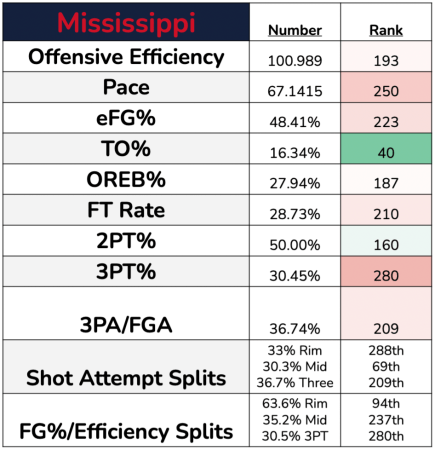
Of Tennessee’s 18 remaining games, this is one of only six without the little (A) or (B) next to it. Ken has Tennessee favored by 15 here; they were favored by 16 against ETSU. That’s the level of opponent you’re drawing. Ole Miss beat Memphis, sure, but that looks less rosy by the day; Ole Miss lost by 23 to 106th-ranked Western Kentucky on a neutral in Atlanta and gave up a 25-4 run in a home loss to a Samford team that just lost by 32 to Furman. Your main goal: do nothing embarrassing.

Mississippi’s offense

The graphic above spells it out fairly well, but it’s worth hammering in some of the details. 280th in 3PT%. 223rd in eFG%. Below the national average in OREB%, FT Rate, and FT%. The only thing they really do well is not turn the ball over, but you could argue that missing shot after shot without much threat of a second-chance opportunity is as good as a turnover. Ole Miss hasn’t made more than 31% of its threes in a game since November 18. Adjusted for opponent strength, Bart Torvik credits Ole Miss with going sub-1 PPP in seven consecutive games. It’s made even worse by just how atrocious their shot selection is.

We’ll get to that. First, it is useful knowing that OM does offer one guy (and a potential second) that is generally able to get his points. Jarkel Joiner (14.8 PPG) is a senior combo guard who’s had to play out of position for much of the season as the main ball-handler. By no means is Joiner bad at that; he has one of the lowest TO% (8.2%) for a moderate-usage player in America and he uses those ball-screens to spring himself free for a wide variety of jumpers. Joiner takes almost as many mid-range twos (50) as he does threes (62), so you’ve got to pick and choose which one you’re more comfortable with. Me: the twos. He’s hitting 42% (0.84 points per shot) on those versus 35.5% (1.065 points per shot) on threes; let him take the 18-footer and move on.

Joiner is a pretty good player who is very clearly the best option Ole Miss has offensively. The second-best is a guy who’s played four games: miniscule (5’9″) freshman Daeshun Ruffin, who’s scored 52 points in the four games he’s played. The Ruffin thing is interesting because he’s the only other guy who’s averaged double-digit points in any fashion while also using the OM ball-screens in a much more intriguing way. Ruffin’s just as likely to reject the pick and barrel his way to the rim as he is to actually use it. Ruffin is a much more natural point guard, and Kermit seems to see this; he ran him for 25 minutes against Samford after not letting him top 16 in any other game.

Beyond Joiner and maybe Ruffin, there is no Ole Miss player that can consistently create their own shot. Tye Fagan and Austin Crowley can do it, but the consistency factor is simply not there. Fagan is a bad shooter (28.4% on 88 career threes) who can score at the rim but do little else; Crowley is a bad-and-streaky shooter (29.2% on 96 career threes, but 6-7 in the first two games this season) who can’t score much of anywhere. Ole Miss can score at the rim, but Ruffin is the only guard on the team that reliably creates the space necessary for the offense to operate. Even then, they spend an alarming amount of time taking awful mid-range twos that make no one happy. Even 7-footer Nysier Brooks, who may be the third-best offensive player, isn’t even cracking 9 PPG because he attempts barely 5.8 shots per game. He has a mildly-intriguing jumper, but rarely uses it.

At least when Tennessee took a billion mid-range jumpers last year, the vast majority were within 15 feet of the basket. Ole Miss laughs at this and has taken a truly remarkable 82 shots from 17 feet to the 3-point line this season. 2020-21 Tennessee: 69 for the entire season. Shameful, this.

CHART! When a Mississippi player makes a shot, refer to this to understand if you should be upset. “Yes” means “is efficient at doing so”; “somewhat” means “does so, but not efficiently”; “no” means you can be very mad. SPECIAL NOTE: I’ve included free throw percentages here upon request. The numbers used are a player’s career FT%, not 2021-22.

Mississippi’s defense

As usual, here is the far more interesting and watchable side of Kermit Davis basketball. Ole Miss is once again running that weird, unlike-anyone-else-in-the-conference hybrid of a man-to-man defense mashed up with a 1-3-1 zone that morphs into one or the other mid-possession. Considering that this is the least-talented Kermit-era Ole Miss roster on paper, it’s still a little impressive in some aspect that KenPom rates this out as a borderline top-50 unit. (Last year’s ranked 25th.) The scout is still basically the same: hit a good amount of the myriad of open threes you receive and you’ll win; toss up a 7-for-29 outing and you’re going home sad.

The difference between 2021-22 Ole Miss and 2020-21, which was a lot better on defense, is pretty easy to sum up:

  • 2020-21 Ole Miss: 31.8% of all opponent shots at the rim, 58.2% FG% allowed (158th nationally)
  • 2021-22 Ole Miss: 36.6% of all opponent shots at the rim, 62.8% FG% allowed (301st nationally)

Can we spot the difference? Ah, I think I’ve found it:

  • 2020-21 Ole Miss: had Romello White
  • 2021-22 Ole Miss: does not have Romello White

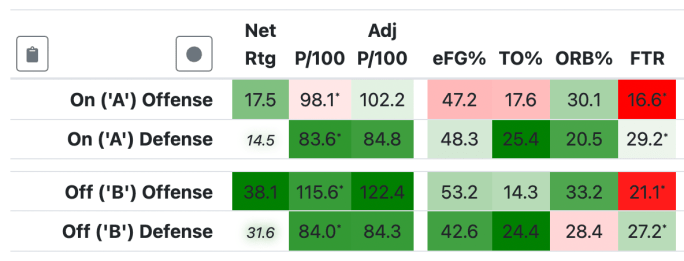
That’s somewhat reductive, but it gets the point across. With White on the court last year, per Hoop-Explorer.com, Ole Miss played at the level of the 10th-best defense in America (AKA, Arkansas). Without White: 50th-best. You may remember such dire times as Tennessee managing an 8-for-26 hit rate on twos against White and company in one of the dumbest, worst games ever played. The good news, if you’re a Tennessee supporter, is that White is gone. Replacement Nysier Brooks is taller, but not as effective at blocking shots and less good at foul avoidance. The zone itself is effective as keeping the ball out of the paint, but there’s no individual standout defender (Luis Rodriguez comes closest). As such, they’ve had some serious issues containing ball-screen actions, ranking in the 26th-percentile in P&R defense nationally.

With the rim issues have come a reduction in how many mid-range twos they’ve forced. Again, recall Tennessee only getting six shots at the rim last season out of 49 total; this year, only Mississippi Valley State, the literal worst team in college basketball, has managed fewer than 17. The length of Nysier Brooks is occasionally enough to force a runner/floater:

But it’s still not enough to make up for the shift in shot selection. Right now, among the 14 SEC teams, Ole Miss is actually forcing the second-lowest amount of jumpers per 100 half-court possessions. (Only Florida has forced less.) The amount of runners/floaters they’ve forced are tied for the best in the conference, but again, how much of a difference does it make when your opponent’s shot quality is objectively better this year versus last? Also, all of this is against a 12-game offensive slate that KenPom ranks as the 330th-toughest in America, meaning Ole Miss has basically played a SWAC schedule and managed to allow that hit rate. Imagine what’ll happen when they play Alabama or Kentucky.

As stated up top, the Ole Miss goal is going to be to make you shoot over the top of them. Their zone/man hybrid has produced a hilarious reverse split where opponents are hitting 37% of guarded threes, but 28% of wide-open ones. They’re below-average at forcing guarded threes, but they’ve been lucky the 3PT% allowed isn’t worse. The trend has been fairly obvious: in the nine games Ole Miss has held opponents below 1 PPP, only one opponent has shot better than 33.3% from deep (Mississippi Valley State, of all teams); in the three they haven’t, all three have shot 37% or better.

The bet you’re placing here is that allowing this type of shot to constantly be open isn’t sustainable.

Considering opponents have shot about 2.3% worse than expected given their shot quality, I don’t think that’ll hold.

The last thing to watch for: turnovers. Ole Miss forces them in bunches, and one of their best qualities as a team is their ability to have active hands on the perimeter. Don’t let them get hot, so they say.

Avoid turnovers, take the open threes, hammer the rim.

How Tennessee matches up

The good news: Tennessee supposedly should have their full roster available for this one, which certainly beats having two of your three best players unavailable when playing #19. Anyway, one of the main issues with Tennessee’s battle against Ole Miss last year, other than the obvious, was that no guard, wing, or forward appeared confident whatsoever in their ability to get to the rim. Fast forward precisely one year, and Tennessee now has two guards (Chandler/Zeigler) and three frontcourt players (Fulkerson/Nkamhoua/Huntley-Hatfield) who appear pretty darn confident that they can bully-ball you. If Justin Powell (19.3% of all attempts at the rim) or Santiago Vescovi (20%) can push just a little more, we’ll include them, too.

The easiest way to get points down low against Ole Miss has been…well, quite simple: cuts to the basket. I feel like I mention this in every preview, but basket cuts have been the most efficient play type in college basketball for a full decade now. Tennessee’s been very good at making them a big part of their offense. Tennessee’s guards can push the issue with driving to the paint, but it’s on the frontcourt to likely finish through contact. I’d like to see more than, you know, one made basket at the rim this time around.

Likewise, Tennessee is going to get some interesting experience in dealing with this weird zone. As outlined in the defensive section, I’m not sure I would call it terribly successful at forcing tough threes, and it doesn’t even force that many jumpers in the first place. Still, Tennessee takes an above-average amount of jumpers in the first place, and you want these to be three-point jumpers and not ones from 17 feet. The best way to crack this style of zone/man hybrid is to go inside-out and work your way to open threes on the wing and in the corner. This one’s at the top of the key, but you get the point; keep Ole Miss on their toes.

Defensively, you basically have to funnel Jarkel Joiner into the mid-range attempts he loves so much. Even a night where Joiner hits 50% of those is still better than him hitting 40% of his threes. There is no true go-to guy on this Ole Miss roster; Daeshun Ruffin could reasonably be that but is a 5’9″ freshman who has played four games. Force Joiner into these mid-range pull-ups off the dribble; he is skilled at hitting them, but it’s better than the alternative of giving up a shot at the rim or from deep.

The Ruffin thing is fascinating because he’s drawing fouls like crazy and is better at getting to the rim than anyone else on the Ole Miss roster, yet he’s made one three in four games (worth noting he was a 37% three-point shooter in Nike EYBL in 2019, though). He also has yet to face a frontcourt as stout as Tennessee’s at defending the rim. This is the exact type of game where walling off the paint is the first and second goal and you can give up the jump shots happily, because with 12 games of data to use, Ole Miss appears to be a terrible jump-shooting team.

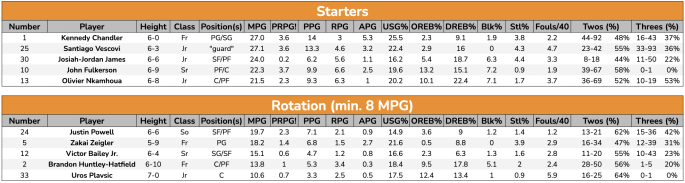
Starters + rotations

Metric explanations: MPG is minutes per game. PPG/RPG/APG/Fouls/Twos/Threes are what you’d guess. USG% is the percentage of possessions a player uses on the court. OREB%/DREB% are your available rebounds usurped. Finally, PRPG! is Bart Torvik’s Points Over Replacement metric; the higher the better. If you’re on mobile, zoom in; if on desktop, right click -> Open Image in New Tab.

Three things to watch for

  • How early and often does Tennessee attack the rim? Mississippi has allowed a 62.8% hit rate at the rim this season, despite playing what KenPom judges as one of the worst non-conference slates in America. I genuinely believe Tennessee should convert no worse than, like, 65% of theirs in this game.
  • Can Tennessee win the boards somewhat handily? It’s not this predictive for everyone, but Ole Miss in four games where they’ve failed to crack a 23% OREB%: 0.724 PPP, 1.123 (against #302 New Orleans), 0.742, 0.877 (against #201 MTSU). You already know that the nights OM is actually on are pretty rare, so don’t give them more shots than they deserve.
  • Can Ole Miss reach a combined number of made threes + forced turnovers that’s…I don’t know, 27 or higher? I mean I can’t think of a serious path to victory for Ole Miss that doesn’t involve “out-of-nowhere three-point explosion” or “Tennessee turtles offensively the entire game.”

Key matchups

Jarkel Joiner vs. Santiago Vescovi. Well, when he’s the only guy who’s played five or more games that averages 10+ PPG, he has to be a key matchup. Joiner is the best shooter on the team, both off-the-dribble and catch-and-shoot; Vescovi and company can’t let him shake free. I’d like to see Tennessee force five or more Joiner mid-range jumpers.

Daeshun Ruffin vs. Kennedy Chandler. Ruffin has yet to start a game, but he looks like easily the best option Ole Miss has at point. Ruffin is a foul-drawing terror but hasn’t really played anyone with serious frontcourt length and stamina yet; he also has not played anyone nearly as good as Chandler. Good news is that Ruffin grades out as a just-okay defender.

Nysier Brooks vs. John Fulkerson. Brooks commits 4.5 fouls per 40 and is facing one of the SEC’s GOATs in foul-drawing. Do your thing.

Three predictions

  1. Tennessee converts 15 or more shots within four feet of the rim;
  2. Tennessee ties a KenPom-era (2001-02 to present) program record by holding its 10th-consecutive opponent below 1 PPP;
  3. Tennessee 73, Mississippi 56.

Revisiting Tennessee’s remaining schedule, from an NCAA Tournament resume perspective

Look: it is January 2 as I type this. I have not much to do at this point in time. I am watching my beloved, stupid Detroit Lions blissfully keep pace for the #1 overall pick. I am sitting through the longest break in Tennessee basketball’s schedule that they’ll have all season. So, naturally, this leads to me checking in on Twitter and seeing a truly terrific tweet from an online buddy:

Content! Content! Thank you for the content.

This is merely a quasi-symptom of what I’ve thought about doing for a few days: providing everyone an update of what Tennessee’s schedule is likely going to look like the rest of the season. I did this in the preseason for the season preview, but it’s been two months, so an update seems useful. Tennessee has 18 games left; 17 of those are SEC opponents, one of those is Texas in the Big 12/SEC Challenge. My guess is that people would like to know how Tennessee measures up here in all likelihood.

I’ve decided to measure this in a two-step method:

  1. First, I’m just using the projected Quadrant 1/2/etc. games as given by Bart Torvik’s website. Torvik actually does projected NET ratings using the available formula, which is really cool. We’ll also use his rankings, which are slightly different from Ken Pomeroy’s but use the same general idea.
  2. Also, I’m using hoop-explorer.com’s Build Your Own Top 25. I’ve weighted it as such: efficiency matters more than W-L, but only by a hair; there’s a mild bonus given to more dominant teams; there’s also a slight boost by weighting the last 30 days 10% more than the resume as a whole. These ratings, to my understanding, use KenPom as a source.

What this is going to do: provide you with two ratings. The first rating is their current rating on Bart Torvik’s website; the second is the BYOT25 rating. How useful is this? No clue, but it beats doing nothing.

The breakdown here is going to follow the NCAA Teamsheet format of Quadrants 1, 2, 3, and 4. Explanation(s) below. All numbers are NET rankings, which we obviously do not have but will be replaced with the Bart Torvik/KenPom/Haslametrics combined numbers for breakdown purposes.

  • Quadrant 1: Home 1-30; Neutral 1-50; Away 1-75.
  • Quadrant 2: Home 31-75; Neutral 51-100; Away 76-135.
  • Quadrant 3: Home 76-160; Neutral 101-200; Away 136-240.
  • Quadrant 4: Home 161-plus; Neutral 201-plus; Away 241-plus.

I’ll list out any differences between the two methods as they exist. Right now, Tennessee ranks #13 on Torvik, #12 on KenPom, and #16 in the BYOT25 thing because the non-conference schedule did…not exactly come together as planned. (Recall that Colorado and Memphis were preseason Quadrant 1 games.) Onward.

Quadrant 1

Previously, this also included Quadrant 1-A, but there’s no difference this time out, so…yeah.

Scheduled games:

  • January 8 at LSU (#12/#13)
  • January 15 at Kentucky (#16/#17)
  • January 22 vs. LSU (#12/#13)
  • January 29 at Texas (#7/#19)
  • February 9 at Mississippi State (#35/#44)
  • February 15 vs. Kentucky (#16/#17)
  • February 19 at Arkansas (#67/#57)
  • February 26 vs. Auburn (#8/#5)

Expected wins: 4.1 out of 8 (Torvik); 4.2 (KenPom)

I guess if you like stability, it’s worth knowing that seven of these eight are the same as they were two months ago. The only new game is home LSU on January 22, a suddenly-pivotal affair for SEC title race purposes. Tennessee projects as an underdog in three of seven, all on the road (LSU, Kentucky, Texas). Regardless of what numbers you’re using, these seven games represent the toughest, most ruthless chunk of Tennessee’s remaining schedule. The most likely outcome for each is a close, tight affair that you’re rooting for the coin flip to land in your favor.

As of now, Tennessee is 2-3 against Quadrant 1 opponents, and if they can find a way to somehow get over .500 across 13 total games (7-6, or 5-3 here), that would be quite a big win. Torvik’s numbers currently project just nine teams in all of college basketball to finish above .500 (min. 10 games) against Quadrant 1 competition. Even six Quadrant 1 wins would be pretty useful, because only 15 other teams are projected to get that many. (In the last full season of 2019-20, 18 teams did this.)

A top ten team would be expected to go either 4-4 or 5-3 against this eight-game slate; it would behoove Tennessee to get to one of the two.

Odds of various records:

  • 0-8: 0.3%
  • 1-7: 2.5%
  • 2-6: 9.3%
  • 3-5: 20.2% (5-8 overall)
  • 4-4: 27.2% (6-7 overall)
  • 5-3: 23.5% (7-6 overall)
  • 6-2: 12.5%
  • 7-1: 3.9%
  • 8-0: 0.5%

Quadrant 2

Scheduled games:

  • January 18 at Vanderbilt (#84/#89)
  • January 26 vs. Florida (#25/#38)
  • February 1 vs. Texas A&M (#81/#56)
  • February 5 at South Carolina (#121/#82)
  • March 5 vs. Arkansas (#67/#57)

Expected wins: 4.01 out of 5 (Torvik); 3.92 (KenPom)

Tennessee will be favored to win all five of these, and in the case of a couple of them (Texas A&M and South Carolina), they’re likely going to be favored by double-digits. Yet none of these five are super-sure things. They’d only be a five-point favorite at Vanderbilt right now, for example. Colorado is a Quadrant 2 game now, and remember how wobbly that felt going in. Even home Arkansas isn’t a cinch.

It’s once again worth noting the rarity of going undefeated against the second Quadrant. As of now, only one team with a minimum of four games against Q2 is projected to go undefeated (Houston). Last year, that number was also one (Baylor); in 2019-20, it was six; in 2018-19, 11. The trend is decidedly not moving in the right direction, which probably makes sense with 2021-22 possessing the highest amount of returning roster talent in the sport’s history. It will be pretty tough to go 5-0 against this group; let’s just hope that if there is a loss, it’s an understandable one.

Odds of various records:

  • 0-5: 0.03%
  • 1-4: 0.6%
  • 2-3: 5%
  • 3-2: 20.2%
  • 4-1: 41%
  • 5-0: 33.2%

Quadrant 3

Scheduled games:

  • January 5 vs. Ole Miss (#112/#112)
  • January 11 vs. South Carolina (#121/#82)
  • February 12 vs. Vanderbilt (#84/#89)
  • February 22 at Missouri (#252/#147)
  • March 1 at Georgia (#217/#239)

Expected wins: 4.57 out of 5 (Torvik); 4.5 (KenPom)

Well, all five of these teams stink in various fashion. All five have terrible losses; all five would be terrible losses if they happened. Tennessee will be double-digit favorites in all of these. As a reminder, the top 22 teams in NET in 2019-20 combined to go 135-2 against Quadrant 3 competition, which is probably a small overachievement but still gives you an idea of how bad it would feel to lose any of these games. Missouri and Georgia are actually Quadrant 4 as of now, but Torvik forecasts them to barely scrape above 240 in NET by year’s end; the less Quad 4 games you play, the better. It seems like it would be hard for either to fall below 240 simply by virtue of playing in an agreed-upon top-four conference.

The most likely outcome here is Tennessee going 5-0, and it better be. Any of these losses would be so singularly embarrassing that it would have the power to cancel out a win over, like, Kentucky. You would beat Kentucky at Rupp and still be thinking about losing to Ole Miss. Don’t do it.

Odds of various records:

  • 0-5: well, imagine a bunch of zeroes followed by a one
  • 1-4: 0.03%
  • 2-3: 0.6%
  • 3-2: 6.3%
  • 4-1: 31.3%
  • 5-0: 61.7%

So: let’s talk most likely overall records, then. Right now, Tennessee sits at 9-3, 0-1 in the SEC. Bart Torvik’s numbers project a 12-6 finish in the SEC for Tennessee, which would put them in a four-way tie for second. KenPom: 12-6, tied for third with Alabama. (They would lose this tiebreaker and be the 4 seed, which still gives you a double-bye.) ESPN’s BPI: 13-5, three-way tie for first with Kentucky and Auburn.

If you’re looking for probabilities, Bart Torvik’s numbers give Tennessee an 85.4% chance of finishing somewhere between 10-8 and 14-4 in the SEC. My opinion here is that, if you’re looking for a regular season title, it’s going to take a minimum of 14 conference wins to at least get a share of the championship. In every metric system I use, at least one team is projected for 14 right now; maybe you get some late-season luck (2017-18, as an example) and it ends up being 13. But: 14 wins is probably the goal.

The only way Tennessee can realistically get to 14 or better is by playing like a top ten team the rest of the season with essentially no serious interruptions. If they go 4-3 in their remaining games against SEC Quadrant 1 competition (losing to Texas in this scenario), they’d have to go perfect against Quadrants 2 and 3. Is that possible? Certainly; it happens in a hair under 21% of all scenarios. But that’s not probable. It merely means it can happen. Tennessee’s gotta be really, really good to make that happen. If they do indeed play like one of the ten best teams in existence, that 21% figure rises to a little under 26%.

Even so, Tennessee will find it pretty hard to find more than 13 SEC wins this year. That’s fine; it’s what I had penned in the preseason. 13-5 in an SEC with five Top 20 teams and an expectation of 7-8 NCAA Tournament teams is a very good record and would likely be enough to lock Tennessee in as no worse than a 3 seed in the NCAAs entering SEC Tournament weekend. (It also probably locks Tennessee in as no worse than a 3 seed in the SEC Tournament, for the record.)

So: that’s the situation Tennessee is in. If Auburn can find a way to be less than expected…if Kentucky keeps having hiccup games…if Alabama can simply have enough off-nights…even if LSU simply isn’t the best defense in America, Tennessee stands to benefit from it. 12 games worth of data with all preseason baselines removed have Tennessee slotted as the 12th-best team in America, per Torvik. Even including preseason, they’re 12th on KenPom. Nearly every metrics system in existence has Tennessee as somewhere between the 8th and 15th-best team in America. I promise you there’s worse positions to be in.

Obligatory Post About How Losing Shorthanded to Alabama is Okay But It Raises the Exact Same Questions Yet Again

This is the seventh in a series of weekly recaps surrounding the 2021-22 Tennessee men’s basketball season.

December 29: #19 Alabama 73, #14 Tennessee 68 (9-3, 0-1 SEC)

Ah, this is how I know it’s basketball season. Not the first loss; not the second; not even the big wins. Not the upsets. Not the amazing buzzer-beaters that make up year-end YouTube videos. Nope: it’s the close, crushing loss when your team is shorthanded that somehow finds the only way imaginable to leave you annoyed and angry.

The staring into the middle distance, the “why didn’t Rick Barnes do this? Why did he do that?” feeling, the wondering why you stayed up until 11:20 PM when you have a 6:45 AM alarm. It’s all back, baby! College basketball! Didn’t you miss it? Didn’t it give you the life you thought you were missing? Or am I simply late to the party on realizing that, in some way, I also have developed Football Mindset?


Objectively speaking, losing by five points to the #19 team on the road when you’re down two of the team’s three best players is not a bad result. Even though neither site adjusts for absences, even the metrics sites are fairly impressed by Tennessee’s efforts; Bart Torvik’s Game Score metric gave Tennessee an 88, which is a good result even before you consider Tennessee led for 28 of a possible 40 minutes. For large portions of this affair, Tennessee controlled the flow of the game, dominated defensively, and forced Alabama into difficult threes that sort of exposed the Alabama Problem: if you stop the flow of points in the paint, you slow down the offense as a whole.

All of that is good and fine. Tennessee held its ninth-straight opponent under one point per possession, which is a streak that’s now a game short of the KenPom-era program record of 10 consecutive sub-1 PPP games (2013-14). They won the turnover battle again. They got to the free throw line a lot. In the absence of Kennedy Chandler and John Fulkerson, Santiago Vescovi and Olivier Nkamhoua stepped up and played very good, very useful games. (Honorable mention to Zakai Zeigler, who wasn’t great on offense but held up much better than I would’ve anticipated on D.)

Again, objectively speaking, Tennessee put up a really good effort against what I anticipate is one of the 20 or so best teams in America in Alabama. Tennessee had multiple chances in the final minute of this game to tie or take the lead and simply didn’t come through; you can imagine that a full-strength Tennessee gets better shots throughout the game and potentially comes home with a surprise road W. We’ll never know, because I guess COVID will never end.

The problem is that it’s hard to be objective when the game unfolds in two particular ways:

  1. Tennessee leads by six points with four minutes to go;
  2. Tennessee spends the vast majority of the final 20% of this game with Victor Bailey, Jr. on the court instead of Justin Powell.

The first point here is a catch-22. At the start of the game, I would have adored any scenario that ended in “Tennessee leads by six points with four minutes to go” because that felt pretty unlikely even with a full-strength roster. Tennessee was certainly aided by what was an outlier of a poor shooting night from Alabama, sure, but they were winning the shot volume battle and seemed to win many of the 50/50 plays. You could easily talk yourself into the ‘toughness’ cliche.

The second is the one that’s going to be talked about the rest of the season. The first image here is Victor Bailey’s 2021-22 On/Off numbers:

The second is Justin Powell’s.

For reasons that I cannot entirely parse, Bailey was the player who got the majority of the run down the stretch of this game as Tennessee’s offense seized up and Powell sat on the bench, quietly watching. To the credit of local media, Rick Barnes was asked to rationalize his choice. I can’t say I’m pleased by the answer.

Justin Powell is not a good on-ball defender. I have half a season of Auburn data and half a season of Tennessee data to say that’s almost certainly the truth. The defense is inarguably worse with him on the court; even though I do not think much of this is Victor Bailey’s doing, the defense is basically break-even with Bailey out there. Whatever, fine, you get your little nitpick win.

But when it comes to the actual effect on the team on the court, Justin Powell is, by any objective measure, the superior option to Victor Bailey. Want to use Net Rating? The team is 15 points better with him on the court over 100 possessions than it is with Bailey. Want to talk offense? The offense is 21 points better with Powell. Three-point shooting? Powell 42% (43% for his career), Bailey 23% (35% career). Individual defensive impact? Bailey and Powell are almost the exact same: a 2.9% Stock% (steals + blocks) for Bailey, 2.6% for Powell. Player that literally just played 26 minutes against the #8 team in America in a win? Justin Powell.

I think this is what sticks. Tennessee played better than I anticipated. They held down Alabama’s offense more than almost any other team has. They forced some surprising guys (Jahvon Quinerly being the main example) into foul trouble. They led for almost three quarters of the game. But you’re sitting there with a 63-57 lead, four or five minutes on the clock, and somehow it never seems to cross anyone’s mind that the lone available guy on the roster who can hit a dagger three to actually bring home the win isn’t on the court.

(Sidebar: I think I’ve had my fill of Tweeting negative things about individual players online. I cannot imagine Victor Bailey, Jr. feels very good today; there is literally zero reason whatsoever for me or anyone else to pile on relentlessly. I say something about Bailey (or Plavsic) (or JJJ) (or anyone at this point) and the replies are a mess of pure garbage. No más. I should’ve remembered the golden rule: Never Tweet.)

So here we are: Tennessee blows a winnable game in a situation where I’m objectively supposed to feel okay but subjectively feel annoyed yet again. Bart Torvik tracks the average lead of every game in America; per his website, this is the 18th time in the Rick Barnes tenure Tennessee has lost a game they led the majority of, with ten of those coming since the start of 2018. Bruce Pearl, the guy everyone will not let go of, has done that just three times in the last four seasons. Every single season, somewhere between two and four times, Tennessee will lose a game that most agree they really should’ve won.

On the flip side, Tennessee has won fourteen games since 2015-16 where they’ve trailed the majority of the way. (Perhaps you remember the 2020 win at Rupp Arena before the world ended.) When that happens a couple of times this year, it will feel nice. Until Tennessee figures out a way to stop losing these winnable games, these affairs will continue to feel uniquely unsatisfying even when they shouldn’t.

I feel like I’m repeating myself but this is a loss that really doesn’t mean all that much because it is one game in a 35ish-game season and Tennessee literally just beat a top ten team at home. I wrote a whole thing about how Tennessee should be pleased to get out of December with just two losses in the month; they did exactly that. Both losses were close, coin-flip things. They did exactly what the average top 10-15 team should have done. Yet, somehow, like always, I find myself frustrated and wondering why X decision didn’t happen or why Z decision did.

In retrospect, I should have remembered one of my favorite images:

Whatever happens, happens. I can’t control it, therefore it is what it is. On to the next one.

Show Me My Opponent, 2021-22: Alabama

GAME INFORMATION
OPPONENT #19 Alabama (9-3)
(26-7, Sweet 16 in 2020-21)
LOCATION Coleman Coliseum
Tuscaloosa Torture House, AL
TIME 9 PM ET
CHANNEL ESPN2
ANNOUNCERS Karl Ravech (PBP)
Jimmy Dykes (analyst)
SPREAD Sinners: Alabama -2.5
KenPom: Alabama -2

Torvik: Alabama -3.4

On the surface, Tennessee is drawing an Alabama team heading in the opposite direction as itself. Alabama pulled off two of the best wins anyone has had this season by beating Gonzaga and Houston, then proceeded to get blown off the court by a Memphis team no one thinks is great, almost lost to Jacksonville State at home, then did lose to Davidson at home. Tennessee, meanwhile, led a top 10 Arizona team wire-to-wire and is literally an Act of God away from going undefeated over the last month of basketball.

And yet: this is a road game at a top 20 KenPom team that has beaten Gonzaga and Houston and is coached by possibly the brightest young star in college basketball, all while Tennessee has had COVID rumors swirling around it for the last 24-36 hours. Pardon me if I am alarmist.


Continue reading “Show Me My Opponent, 2021-22: Alabama”

Heartwarming: Geriatric Kingsport Man Listens to Death Metal For First Time

This is the sixth in a weekly-ish series of two-game recaps of the 2021-22 Tennessee men’s basketball season.

You spend your entire semi-professional writing career online and you’re gonna make some mistakes. One of them was saying Tennessee needed to deploy a bunch of ball-screens against Arizona, which they did, and then they proceeded to score all of 5 points on 18 ball-screen possessions, per Synergy. Another is seemingly any time I have tweeted about poor Uros Plavsic. The latest is thinking that we were probably all-the-way done on ever seeing something like this again.

I know that Twitch bans streamers for saying a word referring to white people now, so use your imagination, but look at this doofus. Almost no one that looks like this is going to be a quality college basketball player. It does not matter that he is a tall, goofy white guy; it matters that on every play, John Fulkerson looks like he is forcing all of his power and strength into the next dribble. Has there ever been a normal photo of Fulkerson playing basketball? I have done approximately three minutes of research and the initial answer is “no, don’t think so.” I mean look.

John Fulkerson has never appeared in a normal basketball picture because John Fulkerson is not a normal basketball player. He never has been. What else do you say of a sixth-year super-senior, a player who had twice as many offers from Big South conference members (4) as he did Big Six offers (2)? How else do you describe a player who willingly fades into the background to share the spotlight with the younger, higher-potential members of Tennessee’s roster, yet seems to know exactly when it’s his turn to come to the forefront?

Part of it is that, after six years, you sort of come to believe that he will somehow return for a seventh season, then an eighth. You think you’ll always see the slow post-ups, the shot fakes, the fadeaway shooting method that sees Fulkerson release the ball at an angle that would make every YouTube shooting coach cringe. You think he’ll continue to be there on the nights where you wonder “why is John Fulkerson still so important to this?” And then you see all the little things he does, the little quirks that open up Tennessee’s offense or provide as a shut-off valve defensively.

On March 5, John Fulkerson will take the court for the final time as a Volunteer at Thompson-Boling Arena. I do not feel it is hyperbole to say that, alongside Admiral Schofield’s Senior Day, it will be the saddest, most bittersweet moment a significant segment of the fan base has experienced since Chris Lofton’s final three at home. I know this because every time I attend a game, I look at all the little children who have procured the #10 jerseys. The young ones that are somehow allowed to wear shirts that say Fulk Yeah. (Do you use that language around your mother?!?) The crowd that, every time Fulkerson’s name is announced, explodes in a roar significantly louder for Fulkerson than for any other starter.

For this weirdo sixth-year senior to still be here and still finding baffling ways to draw 13 fouls from one of the best defensive teams Tennessee will play all season is just…I mean, it is. It is, and there is no more making sense of it. Fulkerson is Fulkerson; if he does this again, consider it icing on the cake.


The other thing is that Tennessee held Arizona to 21 points in the first half, their worst output of the entire season, because the defense is an absolute wrecking ball and oh Tony Basilio if you think I didn’t hear your segment about how the defense wasn’t good I’m right here buddy.

What you’re seeing there is Oumar Ballo, a player who had blocked 13 shots and had zero of his blocked entering last night, get his stuff stuffed by Olivier Nkamhoua. It seems obvious that Nkamhoua is always going to draw complaints from Tennessee fans; I guess I get it. The guy still is not a terrific offensive player, and the hopeful comparisons of Grant Williams seem pretty far away. But: as discussed in the episode about bias, Nkamhoua has improved immensely year-over-year. He’s always been a good defender, but we’re looking at a guy who somehow quietly ranks 5th in the SEC in Block Percentage when he’s on the court.

That little graphic above is from last night. The ON is Olivier Nkamhoua. When Nkamhoua was on the floor for 35 defensive possessions for Tennessee, Arizona scored just 26 points. They made just 38.9% of twos with him out there. We’re 11 games into Nkamhoua’s third year. I don’t think he’ll ever be Grant Williams. He may not even be Kyle Alexander. But he could be a silent ringleader of the Death Metal Defense.

I think when you hold the nation’s #1 scoring offense 18 points below its average and become just the second team all season to not only hold them below 1.1 PPP, but 1 PPP, you’re precisely as good defensively as everyone is hoping for. The difference between the Yves Pons defenses and the post-Pons era is one where Tennessee somehow is even better at forcing bad shots and is replacing the supreme shot-blocker with a trio of wrecking balls. Fulkerson, Nkamhoua, and Josiah-Jordan James all rank within the top 100 nationally in Block Percentage; no other team has three players in the top 100. They are as violent as your typical metal album pretends it is.

To be fair to the metalheads, death metal (and black metal, the only sub-genre I can somewhat stand) is not really about death. I do not come away with the impression they’re serious about it. It’s mostly about face paint.

All of these guys, as serious as they appear to be on the outside, are playing music as an excuse to paint themselves. Seemingly 80% of all bands are in it for the paint; try a Google search on this one. And hey: I applaud it. It’s bizarre. It’s funny. It’s creative. It looks very sweaty and very uncomfortable, and it does not make any sense to me that it works the way it does, but it works, and I find that wonderful.

In some weird fashion, this is how I think of the Tennessee defense. In the preseason preview I wrote a whole thing about how I was kind of concerned we’d see an equal stepback on defense as we saw a step forward offensively. That clearly hasn’t been the case. Tennessee shot kind of terribly for a big stretch of last night’s game; the free throws really did push them over the top. But there wouldn’t have been that all-too-familiar please bring this home, you young men, I am overly reliant on this win to feel okay feeling without an amazing defensive performance.

“But they gave up 52 in the second half!” Yes, and they gave up 21 in the first half against a team that averages 91 points per game. Arizona only got off six unguarded catch-and-shoot threes out of 27 total three-point attempts in this game, per Synergy. No team had held Arizona below a 32.4% OREB%; Tennessee held them to 29.4%. Only one team had forced Arizona to turn it over on 20% or more of their possessions in the last 10 games; Tennessee hit 22.6%. Tennessee saw a frontcourt averaging 30 points per game and said “we will play these riffs in your face, silly men.” Tubelis and Koloko, who everyone was rightfully afraid of, combined for almost as many fouls (9) as points (10).

I do not know what the rest of the season holds, because I am not an oracle. But I do know that right now, this baffling collection of old and young talent, all of which I did not expect to gel together the way it has on this end of the court, is the best defense I have ever seen at Tennessee. They have held eight consecutive opponents (four of them Top 100 teams) below 1 PPP; only the 2013-14 Vols can say they’ve topped that at 10, and those Vols did not start the season completely shutting down all competition like these Vols have.

They are imperfect. They are flawed. They are a college basketball team. They are also a truly fun group of misfits, young men, Google Image Search heroes, and, because of course they are, anime nerds. Let’s see where the rest of this goes. For now, Christmas: surely every metalhead’s favorite holiday.