Blog

Show Me Future Opponents: Kentucky vs. Richmond/Kansas

Hi! This is, hopefully, the final installment for a little while in this short series titled Show Me Future Opponents. Beginning next week, with any luck, I’ll be back to the traditional schedule of previewing Tennessee basketball games. Until then, please enjoy this piece on Kentucky basketball and its successes/failures.

In the preseason, I felt of two minds about Kentucky’s #10 AP Poll ranking, two spots higher than Tennessee’s. On one hand, every post-2015 Kentucky team has started somewhat poorly, but by March, they’ve rounded into the form of roughly an Elite Eight-level team. Consider the following, as run on Bart Torvik’s fantastic site:

  • 2015-16: #25 overall in games played from Nov. 1 to Dec. 31; #3 in games played from Jan. 1 to end of season
  • 2016-17: #3; #8
  • 2017-18: #29; #21
  • 2018-19: #25; #6
  • 2019-20: #42; #26

In four of the last five seasons, they’ve gotten noticeably better once conference play has started; the only outlier was the 2016-17 squad that was consistently excellent pretty much the whole way through. (Also a reminder that every 2019-20 SEC team was worse than you remember.) It stands to reason that a team that barely returned 7% of its minutes from 2019-20 won’t be very good to start the season, yes?

However, I’d like to posit the other hand of my argument: has Kentucky’s recent second-half play actually been enough to make up for their first-half issues? Look at those numbers over the last five years and you’ll see Kentucky failing to elevate their play in time for March in both 2017-18 and 2019-20. In four of those five years, they were barely, if at all, a top 25-level team entering conference play. Shouldn’t Kentucky automatically be given, like, the 19th spot in the preseason Top 25 until they show they can figure it out for a full season?

When Kentucky had the ball

Anyway, that’s a long way of saying I wasn’t terribly surprised this Kentucky roster lost to Richmond or Kansas, though it was kind of surprising they lost to both. A Richmond team that returned 80% of its minutes from a year ago was going to be much more prepared for a November battle; same goes for Kansas, even if they returned just under half of their minutes. What shouldn’t be excusable about Kentucky’s play thus far, even against two exceptional opponents, is just how bad their shot selection has been.

It’s one thing for Kentucky to be shooting 9-for-47 from three this season, as we’ll cover shortly. (They went 3-for-31 against Richmond and Kansas combined.) However, it would be another thing if Kentucky were simply missing shots you know they can hit while taking good, worthy shots otherwise. They decidedly aren’t doing that. Per Simon Gerszberg’s Shot Quality metric, Kentucky’s offense ranks in the 34th-percentile nationally through three games in terms of offensive shot quality. They’re two spots behind Howard, a team that got demolished by Division II Queens (NC) last week. Things are not good!

Through three games, Kentucky has some truly alarming shooting splits, in terms of where their shots are being taken. An astounding 39.1% of Kentucky’s field goal attempts thus far are non-rim twos, which, as we’ve discussed frequently, offers the lowest return on investment in college basketball. Players do have the capacity to hit these shots, obviously, and Kentucky is making about 41% of their non-rim twos thus far. Brandon Boston, Jr., Olivier Sarr, and Terrence Clarke have all flashed a propensity and a desire to get to 14 feet.

However, you’ve also got to get some amount of good shots to go with your bad ones that you’re currently making. Kentucky…is not doing that. Frequently throughout both of these games, the Wildcats appeared terribly disinterested in moving off the ball, running off-ball screens to get a shooter loose, or performing any relatively basic offensive task in general. Here’s a possession where three of five players don’t move a pixel after the ball crosses half-court:

Here’s a possession where Kentucky clears out with 16 seconds left on the shot clock for Brandon Boston, Jr. to commit a charge (not called) and brick a 14-footer worthy of the Reed’s Ranch Basketball League:

And here’s one where Kentucky’s lineup farts around for 29 seconds with little-to-no-movement, resulting in Terrence Clarke plowing a guy over while tossing the ball into the fourth row.

All of this is awful, and somehow, I’ve barely touched on the fact that Kentucky is shooting 19.1% from three through three games. Of course, that won’t last, and I don’t doubt that John Calipari is telling some version of the truth when he says that guys like Brandon Boston, Jr. (0-for-11) and Terrence Clarke (0-for-8) are clearly better shooters than they appear to be right now. However, I’d also argue that a good chunk of this is on Calipari. Davion Mintz (4-for-10) and Dontaie Allen (2-for-5) are the main shooters mentioned in essentially every Kentucky basketball article. For a team that needs shooting, you’d imagine guys who can hit shots like this would be playing big minutes right now, yes?

Ahhhhhh not really, sorry. Mintz played a combined 32 minutes against Richmond and Kansas despite Kentucky’s net rating being nearly 15 points better per 100 possessions with him in the game. Allen is trickier because he didn’t play a minute against Richmond and only got eight against Kansas, but Kentucky’s offense appeared to have way better spacing with him simply being on the court:

This could be a thing where Allen’s defense is so bad that it doesn’t allow him to play many minutes, but…kinda hard to judge that when he plays eight total minutes across two games, no?

Lastly, I don’t want to be all negative, so we’ll end on Kentucky’s lone positive. The Wildcats are simply dominant on the offensive boards against all competition, which obviously makes sense when four members of the starting lineup are 6’7” or taller. Richmond won by 12 despite giving up 21 offensive boards to these Wildcats, and Kansas allowed 13 of them. In particular, Isaiah Jackson appears to be a fantastic rebounder at 6’10”:

Jackson had seven offensive rebounds against Richmond and already has 12 total in his first four college games. That is, uh, good. It’s about all the positives you can give Kentucky thus far.

Kentucky’s got a ton of offensive problems. Some of them will resolve themselves just fine; obviously, I don’t think Boston and Clarke will go a combined 0-for-19 over every three-game stretch forever. However, when you look at the type of shots the Wildcats are getting, along with how many bad possessions are being used in isolation and fruitless 2006 post-ups, it gets much harder to figure out how this team’s going to perform a miraculous post-New Year turnaround to go from looking like a 10 seed to fulfilling being the preseason #10 team in the country.

When Kentucky’s opponents had the ball

If that section read like 800 words of disgust, this one will read like a polar opposite. Three games in, Kentucky’s defense has looked better than some of even the highest expectations their fans had. None of Morehead State, Richmond, or Kansas cracked a point per possession, and Richmond cracked 50% on two-pointers by just a hair. The only player who has consistently cracked the Kentucky code inside the perimeter was Richmond forward Nathan Cayo, who went 7-for-10 at the rim thanks to some quality designs by the Richmond staff:

Richmond went 18-for-24 at the rim against Kentucky largely because Olivier Sarr couldn’t get any long-term help. Sarr was forced to play 38 minutes, and as the game wore on, he was running out of steam fast:

As upsetting as that Richmond loss probably was, it came with a few positives. Notably, the Spiders shot just 11-for-43 on everything that wasn’t at the rim. When Kentucky was able to keep the Spiders away from the rim – something they weren’t nearly as successful at in the second half – things generally went much better for the Wildcats. Richmond was forced to take a lot of uncomfortable jumpers early in the game, which led to their poor halftime shooting percentage:

While Chris Mooney was right that Richmond wouldn’t shoot as poorly in the second half, most of the gains came at the rim. Against Kansas, Sarr wouldn’t have the same problem of overplay. Instead, he swung hard to the other end of the spectrum, playing just 14 minutes due to constant foul trouble. Without Sarr in the game, Kentucky figured to have rim protection issues…until Isaiah Jackson popped up out of nowhere and started blocking every shot known to man.

Jackson’s presence on the court forced Kansas to endure a 14-for-33 outing at the rim, and unlike the Gonzaga game, they didn’t make up that difference from the mid-range, converting just 1-of-13 non-rim two-pointers. With Jackson’s long arms out there, the odds of getting anything up over him seemed quite tall. I’d be fascinated to see how Kentucky can build this defense around him as the season goes on.

It also appears as if no threes will be made by either team participating in a Kentucky game this year. Through these first three games, Wildcat opponents are 15-for-67 (22.4%) from three, around 10% below the national average so far. Synergy judges Kentucky’s catch-and-shoot defense as needing some work, for what it’s worth – 24 unguarded threes have been allowed, compared to 22 guarded ones. Still, Kentucky has seemed to somewhat master three-point defense, as much as it can be mastered in college basketball. Only one Calipari team (2018-19) has ranked outside of the top 100 in opposing 3PT%, and all but two have ranked 63rd or higher. There’s a real skill to it:

Also, it helps when all you’ve recruited for years now is the same exact 6’6”-6’10” guard/forward archetype that’s all arms and can jump out of a gym. Kentucky basketball: the perfect team for those who hate threes for some reason.

2020 Tennessee high school football championship predictions

Hello all! Thanks for checking out these championship week projections. Last week’s semifinals projections went 9-3 (75%), a bit better than what I’d anticipated. That brings the playoff record to 151-29 (83.9%), meaning as long as these picks go 2-7 or better, it’ll set a new record for this projection system. I think that’s pretty remarkable, considering this was a pandemic season with fewer games played than any other year in modern history and a less-stable base to work with.

Up top, while I haven’t written nearly as much about high school athletics in Tennessee this year, a hearty congratulations to the athletes participating in this week’s BlueCross Bowls. This has been the strangest year of my lifetime, and you’ve held it together both in the classroom and on the football field. Well done!

Below are the game projections. As I’ve said in the past, I don’t do game-by-game analysis anymore; smarter, better people than I get paid to do that, and they are called names like Tom Kreager and Khari Thompson and Jesse Smithey.

II-A

Game Time: 12 PM Eastern, Thursday, December 3, 2020

Championship odds: Davidson Academy 74.3%, University School of Jackson 25.7%

Have they played this season? Yes; Davidson Academy won, 31-9.

Projection: (W #2) University School of Jackson 17 vs. (W #1) Davidson Academy 28

II-AA

Game Time: 4 PM Eastern, Thursday, December 3, 2020

Championship odds: Christ Presbyterian Academy 52.6%, Lipscomb Academy 47.4%

Have they played this season? Yes; Lipscomb Academy won, 20-14.

Projection: (M #2) Christ Presbyterian Academy 24 vs. (M #1) Lipscomb Academy 23

II-AAA

Game Time: 8 PM Eastern, Thursday, December 3, 2020

Championship odds: McCallie 56.1%, Memphis University 43.9%

Have they played this season? No.

Projection: (W #3) Memphis University 24 vs. (E #3) McCallie 27

1A

Game Time: 12 PM Eastern, Friday, December 4, 2020

Championship odds: South Pittsburg 82.3%, Fayetteville 17.7%

Have they played this season? No.

Projection: (R3 #1) South Pittsburg 35 vs. (R5 #1) Fayetteville 19

3A

Game Time: 4 PM Eastern, Friday, December 4, 2020

Championship odds: Alcoa 72.9%, Milan 27.1%

Have they played this season? No.

Projection: (R2 #1) Alcoa 29 vs. (R7 #1) Milan 18

5A

Game Time: 8 PM Eastern, Friday, December 4, 2020

Championship odds: Summit 52.6%, Oak Ridge 47.4%

Have they played this season? No.

Projection: (R3 #2) Oak Ridge 24 vs. (R5 #1) Summit 25

2A

Game Time: 12 PM Eastern, Saturday, December 5, 2020

Championship odds: Peabody 69.5%, Meigs Co. 30.5%

Have they played this season? No.

Projection: (R2 #1) Meigs Co. 21 vs. (R7 #1) Peabody 30

4A

Game Time: 4 PM Eastern, Saturday, December 5, 2020

Championship odds: Elizabethton 75.1%, Haywood 24.9%

Have they played this season? No.

Projection: (R1 #1) Elizabethton 34 vs. (R7 #1) Haywood 22

6A

Game Time: 8 PM Eastern, Saturday, December 5, 2020

Championship odds: Oakland 74.3%, Brentwood 25.7%

Have they played this season? Yes; Oakland won, 37-0.

Projection: (R3 #1) Oakland 32 vs. (R6 #1) Brentwood 21

Best of luck to all teams and fans involved this weekend, and congrats on making it through this season.

Show Me Future Opponents: LSU/Saint Louis

Saturday, while most of you were watching the vile sport known as College Football, which has definitely not hurt me in thousands of horrifying ways, I was partaking in a little ESPN Plus action. Nothing is better than watching the ESPN Plus broadcasts most barely notice on the ESPN app itself. A good chunk of them are team-specific broadcasts, as it was in this case. The Saint Louis broadcasters were quite enthusiastic both ways, as they should’ve been; this was a close, fun game throughout. But I couldn’t get over a very specific issue the game’s cameras had.

Give it a zoom via your phone. At some point during the game, every player looked like they’d stuck a knife in a wall socket, as if they’re clipping in real life. When I sat on my couch around nine feet away, this was a little bit easier to ignore, but I also was working on the family Christmas tree at this time and got a good close-up of this bizarre camera bug. Remember during the NBA’s restart when they had to super-impose team-specific ads and players would clip into them, like Nikola Jokic becoming Mountain Dew?

This was as if players were clipping in and out of Videodrome, which is a much less enjoyable bug to see unfold.

Anyway, they did play a game despite these camera issues. Saint Louis, who is a legitimate top 25 team in America, defeated LSU 85-81. There’s more specific analysis below, but in an attempt to highlight What This Means in an SEC context, I figure I’d do it like this: even without a crowd, this would be roughly equivalent to losing at Florida. Nothing to really be ashamed of, obviously, but certainly a missed opportunity for a key win.

When LSU had the ball

Similar to how I reviewed the Gonzaga/Kansas game, I’m doing offense vs. defense splits to make this the easiest possible read. Over the Tigers’ first two games, you could find it incredibly easy to buy into this team’s optimism on this side of the ball. Bart Torvik’s individual opponent-adjusted efficiency numbers have LSU as the best offense in America through all of two games played, which does seem like a silly stat to bring up but it’s a stat. It’s not really based on unbelievable three-point shooting, though it has been excellent so far (21-for-50). LSU simply appears to have a collection of great one-sided talent that doesn’t turn the ball over, gets the shots that work for them, and, so far, scores a ton of points in a fun system.

As a stats guy, I have to break my brain a tad to be able to fully enjoy the LSU high-octane attack. For instance, a full 20% of LSU’s possessions were in isolation, which is generally one of the two least-efficient play types…but LSU scored 18 points on these 14 possessions.

That three above was courtesy of Cameron Thomas, who looked every bit the part of a player Will Wade suggested may lead the SEC in scoring. Thomas, a freshman, merely dumped 25 points on the first high-quality opponent of his college career. He appears to be a magnificent shot-maker.

Thomas was electric everywhere in this one, going 6-for-8 on twos and 4-for-10 on threes. If he’d had even a good game – like, say, 16 points – LSU gets blown out. Thomas single-handedly kept LSU alive in the second half during an atrocious defensive performance; 21 of his 25 points came after halftime. Saint Louis, who would be one of the 3-4 best teams in the SEC, had no answer for him at all.

It was a tad surprising that it was he and not slightly older players Javonte Smart/Trendon Watford driving the offense down the stretch, but hey, pandemic basketball is going to be strange. Speaking of those two, they also were pretty solid, combining for 42 points on 25 shots. Smart didn’t shoot very much but he was terrific from three.

Watford had two very distinct halves in this one – in the first, most of his work came in isolation, which seems to be his preferred status:

But in the second, Will Wade found a few ways to get him the ball in the post and let him go to work.

Generally, LSU’s attack seems to be solidly four-pronged, with Darius Days usually having better games than he had in this one. Through two games, LSU appears to have three seriously good deep shooters in their starting lineup, along with a fledging deep shooter in Watford. The key difference between them and several other potentially great offenses is a sort of reverse-psychology approach to analytical shot selection. While LSU took 17 non-rim twos in this game to just 11 shots at the rim (10 of which they made), only two were of the dreaded “long two” variety. (They missed both.) LSU hit nine of their other 15 non-rim twos, with a lot of them being just a couple steps from the rim.

(Quick section on small sample sizes before more about small sample sizes: two games in, LSU appears to have somewhat reduced their ball-screen reliance, with just 16.1% of possessions coming via a pick-and-roll. Last year, this number was 27.2%. They’re also taking way more threes and are less reliant on Javonte Smart/Skylar Mays bulldozing their way to the paint. I need more evidence on this front, but they’re showing signs of taking a serious turn towards being Louisiana Davidson versus being a traditional Will Wade offense.)

Again, we’re only two games in, and plenty of these takes could age poorly. However, it seems clear that LSU has sky-high offensive potential. I think it would be one thing if LSU were simply having a hot streak from downtown, and certainly, I don’t think they’ll shoot 42% from three the entire season or 81% from the free throw line. Still: a formula of low turnovers, high-percentage shot attempts, and various scorers that can take and make difficult shots seems like a formula for consistent success in the high-variance world of college basketball.

When Saint Louis had the ball

On the other hand, this appears to be very stinky garbage. LSU has played an SIU Edwardsville team that ranks 337th on KenPom and a Saint Louis team that didn’t crack the top 100 of Ken’s offensive rankings last year. They gave up 81 and 85 points in a pair of consistently terrible outings. Against Edwardsville, they did happen to run into an unusually good shooting performance from three from basically the entire rotation (13-for-27):

But at the same time, it was pretty alarming that SIU Edwardsville got all of the open threes to begin with. In that one, SIUE had 26 catch-and-shoot jumpers, per Synergy; exactly half (13) were judged as “unguarded”, which I generally take to mean there being no defender within four feet of the shooter. That’s…not great. But at least in that game, you can figure LSU is running at 60% speed against a totally overwhelmed opponent, even though that opponent made them sweat more than they’d expected to.

Against Saint Louis, LSU allowed 25 catch-and-shoot jumpers to the Billikens, per Synergy. The ratio in this one was far worse: 16 of 25 were unguarded. Early on, this was due to LSU just making simple mistakes on the perimeter, like failing to hustle back on defense:

In the second half, once Saint Louis figured out LSU could not stop them inside the perimeter, either, Will Wade began to throw out a half-court trap-heavy zone defense that aggressively went for steals. This occasionally worked, in the sense that it did force one turnover around midway through the second half…but it also led to 17 points on 10 second-half possessions against the zone, including a pair of crucial wide-open threes due to LSU playing the ball too aggressively:

Last year, the only player on the LSU roster who had a prayer of stopping an opponent one-on-one on the perimeter was Skylar Mays, who posted a near-3% Steal Percentage and was a genuine defensive difference maker in several SEC games. This year, I really am not sure who that person is supposed to be, because no one on the LSU defense appeared terribly interested in slowing down Javonte Perkins (32 points) and his variety of drives inside the perimeter.

Perkins roasted every LSU defender that tried him in this game, going 6-for-10 on twos and 4-for-8 on threes. When it wasn’t Perkins, it was Gibson Jimerson – a truly bewildering name of a real person – that hit 4 of his 9 threes. Or it was Jordan Goodwin, who went 3-for-4 at the rim and picked up 11 rebounds. Or it was Demarius Jacobs, who went a perfect 4-for-4 at the rim. The point I’m getting at here is that Perkins will deservedly get the headlines, but if it was just Perkins having a great day, you could reasonably write this off as an unfortunate loss. That isn’t the case here.

Let’s go back to the SIU Edwardsville fixture. The Cougars (yes, I checked) did have that great day from downtown, but they also went 11-for-13 on attempts at the rim and got nine offensive rebounds. As is seemingly tradition now for LSU, they have oodles of length and talent but simply fall asleep for large stretches of any given game:

Check out how LSU, uh, “defends” this elevator screen run for Saint Louis’s Demarius Jacobs. For a full second, Jacobs is so wide-open that Jordan Goodwin is either too shocked to throw the pass or legitimately can’t believe it:

Multiple times, LSU’s defenders simply completely lost track of where their man was supposed to be. Yes, it helps that SLU hit 9 of their 16 non-rim twos, 2-3 shots above expectation. Then again, LSU had an unusually good day from the same range. Giving up a 12-for-16 hit rate at the rim to a team whose tallest starter is 6’6” is extremely alarming, especially when it’s Saint Louis’s offense that’s supposedly their weaker side.

I guess I’d be less alarmed if I were an LSU fan if SIU Edwardsville had a similar-ish day against this Saint Louis team, who they played on Wednesday…but SIU Edwardsville lost to Saint Louis by 37 points and committed 25 turnovers in a game they probably would’ve lost by 50 had the Billikens not pulled most of their starters with ten minutes to play. They only turned it over 15 times against LSU, who, again, hired a defense-first head coach that now oversees one of the best offenses in college basketball.

Obviously, that seems like a mild joke, but I think it’s legitimately worth discussing. When LSU hired Wade, he’d just come off of two seasons at VCU where his defenses ranked 24th and 41st in adjusted efficiency. For a non-Big Six team, those are really good numbers. VCU generally always has great defenses, of course, but Wade’s forced a ton of turnovers and made opponents take tough shots. At no point during his first four years as a head coach did his offenses look anything other than fine. Through three-plus years at LSU, his defenses have ranked 136th, 59th, and 179th, with this year’s contingent starting to look like it might set a new low. When your goal is ostensibly to take LSU basketball to new heights, having defenses this bad puts a hard cap on your hopes. Then again, maybe you just win every game 94-92.

If you want a defensive positive or two, LSU did start to force some key turnovers from the Billikens when they needed them; in particular, the second half was better for Watford. Also, after giving up five true (i.e., not out-of-bounds accidents) offensive rebounds in the first half, they only gave up two in the second. Other than that, well, they should probably start rooting for Skylar Mays 2.0 to somehow find his way to the basketball team. Or for Shareef O’Neal to live up to the hype, I guess.

2020 Tennessee high school football playoff projections, Semifinals edition

Happy Thanksgiving! Hope you’ve all had a great one. Last week’s picks went 22-8 (73.3%), with a couple of serious shockers happening. (Oak Ridge beating Knoxville West and Tullahoma losing to Nolensville were the main two.) The playoff picks are now 142-26 (84.5%) overall. Here’s this week’s games, with championship games to come next week.

1A

Remaining championship odds: South Pittsburg 77.6%, Fayetteville 12.2%, Lake Co. 6.9%, Coalfield 3.3%

Most likely title game: South Pittsburg vs. Fayetteville (50.7% odds of happening)

  • (R2 #1) Coalfield 15 at (R3 #1) South Pittsburg 39
  • (R5 #1) Fayetteville 30 at (R7 #2) Lake Co. 27

2A

Remaining championship odds: Peabody 70.8%, Meigs Co. 15.6%, Trousdale Co. 12.6%, Waverly Central 0.9%

Most likely title game: Peabody vs. Meigs Co. (48.3% odds of happening)

  • (R2 #1) Meigs Co. 23.2 at (R4 #2) Trousdale Co. 22.9
  • (R6 #1) Waverly Central 11 at (R7 #1) Peabody 40

3A

Remaining championship odds: Alcoa 52.2%, Pearl-Cohn 24%, Milan 14.7%, Red Bank 9.1%

Most likely title game: Alcoa vs. Pearl-Cohn (42% odds of happening)

  • (R2 #1) Alcoa 29 at (R3 #1) Red Bank 17
  • (R5 #1) Pearl-Cohn 25 at (R7 #1) Milan 22

4A

Remaining championship odds: Elizabethton 45.5%, Nolensville 19.2%, Lexington 19.1%, Haywood 16.2%

Most likely title game: Elizabethton vs. Lexington (32% odds of happening)

  • (R1 #1) Elizabethton 27 at (R4 #2) Nolensville 21
  • (R6 #1) Lexington 27.0 at (R7 #1) Haywood 26.9

5A

Remaining championship odds: Oak Ridge 36.3%, Summit 25.5%, Henry Co. 24%, South-Doyle 14.2%

Most likely title game: Oak Ridge vs. Henry Co. (34% odds of happening)

  • (R2 #2) South-Doyle 22 at (R3 #2) Oak Ridge 29
  • (R5 #1) Summit 24 at (R7 #1) Henry Co. 25

6A

Remaining championship odds: Oakland 38.8%, Maryville 32.9%, Brentwood 16%, Bartlett 12.3%

Most likely title game: Oakland vs. Brentwood (27.9% odds of happening)

  • (R2 #1) Maryville 29 at (R3 #1) Oakland 31
  • (R6 #1) Brentwood 22.2 at (R7 #3) Bartlett 21.6


Show Me Future Opponents: Gonzaga/Kansas

On Earth-2, instead of this post, you are reading the preview of Tennessee’s fixture against VCU, which would have happened at 6:30 PM Eastern this evening. (Also, on Earth-2, COVID just doesn’t exist, so we are several games deep.) Unfortunately, we do not live on Earth-2, and Tennessee basketball is paused due to COVID concerns for at least a few days more. Until then, we’ll be taking a look at some other teams on Tennessee’s future schedule, along with a team Tennessee was going to play but won’t until, if ever, March/April.

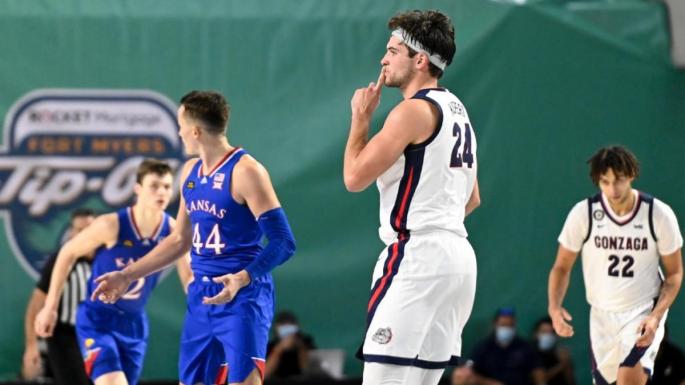
In the midst of my Thanksgiving lunch, while I was on serving #3 of stuffing, the best game of college basketball’s opening week was being played: #6 Kansas vs. #1 Gonzaga at a neutral site. Both teams lost three of their five starters from a year ago, when they were the two best teams in basketball, but one team happened to reload a little better than the other. As astounding as it might be to imagine this, it was Gonzaga who brought in more blue-chip recruits – three to Kansas’s one. Both teams returned about the same amount of minutes and production, but Gonzaga had the higher potential, most thought. Also, this was before Gonzaga added Andrew Nembhard, Florida’s starting point guard the last two seasons, for this season on Tuesday.

On Thanksgiving day, two of the three-ish best programs of the last half-decade went at it on FOX. If you told Kansas fans before the game that they’d do the following:

  • Score 90 points
  • Tied the turnover battle
  • Made two more threes than Gonzaga
  • Hold Gonzaga to 6-for-18 from three

They would be well within their right to guess Kansas won this game fairly easily, because all of those stats should bode really well for the team involved. Instead, Kansas is leaving Thanksgiving Day with a 102-90 loss and their most points allowed to an opponent in regulation in 30 years. Gonzaga, one of the best three-point shooting teams of the last decade, didn’t need a great day from downtown, because they were absurdly dominant in the paint. We’re going to explore why, with an offense vs. defense exploration on both ends.

When Gonzaga had the ball

Mark Few had a mission and pursued it start-to-finish: attack the paint in a wide variety of ways with their taller, more versatile lineups. Kansas’s best player last year was Devon Dotson, but their most important piece was Udoka Azubuike, a giant center who simply could not stop blocking shots. Last year, Kansas allowed the third-lowest 2PT% in the nation, a figure made even more impressive by the fact they played KenPom’s second-hardest schedule.

This year, Kansas has David McCormack, a perfectly fine 6’10” center who can’t move nearly as well as Azubuike and was rendered unplayable for significant portions of this game.

McCormack only got to 20 minutes in this game because Drew Timme, a Gonzaga sophomore, was destroying him all over the court. Timme went for 25 points on 15 shots (9-for-11 at the rim), a career-high in points, along with six rebounds and a couple of steals. Timme was used in a variety of Gonzaga sets – most of them of the ball-screen variety – and he explored a few different ways of getting the ball in positive situations. Timme slips the pick in the GIF above, but here’s one where he comes off a roll action unguarded with as easy a dunk as he’ll have this year:

Of course, it wasn’t just Timme. The headliner coming out of this game will be star freshman Jalen Suggs, an almost-certain lottery pick who lived up to and exceeded his own hype. Against a top-10 team in his first college game, Suggs scored 24 points in 24 minutes and looked unstoppable everywhere. For years, Few has loved to push the pace in transition offensively, believing (correctly) that with the right talent, it can produce his most efficient offense possible. Suggs looks to be the perfect piece to ignite the Gonzaga engine:

Let me reiterate: in his first-ever college game against a top-10 team, Jalen Suggs got 24 points on 15 shots along with eight assists in 24 minutes. This is a very special player, even before you get to his scoring skillset. Suggs was able to get to the rim at will, scoring seven times on 11 attempts from a variety of looks, but he looked especially threatening off of picks:

In a way, it does make me the mildest bit relieved Tennessee does not have to defend this offense yet. Bill Self is one of the greatest coaches of the 21st century, and over the last five seasons, Kansas has consistently had one of the 5-10 best defenses each season. After the dust settles in 2020-21, despite the pandemic, I don’t expect this to change. There’s several good individual defenders on the Kansas roster. And it did not matter one bit, because this Gonzaga offense has a historic amount of fantastic shooters, great drivers, excellent big men, and all-around good scorers. Rarely, if ever, do these pieces come together on the same team. This particular offense has the potential to be as good, if not better, than 2017-18 Villanova.

The offense is so good that I feel rude for excluding a few other fun performances in this one, namely Nembhard (11 points on six shots) and Joel Ajayi (15 points and nine rebounds). But it wouldn’t feel right to end this somewhere other than Corey Kispert (23 points on 13 shots). Kispert realistically could’ve made an NBA roster after last season, and not many expected him to return for 2020-21. When he did, it cemented Gonzaga as a serious championship contender. There’s still improvements to be made defensively, but he remains Gonzaga’s very best three-point shooter regardless of game situation:

You cannot give him even an inch of space to get these off. Kispert shot 3-for-8 from three in this one (everyone else on Gonzaga combined for 3-for-10), which may look just okay, but 37.5% is a solid rate for any one game. Kispert’s status as the lone senior starter on this team (and a career 39.3% three-point shooter) helps cement him as probably the important piece for a Gonzaga run; as fun as the one-and-dones are, it is valuable to have these more experienced pieces come March.

Lastly: Gonzaga’s main five are going to be incredibly difficult for anyone to defend, much less their overwhelmed WCC opponents. Kispert, the best deep shooter, actually functions as the nominal 4 in the Zags’ lineup, and center Timme appears to have added at least some type of a three-point shot. (He attempted one and missed it.) All five starters were very efficient against a high-end opponent. While you can’t take too much from one game, I really don’t know how many defenses in basketball – maybe only Virginia and Texas Tech – will be equipped to keep Gonzaga somewhat contained for most of a 40-minute game.

When at least four of Gonzaga’s main five were on the court together, the Bulldogs outscored Kansas by 22 points across roughly a 29-minute span of the game. When all five were out there together – which only happened in the second half – Gonzaga outscored Kansas 37-19 in a 12-minute span of game time. Again, this is against the #6 team on KenPom, #16 on Bart Torvik. It’s not as if they’re a pushover; they just had nothing for this offense.

When Kansas had the ball

Again, go back to those stats from the intro. Kansas did a lot of good in this game offensively, and a 1.098 points-per-possession rate adjusts out to a very good offensive performance against a top-20 defense. Like I mentioned, the Jayhawks hit eight of their 18 three-point attempts, with three different players spreading the wealth and hitting two each. Gonzaga had a tough time guarding both Marcus Garrett and Ochai Agbaji, as both got open from downtown frequently.

Still, it isn’t enough to overcome a masterful offensive outing by Gonzaga and, in return, a disastrous defensive performance by the Jayhawks. Gonzaga’s shooting numbers would make any competition look feeble in comparison, and it unfortunately did so to this Kansas outing. Kansas posted an eFG% of 59.7%, which would’ve been their seventh-best performance last season and the third-worst eFG% given up by 2019-20 Gonzaga. They had a great day on the offensive end. Unfortunately, they needed to have a historically great day to win.

Kansas has a lot of good to take away from this game on offense, though. Before the season started, I wasn’t really sure who would drive the Kansas offense forward like Devon Dotson did last year. There wasn’t an obvious answer, and as many as four different players seemed like reasonable responses. Both Garrett and Agbaji stepped up yesterday to give Kansas fans some serious hope. In the first half, Self ran several high ball-screen sets to get Garrett space to drive to the rim:

In the first half, Gonzaga mostly allowed these to not become hard-hedges or “ice” calls, largely staying in single coverage. At halftime, though, Few made a clear adjustment by hedging hard and forcing a double team on the ball-handler for at least a second or two, which took the ball out of Garrett’s hands more often. Bill Self actually countered this fairly well by getting the ball out of his guards’ hands very quickly, but Kansas simply made mistake after mistake and failed to take advantage.

Let’s counter this with an area of joy for the Jayhawks: the amount of open looks they got all over the court. Per Synergy, 15 of the 20 catch-and-shoot jumpers in half-court for Kansas were unguarded, and they took advantage, scoring 19 points and particularly getting a lot of open looks in the first half. Christian Braun got looks this open on two consecutive possessions late in the first half, and you could tell it was giving Mark Few a headache.

Again, at halftime, Few made an adjustment: Gonzaga was to close out hard on these three-point attempts and either force tougher looks or make Kansas head inside the arc to try their luck. It doesn’t often work this way, but it’s exactly what ended up happening. Kansas made 6-of-11 threes in the first half, but just 2-of-7 in the second while taking a ton of mid-range jumpers. Luckily for the Jayhawks, they had one of their best days ever from the mid-range, converting 12-of-21 non-rim two-pointers. Bryce Thompson (not the cornerback) in particular kept Kansas in this for a while:

Here’s a more accurate example of what I’m talking about:

All in all, both teams probably have things to be excited about here and serious questions to address. For this side of the ball specifically – Kansas’ offense, Gonzaga’s defense – let’s address a positive and negative for each.

Kansas can be excited about the fact they found four double-digit scorers against the best team in the nation and weren’t entirely reliant on one player to drive the offense. They found a ton of open shots, particularly in the first half, and made Gonzaga present several adjustments they clearly weren’t hoping to have to use at the start of the game. Kansas countered some of these adjustments pretty well. However, they should be worried about the fact Gonzaga erased their traditional ball-screen sets almost entirely in the second half, and to be honest, they should probably be more than a little alarmed at how easily they settled for 17-20 foot two-pointers instead of shooting more threes.

Gonzaga won the game, successfully countered several of Bill Self’s main actions, and took control in the second half when the game was up for grabs. Of particular note should be the Bulldogs forcing nine Kansas turnovers, rendering a 57.7% half from two useless. That said, Gonzaga gave up a ton of open threes in the first half, and the blueprint seems to be there to get open shots against this defense. Plus, uh, not exactly over the moon on the rim protection here – Kansas went just 13-for-23 at the rim, but Gonzaga didn’t block a single shot and a few of the Kansas misses were self-inflicted.

If you like these, let me know by emailing statsbywill@gmail.com or Tweeting @statsbywill on said website.

2020 Tennessee high school football playoff projections, Quarterfinals edition

Last week’s picks went 48-8 (85.7%), which is pretty good for a system that literally took the system off. That brings these picks to 120-18 (87%) through two rounds. Regression will come eventually, but I am very pleased with how these have done so far. Again, not doing analysis this year; it’s just the picks and the numbers.

1A

Favorites (30% or greater to win title): South Pittsburg (50.3%)

Second-tier contenders (15% or greater to win title): Moore Co. (15.5%), Gordonsville (15.2%)

Darkhorses (5% or greater to win title): Fayetteville (10%), Lake Co. (5%)

Most likely championship game: South Pittsburg vs. Moore Co. (24.6% odds of happening)

  • (R2 #2) Oliver Springs 17 at (R2 #1) Coalfield 27
  • (R3 #1) South Pittsburg 32 at (R4 #1) Gordonsville 24
  • (R5 #2) Moore Co. 23 at (R5 #1) Fayetteville 22
  • (R7 #3) West Carroll 26 at (R7 #2) Lake Co. 35

2A

Favorites: Peabody (64.7%)

Second-tier contenders: Watertown (16.8%)

Darkhorses: Meigs Co. (9.6%), Trousdale Co. (5.2%)

Most likely championship game: Peabody vs. Watertown (39.7% odds of happening)

  • (R1 #1) South Greene 18 at (R2 #1) Meigs Co. 32
  • (R4 #2) Trousdale Co. 19 at (R4 #1) Watertown 27
  • (R6 #2) Riverside 19 at (R6 #1) Waverly Central 23
  • (R7 #2) McKenzie 13 at (R7 #1) Peabody 37

3A

Favorites: Alcoa (48.2%), Pearl-Cohn (33.1%)

Second-tier contenders: none

Darkhorses: Milan (9%), Red Bank (6.8%)

Most likely championship game: Alcoa vs. Pearl-Cohn (48.9% odds of happening)

  • (R2 #2) GPittman 10 at (R2 #1) Alcoa 41
  • (R3 #2) Loudon 19 at (R3 #1) Red Bank 29
  • (R5 #1) Pearl-Cohn 40 at (R6 #1) Stewart Co. 5
  • (R7 #2) South Gibson 20 at (R7 #1) Milan 29

4A

Favorites: Tullahoma (45.9%)

Second-tier contenders: Elizabethton (23.7%)

Darkhorses: Haywood (12.6%), Lexington (6.8%), Hardin Co. (6.8%)

Most likely championship game: Tullahoma vs. Haywood (28.4% odds of happening)

  • (R1 #2) Greeneville 20 at (R1 #1) Elizabethton 34
  • (R4 #2) Nolensville 13 at (R4 #1) Tullahoma 32
  • (R6 #2) Hardin Co. 21 at (R6 #1) Lexington 23
  • (R7 #2) Ripley 15 at (R7 #1) Haywood 38

5A

Favorites: Knoxville West (41.3%)

Second-tier contenders: Beech (21.3%), Henry Co. (16%)

Darkhorses: Oak Ridge (7.5%), Knoxville Central (5.4%)

Most likely championship game: Knoxville West vs. Beech (26.8% odds of happening)

  • (R2 #2) South-Doyle 24 at (R2 #1) Central 27
  • (R3 #2) Oak Ridge 18 at (R3 #1) Knoxville West 30
  • (R5 #1) Summit 20 at (R6 #1) Beech 31
  • (R7 #2) Northeast 16 at (R7 #1) Henry Co. 38

6A

Favorites: Maryville (41.4%)

Second-tier contenders: Oakland (27.6%), Brentwood (17%)

Darkhorses: Bartlett (8%)

Most likely championship game: Maryville vs. Brentwood (26% odds of happening)

  • (R1 #1) Dobyns-Bennett 14 at (R2 #1) Maryville 35
  • (R3 #2) Riverdale 21 at (R3 #1) Oakland 35
  • (R6 #4) Franklin 16 at (R6 #1) Brentwood 30
  • (R7 #2) Collierville 20 at (R7 #1) Bartlett 31

II-A

Favorites (40% or higher): Davidson Academy (69.6%)

Second-tier contenders (20% or higher): none

Darkhorses (10% or higher): University School of Jackson (14.2%)

Most likely championship game: Davidson Academy vs. University School of Jackson (45.6% odds of happening)

  • (W #2) University School of Jackson 23 at (E #1) Donelson Christian Academy 22
  • (W #3) Nashville Christian 15 at (W #1) Davidson Academy 34

II-AA

Favorites (40% or higher): Christ Presbyterian Academy (52.7%), Lipscomb Academy (41.9%)

Second-tier contenders (20% or higher): none

Darkhorses (10% or higher): none

Most likely championship game: Christ Presbyterian Academy vs. Lipscomb Academy (73% odds of happening)

  • (M #1) Lipscomb Academy 33 at (W #1) Evangelical Christian 17
  • (M #3) Goodpasture Christian 14 at (M #2) Christ Presbyterian Academy 35

II-AAA

Favorites (40% or higher): Brentwood Academy (50.6%)

Second-tier contenders (20% or higher): Montgomery Bell Academy (22.8%)

Darkhorses (10% or higher): McCallie (13.3%), Memphis University (13.3%)

Most likely championship game: Brentwood Academy vs. Montgomery Bell Academy (44.5% odds of happening)

  • (E #3) McCallie 20 at (E #1) Brentwood Academy 31
  • (W #3) Memphis University 18 at (W #1) Montgomery Bell Academy 22

Tennessee basketball: a 2020-21 preview

After the longest year in human history, we have returned. Basketball is around the corner, amazingly enough. In a normal year, you would have seen this preview at least three weeks ago, if not further back, and you would already know a bit about the 2020-21 Tennessee basketball team by way of them having played two or three games. That’s not a huge sample size, and yet: it is larger than zero games, which is what we’re going off of right now.

All we can do is analyze what may or may not be there. What we know is that Tennessee returns roughly 70% of production from last year’s roster, including the Defensive Player of the Year and All-SEC John Fulkerson. They add two five-star recruits to the roster, along with suddenly-forgotten four-star Corey Walker. Understandably, this particular Tennessee roster has created the most anticipated Tennessee basketball season in years, perhaps even more anticipated than the final Grant Williams/Admiral Schofield run. 

Of course, it’s worth remembering how far we’ve all come in this year alone. When I last wrote about Tennessee basketball on this site, it was about a game that didn’t actually end up happening: the SEC second-round fixture against Alabama. The night before, Rudy Gobert’s positive COVID test forced the NBA to postpone their season for over four months, and a similar postponement simply wasn’t possible for college basketball. It felt like a matter of time building up to the Thursday afternoon announcement that the NCAA Tournament was done.

Here we are, eight months and 18 days since Tennessee last played basketball. It’s easy to forget that the last Tennessee road game played was an out-of-nowhere 81-73 win over SEC champion Kentucky. (Don’t check the score of the Auburn home finale played four days later, the last sporting event I attended in 2020.) Before we get into 2020-21’s expectations, let’s go over a brief reminder of what went down in 2019-20:

  • Tennessee started 5-0, then 7-1, with wins over Washington and VCU. By the end of the season, these wins looked pretty forgettable, but at the time of each game, they were really important. With a six-man rotation and a makeshift roster, Tennessee flew to Toronto and dismantled Top 25 Washington for a full 40 minutes; in a tournament in Florida, they battled VCU to the wire and got a Lamonte Turner buzzer-beater to pull off a huge win. At the time, both wins looked to be a key part of a Tennessee NCAA Tournament resume, alongside a close loss to future ACC champion Florida State. Washington and VCU would finish their seasons at 15-17 and 18-13, nowhere near the NCAA Tournament. Still, Tennessee’s defense looked genuinely great, holding their first six opponents and eight of their first nine to 0.87 PPP or lower offensively.
  • Tennessee lost four out of their next five games, and in the only win, Lamonte Turner’s career ended. Turner battled shoulder issues during his shortened senior season and shot horribly, but once we all found out how bad the pain was, it became a lot more understandable. Suddenly, Tennessee had nothing resembling a true point guard at all, and offense became an excruciating thing to watch. Tennessee posted four games of 0.8 points per possession or lower offensively, their worst bad-game rate since 2011-12, the first Cuonzo season.
  • Enter Santiago Vescovi and an erratic SEC run. Last year’s SEC was very bad, and I don’t think that any member of the conference would’ve progressed past the Sweet Sixteen. It makes sense that Tennessee wouldn’t have found any real consistency. That said, they were simply more exciting by way of Vescovi’s deep range, fascinating passes, and extreme offensive volatility. In one three-game sample, Vescovi went from scoring 20 points to 7 to 14, and in his first game in a Tennessee uniform, he committed nine turnovers. For a half-season freshman, consistency wasn’t his thing, but you’d hope he’ll find more of that in a full season.
  • Some good wins, some close good losses, and some horrific performances. For a team with so little returning from the previous season, Tennessee was always going to have consistency issues. But even they might have been shocked by how inconsistent they were. Bart Torvik’s Game Score metric measures a team’s performance on a 0-to-100 scale. In the same season, Tennessee posted six 95-or-higher rated performances alongside three games rated a 21 or lower. Meaning: in certain games, Tennessee looked like a top 15 team; in others, they looked like a bottom-half Conference USA squad. Not once in the final five games did Tennessee hold their opponent below a point per possession offensively. In the season’s final week, Tennessee posted wins over Florida and Kentucky, two NCAA Tournament teams…and then promptly lost at home by 22 points to Auburn, the least-good of the three.

Using that as a refresher, we can be confident of some things heading into 2020-21. Tennessee brings back a lot of talent from last year’s roster and a lot of young players with high levels of potential. They’ll get a full season to grow together, and even in a strange pandemic season, hopes are high. Preseason statistics models are a little lower on Tennessee, simply because their 2019-20 was kind of disappointing, finishing 68th on KenPom and 61st on Torvik, both the lowest of any school ranked in either site’s 2020-21 Top 20. National experts seem to generally have the Vols somewhere between 8th and 14th, which feels fair. Either way, fans are within their right to expect great things from this group and great things from the $5 million man heading the operation. They’ll have a lot of questions to resolve from here to March, but the nice thing about having as much talent as Tennessee has is an extended timeline to figure out the answers to those questions.

if you’d like to skip ahead to a certain section, click below:

2020 Tennessee high school football playoff projections, round two

If you’re curious, I am at the beach and, as of 4:22 PM ET, just realized I never posted this. I’ll get the graphics back next week.

1A

Favorites to win championship (20% or higher): South Pittsburg (39.6% to win; -2.9% from last week)

Second-tier contenders (5% or higher): Gordonsville (18.6%; +2.7%), Huntingdon (9.8%; +2.3%), Fayetteville (9.5%; +0.8%), Moore Co. (8.6%; -0.7%), Lake Co. (6.2%; -0.8%)

Darkhorses (1% or higher): Coalfield (2.4%; -0.8%), Greenback (1.6%; +0.2%), Monterey (1.5%; +0.2%)

Most likely championship game: South Pittsburg vs. Huntingdon (12.1% chance of happening)

  • (R2 #2) Oliver Springs 26 at (R1 #1) Cloudland 20
  • (R2 #3) Greenback 24 at (R2 #1) Coalfield 28
  • (R4 #2) Monterey 18 at (R3 #1) South Pittsburg 37
  • (R4 #3) Clay Co. 13 at (R4 #1) Gordonsville 30
  • (R5 #3) Huntland 16 at (R5 #1) Fayetteville 29
  • (R5 #2) Moore Co. 26 at (R6 #1) Huntingdon 28
  • (R7 #3) West Carroll 25.4 at (R7 #1) Greenfield 25.1
  • (R7 #4) Dresden 21 at (R7 #2) Lake Co. 38

2A

Favorites to win championship (20% or higher): Peabody (63.9%; +0.3%)

Second-tier contenders (5% or higher): Watertown (16.8%; -0.6%), Meigs Co. (9.8%; -0.8%)

Darkhorses (1% or higher): Trousdale Co. (3.4%; +1.0%), Lewis Co. (1.4%; -0.3%), McKenzie (1.2%; no change), Bledsoe Co. (1.1%; no change)

Most likely championship game: Peabody vs. Watertown (36.5% chance of happening)

  • (R2 #2) Rockwood 17 at (R1 #1) South Greene 28
  • (R1 #2) Hampton 17 at (R2 #1) Meigs Co. 32
  • (R4 #2) Trousdale Co. 23 at (R3 #1) Bledsoe Co. 20
  • (R3 #2) Marion Co. 18 at (R4 #1) Watertown 35
  • (R6 #2) Riverside 16 at (R5 #1) Lewis Co. 25
  • (R5 #2) Forrest 18 at (R6 #1) Waverly Central 28
  • (R7 #3) Union City 14 at (R7 #1) Peabody 46
  • (R7 #4) Adamsville 20 at (R7 #2) McKenzie 27

3A

Favorites to win championship (20% or higher): Alcoa (56%; -2.2%), Pearl-Cohn (24.2%; -0.2%)

Second-tier contenders (5% or higher): Red Bank (7.8%; +1.2%), Milan (5%; +0.4%)

Darkhorses (1% or higher): Covington (3.3%; +0.4%), South Gibson (2.3%; +0.2%)

Most likely championship game: Alcoa vs. Pearl-Cohn (42.9% chance of happening)

  • (R2 #4) Pigeon Forge 21 at (R2 #2) GPittman 31
  • (R2 #3) Kingston 2 at (R2 #1) Alcoa 43
  • (R3 #3) Brainerd 11 at (R3 #1) Red Bank 37
  • (R3 #2) Loudon 28 at (R4 #1) Upperman 18
  • (R5 #3) East Nashville 13 at (R5 #1) Pearl-Cohn 32
  • (R5 #2) Giles Co. 25 at (R6 #1) Stewart Co. 19
  • (R7 #3) Covington 22 at (R7 #1) Milan 25
  • (R7 #4) Westview 17 at (R7 #2) South Gibson 31

4A

Favorites to win championship (20% or higher): Tullahoma (37.4%; +3.8%), Elizabethton (30%; -6.5%)

Second-tier contenders (5% or higher): Lexington (9.8%; -0.3%), Hardin Co. (5.9%; +1%)

Darkhorses (1% or higher): Haywood (4%; -0.1%), Anderson Co. (3.6%; +0.9%); Nolensville (2.2%; +0.2%), Marshall Co. (2.1%; +0.6%), Dyersburg (2%; +0.5%), Springfield (1.8%; +0.1%)

Most likely championship game: Tullahoma vs. Lexington (15.6% chance of happening)

  • (R1 #3) Sullivan South 8 at (R1 #1) Elizabethton 41
  • (R1 #2) Greeneville 25 at (R2 #1) Anderson Co. 33
  • (R4 #2) Nolensville 28 at (R3 #1) DeKalb Co. 19
  • (R4 #3) Marshall Co. 16 at (R4 #1) Tullahoma 32
  • (R6 #2) Hardin Co. 24 at (R5 #1) Springfield 20
  • (R5 #2) Creek Wood 15 at (R6 #1) Lexington 33
  • (R7 #3) Dyersburg 28 at (R7 #1) Haywood 32
  • (R7 #4) Crockett Co. 26 at (R7 #2) Ripley 25

5A

Favorites to win championship (20% or higher): Knoxville West (36.5%; +5.9%)

Second-tier contenders (5% or higher): Henry Co. (18.4%; +1%), Beech (14.5%; -2.6%), Oak Ridge (8.5%; -1.3%), Summit (6.9%; +1.2%), Central (5.5%; +1.3%)

Darkhorses (1% or higher): South-Doyle (2.8%; +1.1%), Hillsboro (2.3%; +0.9%), Rhea Co. (1.9%; +0.9%), David Crockett (1%; -0.3%)

Most likely championship game: Knoxville West vs. Henry Co. (22.8% chance of happening)

  • (R2 #2) South-Doyle 29 at (R1 #1) David Crockett 27
  • (R2 #3) Knoxville Halls 21 at (R2 #1) Central 31
  • (R4 #2) Walker Valley 18 at (R3 #1) Knoxville West 38
  • (R3 #2) Oak Ridge 27 at (R4 #1) Rhea Co. 22
  • (R5 #3) Columbia Central 11 at (R5 #1) Summit 34
  • (R6 #3) Hillsboro 22 at (R6 #1) Beech 32
  • (R8 #2) Brighton 10 at (R7 #1) Henry Co. 40
  • (R7 #4) Clarksville 22 at (R7 #2) Northeast 33

6A

Favorites to win championship (20% or higher): Maryville (30.4%; +0.7%), Oakland (29.8%; -0.3%)

Second-tier contenders (5% or higher): Ravenwood (12.2%; -0.5%), Bartlett (8.7%; -0.4%), Brentwood (8.5%; +1.4%)

Darkhorses (1% or higher): Riverdale (2.5%; +0.3%), Independence (2.1%; -0.2%), Dobyns-Bennett (1.9%; -0.7%), McMinn Co. (1.8%; +0.2%), Collierville (1.1%; no change)

Most likely championship game: Oakland vs. Ravenwood (12.9% chance of happening) and Maryville vs. Ravenwood (12.4% chance of happening)

  • (R2 #2) McMinn Co. 24 at (R1 #1) Dobyns-Bennett 26
  • (R2 #3) Bradley Central 21 at (R2 #1) Maryville 43
  • (R4 #2) Mount Juliet 13 at (R3 #1) Oakland 43
  • (R3 #2) Riverdale 26 at (R4 #1) Hendersonville 22
  • (R6 #4) Franklin 16 at (R6 #2) Ravenwood 36
  • (R6 #3) Independence 19 at (R6 #1) Brentwood 27
  • (R7 #3) Bartlett 33 at (R7 #1) Houston 20
  • (R7 #4) Cordova 17 at (R7 #2) Collierville 30

II-A

Favorites to win championship (20% or higher): Davidson Academy (67.2%; +3%)

Second-tier contenders (5% or higher): University School of Jackson (17.2%; -1.4%), Donelson Christian Academy (9%; -0.4%)

Darkhorses (1% or higher): Nashville Christian (4.5%; -0.5%), King’s Academy (1.2%; -0.1%)

Most likely title game: Davidson Academy vs. University School of Jackson (47.8% chance of happening)

  • (W #4) Trinity Christian Academy 17 at (E #1) Donelson Christian Academy 34
  • (E #3) Middle Tennessee Christian 13 at (W #2) University School of Jackson 39
  • (W #5) Jackson Christian 13 at (W #1) Davidson Academy 41
  • (W #3) Nashville Christian 32 at (E #2) King’s Academy 28

II-AA

Favorites to win championship (20% or higher): Christ Presbyterian Academy (49.2%; -1.6%), Lipscomb Academy (42.1%; +0.4%)

Second-tier contenders (5% or higher): CAK (6%; +1%)

Darkhorses (1% or higher): Evangelical Christian (1.3%; +0.4%)

Most likely title game: Christ Presbyterian Academy vs. Lipscomb Academy (64.8% chance of happening)

  • (M #4) Battle Ground Academy 22 at (W #1) Evangelical Christian 26
  • (W #2) Lausanne Collegiate 14 at (M #1) Lipscomb Academy 38
  • (M #3) Goodpasture Christian 20 at (E #1) CAK 32
  • (E #4) Chattanooga Christian 7 at (M #2) Christ Presbyterian Academy 41 (game cancelled due to COVID-19)

II-AAA

Favorites to win championship (20% or higher): Brentwood Academy (46.4%)

Second-tier contenders (5% or higher): Montgomery Bell Academy (16.5%), Father Ryan (11.3%), McCallie (9.5%), Pope John Paul II (5.8%)

Darkhorses (1% or higher): Memphis University (3.9%), Christian Brothers (3.9%), Baylor (2.7%)

Most likely title game: Brentwood Academy vs. Montgomery Bell Academy (26.9% chance of happening)

  • (W #4) Pope John Paul II 19 at (E #1) Brentwood Academy 32
  • (E #3) McCallie 27 at (W #2) Christian Brothers 24
  • (E #4) Baylor 16 at (W #1) Montgomery Bell Academy 25
  • (W #3) Memphis University 23 at (E #2) Father Ryan 29

2020 Tennessee high school football playoff projections, round one

Hello, and welcome to a yearly tradition here at Stats By Will dot com: the TSSAA high school football playoff projections. I’m a little surprised to be bringing this back this year, as in early September, I announced my plans to not cover high school football at all this year. Without going into great detail, I’ve taken on more responsibilities in my professional role, and to be honest, I care a lot more about my work in basketball than I really do this. That being said, I do enjoy the fun that projections like these can bring. In particular, the playoff projections are pretty easy to put together each year once the field is set.

This year, there won’t be any class-by-class analysis beyond what I’ve posted on Twitter, which were the class-by-class odds. I’ll put the favorites, second-tier contenders, and darkhorses for each class above the projections here so you can get a grasp on what’s at stake in each class. The game with the highest Quarterfinals swing at risk will be bolded and italicized in each class as well. This is not necessarily the best game, but the one that looks to mean the most to the eventual fields of 8. Other writers, like Tom Kreager and Donovan Stewart, know far more about this stuff than I do, so you should listen to them when it comes to high school football. However, I do enjoy providing this simple service for those that enjoy it.

I’ve made a few tweaks to this year’s playoff projections:

  1. The ratings are a little different mix than usual. This year, I just used Cal Preps and Massey Ratings, as Sonny Moore’s ratings haven’t performed as well as those two in my time using both. Also, for the first time ever, my preseason ratings have a very small say in what you see here. They’re factored in at a rate of about 1.8%, which is miniscule, but has helped the ratings be a very tiny bit more accurate on the whole. (For instance, this probably would’ve made my call on last year’s Monterey/Whitwell game less extreme – by the time the game arrived, Monterey was a 95.8% favorite to win, but Whitwell won. They were the higher-ranked team in preseason by far.)
  2. I’ve added a small amount of extra uncertainty to game-by-game picks. It isn’t much, but it’s enough to reflect that any sports season in COVID times is going to be more unpredictable than usual. I already know of two teams that can’t participate in the playoffs because of contact tracing issues. Also, some teams played six or seven games while others got in their full ten. I’m trying to do the best I can with this abnormally-small sample size.
  3. I gave Alcoa a 30-point boost because otherwise, their fans will protest outside of my home. Not really, they’re simply as good as they always are.

Typically, these projections get around 80% of the games right during the playoffs, but I do expect this year to be a little lower. It’s a strange season, I’ve been told. Also, I think I still owe a guy a T-shirt because the school he played for beat the spread in one of the playoff games. If you are this player, please email statsbywill@gmail.com and I will write something very silly on a shirt for you.

1A

Favorites (20% or higher): South Pittsburg (42.5%)

Second-tier contenders (5% or higher): Gordonsville (15.9%), Moore Co. (9.3%), Fayetteville (8.7%), Huntingdon (7.5%), Lake Co. (7%)

Darkhorses (1% or higher): Coalfield (3.2%), Greenback (1.4%), Monterey (1.3%)

Most likely title game: South Pittsburg vs. Moore Co. (12.1% chance of happening)

  • (R1 #3) Jellico 9 at (R2 #2) Oliver Springs 40
  • (R1 #4) Hancock Co. 0 at (R2 #1) Coalfield 57
  • (R2 #3) Greenback 47 at (R1 #2) Unaka 16
  • (R2 #4) Midway 25 at (R1 #1) Cloudland 24
  • (R3 #3) Sale Creek 11 at (R4 #2) Monterey 38
  • (R3 #4) Whitwell 8 at (R4 #1) Gordonsville 44
  • (R4 #3) Clay Co. 19 at (R3 #2) Copper Basin 22
  • (R4 #4) Byrns [Jo] 5 at (R3 #1) South Pittsburg 46
  • (R5 #3) Huntland 25 at (R6 #2) Collinwood 20
  • (R5 #4) Cornersville 22 at (R6 #1) Huntingdon 32 (49.7% Quarterfinal swing – Huntingdon 41.2%, Cornersville 8.5%)
  • (R6 #3) Wayne Co. 10 at (R5 #2) Moore Co. 37
  • (R6 #4) Hollow Rock-Bruceton Central 8 at (R5 #1) Fayetteville 36

2A

Favorites: Peabody (63.6%)

Second-tier contenders: Watertown (17.4%), Meigs Co. (10.6%)

Darkhorses: Trousdale Co. (2.4%), Lewis Co. (1.7%), McKenzie (1.2%), Bledsoe Co. (1.1%)

Most likely title game: Peabody vs. Watertown (38% chance of happening)

  • (R1 #3) Happy Valley 12 at (R2 #2) Rockwood 23
  • (R1 #4) Cosby 0 at (R2 #1) Meigs Co. 61
  • (R2 #3) Oneida 17 at (R1 #2) Hampton 30
  • (R2 #4) Cumberland Gap 7 at (R1 #1) South Greene 46
  • (R3 #3) Tyner Academy 17 at (R4 #2) Trousdale Co. 34
  • (R3 #4) Tellico Plains 1 at (R4 #1) Watertown 45
  • (R4 #3) Westmoreland 29 at (R3 #2) Marion Co. 38
  • (R4 #4) Cascade 10 at (R3 #1) Bledsoe Co. 30
  • (R5 #3) Eagleville 12 at (R6 #2) Riverside 29
  • (R5 #4) Loretto 13 at (R6 #1) Waverly Central 35
  • (R6 #3) East Hickman Co. 19 at (R5 #2) Forrest 27 (31.2% Quarterfinal swing – Forrest 23.2%, East Hickman Co. 8%)
  • (R6 #4) Scotts Hill 5 at (R5 #1) Lewis Co. 44

3A

Favorites: Alcoa (58.2%), Pearl-Cohn (24.4%)

Second-tier contenders: Red Bank (6.6%)

Darkhorses: Milan (4.6%), Covington (2.9%), South Gibson (2.1%)

Most likely title game: Alcoa vs. Pearl-Cohn (46.2% chance of happening)

  • (R1 #3) Unicoi Co. 17 at (R2 #2) GPittman 42
  • (R1 #4) Johnson Co. 0 at (R2 #1) Alcoa 52
  • (R2 #3) Kingston 30 at (R1 #2) Chuckey-Doak 17
  • (R2 #4) Pigeon Forge 30 at (R1 #1) Claiborne 25
  • (R3 #3) Brainerd 33 at (R4 #2) Smith Co. 18
  • (R3 #4) Signal Mountain 20 at (R4 #1) Upperman 28
  • (R4 #3) York Institute 5 at (R3 #2) Loudon 42
  • (R4 #4) Grundy Co. 0 at (R3 #1) Red Bank 49
  • (R5 #3) East Nashville 29 at (R6 #2) Fairview 17
  • (R5 #4) Stratford 22 at (R6 #1) Stewart Co. 23 (33.5% Quarterfinal swing – Stewart Co. 19.5%, Stratford 14%)
  • (R6 #3) Harpeth 7 at (R5 #2) Giles Co. 38
  • (R6 #4) Camden Central 0 at (R5 #1) Pearl-Cohn 56

4A

Favorites: Elizabethton (36.5%), Tullahoma (33.6%)

Second-tier contenders: Lexington (10.1%)

Darkhorses: Hardin Co. (4.9%), Haywood (4.1%), Anderson Co. (2.7%), Nolensville (2%), Springfield (1.7%), Dyersburg (1.5%), Marshall Co. (1.5%)

Most likely title game: Elizabethton vs. Lexington (15.4% chance of happening)

  • (R1 #3) Sullivan South 24 at (R2 #2) East Hamilton 27
  • (R1 #4) Grainger 13 at (R2 #1) Anderson Co. 39
  • (R2 #3) Howard Tech 14 at (R1 #2) Greeneville 40
  • (R2 #4) East Ridge 1 at (R1 #1) Elizabethton 48
  • (R3 #3) Livingston Academy 12 at (R4 #2) Nolensville 32
  • (R3 #4) Stone Memorial 4 at (R4 #1) Tullahoma 42
  • (R4 #3) Marshall Co. 30 at (R3 #2) Macon Co. 18
  • (R4 #4) Spring Hill 17 at (R3 #1) DeKalb Co. 27
  • (R5 #3) White House-Heritage 11 at (R6 #2) Hardin Co. 38
  • (R5 #4) White House 9 at (R6 #1) Lexington 40
  • (R6 #3) Jackson North Side 25 at (R5 #2) Creek Wood 28
  • (R6 #4) Jackson South Side 10 at (R5 #1) Springfield 34
  • (R7 #3) Dyersburg 37 at (R8 #2) Millington Central 11
  • (R7 #4) Crockett Co. 35 at (R8 #1) Fayette Ware 22 (47.2% Quarterfinal swing – Crockett Co. 40.9%, Fayette Ware 6.3%)

5A

Favorites: Knoxville West (30.6%)

Second-tier contenders: Henry Co. (17.4%), Beech (17.1%), Oak Ridge (9.8%), Powell (8.1%), Summit (5.7%)

Darkhorses: Knoxville Central (4.2%), South-Doyle (1.7%), Hillsboro (1.4%), David Crockett (1.3%), Rhea Co. (1%)

Most likely title game: Knoxville West vs. Henry Co. (18% chance of happening)

  • (R1 #3) Daniel Boone 22 at (R2 #2) South-Doyle 30 (52% Quarterfinal swing – South-Doyle 37.6%, Daniel Boone 14.4%)
  • (R1 #4) Morristown East 13 at (R2 #1) Central 34
  • (R2 #3) Knoxville Halls 26 at (R1 #2) Tennessee 28
  • (R2 #4) Sevier Co. 24 at (R1 #1) David Crockett 44
  • (R3 #3) Powell 35 at (R4 #2) Walker Valley 22
  • (R3 #4) Fulton 21 at (R4 #1) Rhea Co. 29
  • (R4 #3) Soddy Daisy 10 at (R3 #2) Oak Ridge 43
  • (R4 #4) Lenoir City 0 at (R3 #1) Knoxville West 53
  • (R5 #3) Columbia Central 16 at (R6 #2) Gallatin 23
  • (R5 #4) Lincoln Co. 8 at (R6 #1) Beech 39
  • (R6 #3) Hillsboro 29 at (R5 #2) Page 22
  • (R6 #4) Hillwood 10 at (R5 #1) Summit 37
  • (R7 #3) Dyer Co. 32 at (R8 #2) Brighton 24
  • (R7 #4) Clarksville 20 at (R8 #1) Munford 31

6A

Favorites: Oakland (30.1%), Maryville (29.7%)

Second-tier contenders: Ravenwood (12.7%), Bartlett (9.1%), Brentwood (7.1%)

Darkhorses: Dobyns-Bennett (2.6%), Independence (2.3%), Riverdale (2.2%), McMinn Co. (1.6%), Collierville (1.1%)

Most likely title game: Oakland vs. Ravenwood (13.4% chance of happening)

  • (R1 #3) Bearden 18 at (R2 #2) McMinn Co. 38
  • (R1 #4) Science Hill 15 at (R2 #1) Maryville 42
  • (R2 #3) Bradley Central 28 at (R1 #2) Farragut 35
  • (R2 #4) Cleveland 13 at (R1 #1) Dobyns-Bennett 36
  • (R3 #3) Warren Co. 24 at (R4 #2) Mount Juliet 27
  • (R3 #4) Blackman 21 at (R4 #1) Hendersonville 30 (38.5% Quarterfinal swing – Hendersonville 30.8%, Blackman 7.7%)
  • (R4 #3) Wilson Central 12 at (R3 #2) Riverdale 32
  • (R4 #4) Rossview 10 at (R3 #1) Oakland 45
  • (R5 #3) Stewarts Creek 9 at (R6 #2) Ravenwood 43
  • (R5 #4) Cane Ridge 12 at (R6 #1) Brentwood 35
  • (R6 #3) Independence 39 at (R5 #2) LaVergne 12
  • (R6 #4) Franklin 26 at (R5 #1) Smyrna 24

II-A

Favorites: Davidson Academy (64.2%)

Second-tier contenders: University School of Jackson (18.6%), Donelson Christian Academy (9.4%), Nashville Christian (5%)

Darkhorses: King’s Academy (1.3%), Friendship Christian (1%)

Most likely title game: Davidson Academy vs. University School of Jackson (46.6% chance of happening)

  • (E #5) Grace Christian Academy 20 at (W #4) Trinity Christian Academy 37 (14.8% Semifinals swing – Trinity Christian 14.3%, Grace Christian 0.5%)
  • (E #6) Webb Bell Buckle 5 at (W #3) Nashville Christian 45
  • (W #5) Jackson Christian 24 at (E #4) Friendship Christian 33
  • (W #6) Columbia Academy 26 at (E #3) Middle Tennessee Christian 28 (game forfeited by Columbia Academy due to COVID-19)

II-AA

Favorites: Christ Presbyterian Academy (50.8%), Lipscomb Academy (41.7%)

Second-tier contenders: CAK (5%)

Darkhorses: none; Evangelical Christian (0.9%) closest

Most likely title game: Christ Presbyterian Academy vs. Lipscomb Academy (66.9% chance of happening)

  • (W #4) Harding Academy 4 at (W #2) Lausanne Collegiate 46
  • (W #5) St. George’s 6 at (M #1) Lipscomb Academy 45
  • (M #4) Battle Ground Academy 32 at (W #3) Northpoint Christian 12
  • (M #5) Franklin Road Academy 20 at (W #1) Evangelical Christian 31 (55.8% Semifinals swing – Evangelical Christian 46.8%, Franklin Road Academy 9%)
  • (E #3) Webb 19 at (M #3) Goodpasture Christian 30
  • (E #4) Chattanooga Christian 23 at (E #2) Grace Christian 29
  • (E #5) Silverdale Academy 0 at (M #2) Christ Presbyterian Academy 48
  • (E #6) Boyd-Buchanan 12 at (E #1) CAK 41

There are 88 games this week in all; the expected record of these projections is roughly 73-15 (83.1%). We’ll see how they do.

A special best of luck to my former high school, Warren County, who will be playing my little brother’s high school, Mount Juliet. In a true battle for the ages, Warren County has the opportunity to secure their first playoff win since 1983 (!), along with their first nine-win season since 1983. It’s been a historic year, and I sincerely hope they pull this one off.

Good luck to all teams involved, and I’ll be back next Friday morning with more projections.

Exploring somewhat-sane proposals for the 346-team NCAA Tournament

Like a bolt of lightning in the dead late-summer air came this tweet across my timeline:

Content! Beautiful content. The ACC has achieved what the most daydream-prone among us have hoped for: pure, uncontrollable chaos. Nothing about a 346-team NCAA Tournament (11 of Division I’s 357 programs are ineligible for this year’s Tournament for various reasons) is normal at all, and all it can bring is something wild. Imagine the takes if 1 seed Villanova loses to 346 seed Mississippi Valley State in the shocker of a lifetime!

Of course, that exact scenario takes numerous leaps of logic to achieve. A straight 346-team tournament isn’t possible without either a laundry list of byes or play-in rounds. Everyone knows the NCAA Tournament loves money, and such a massive loss to a star team would be a monetary dent in terms of viewership and advertising dollars, both of which the NCAA needs in droves (apparently!) after the cancellation of the 2020 NCAA Tournament. That’s why I’d offer The Will Warren Somewhat Sane Solution. It is not the Everyone’s Easy Solution That Just Adds a Couple Extra Games.

(Quick aside: you can just turn the Field of 64 into the Field of 256 by having one play-in round for teams seeded 167 through 346, protecting the top 166. It’s not a bad idea, but forcing the top teams to win eight straight games instead of six both seems a little nuts and seems like it could massively overwhelm host cities. We’re assuming no/limited crowds for the purpose of this experiment, and having even 16 teams podded up in one city probably means at least a couple of hotels at full capacity. I went to school for English, not Hotel Management, so maybe this is actually fine, but who knows.)

Here is the Official guide to a plan I cooked up yesterday afternoon, along with questions I still have to answer:

1. A ladder system that protects the top 32 teams.

In order to ensure that proper respect is paid to teams that have a lot of success during the conference-only regular season (another assumption that I’m running with), I’ve instituted a system that gives the 32 best* teams a free run to the Field of 64. It’s how it would work in a normal season, so it seems fair to keep this part. What this means is that 32 teams out of the remaining 314 will have to play their way into the Field of 64 by way of our 1-to-346 seeded ladder system.

What’s a ladder system? Think of it the way they run it in the Korean Baseball League.

  • The fifth-seeded team plays the fourth-seeded team.
  • The winner plays the third-seeded team.
  • That winner plays the second seed…
  • And finally, that winner gets to play the first seed.

It’s a testament to how well you can sustain your success if you make it all the way up the ladder, and it rewards those who’ve had full-season success as opposed to those who get hot for a few games. How does our ladder system work?

2. Six play-in rounds, spread out over 10-14 days at neutral sites, that slowly whittle the field from 346 to 64 teams.

Bear with me here. This is pretty nuts, I’ll admit, but so’s the idea of a 346-team college basketball tournament in a sport ripe with variance. Anything can happen in any one game, which is why we’re introducing this ladder system as opposed to the 166-team protection. This enables full-season success to matter, while allowing a team to run their way from the bottom to the big time if they’re hot. It attempts to simulate Conference Championship Week in some form, though with more rounds than any individual conference championship.

Here’s how it works. Teams are reseeded by round; i.e., if the #334 team wins in the first round but no team below them wins, they will play the #212 seed in the second, and so on.

  • Teams seeded 257-346 (90 teams total) will play each other from top to bottom – 257 vs. 346, 258 vs. 345, 259 vs. 344, etc. – in order to eliminate 45 teams. This leaves us with 301 teams after one round.
  • Teams seeded 212-256 (45 teams) will play the first round winners to eliminate another 45 teams, giving us 256 teams after two rounds.
  • Now, we could go right into a 256-team field and stop here. If we don’t, we have a third play-in round that gets the field to 192 teams by way of teams seeded 129-211 playing the second-round winners.
  • For the fourth round, teams seeded 65-128 will play the third-round winners, pushing the field to 128 teams.
  • The fifth round features the teams seeded 33-64 and the fourth-round winners for a total of 48 games being played, eliminating 48 teams to get to 80.
  • Now – finally – our final play-in round allows for teams seeded 49-80 to play each other for the right to be in the field of 64.

This is very much silly, but it also works. Teams are forced to climb their way up the ladder system to earn their spot in the NCAA Tournament in a system that somewhat simulates conference tournaments with much less structure and more chaos. You like chaos, right?

3. Alternately, the same plan, but with four play-in rounds and a 128-team field.

This allows for a shorter time period and is less complicated. Again, teams are reseeded after reach relevant round; if #340 beats #263 but no other team below them wins, they would play #212 in the next round.

  • Teams seeded 257-346 (90 teams total) will play each other from top to bottom – 257 vs. 346, 258 vs. 345, 259 vs. 344, etc. – in order to eliminate 45 teams. This leaves us with 301 teams after one round.
  • Teams seeded 212-256 (45 teams) will play the first round winners to eliminate another 45 teams, giving us 256 teams after two rounds.
  • A third play-in round that gets the field to 192 teams by way of teams seeded 129-211 playing the second-round winners.
  • For the fourth round, teams seeded 65-128 will play the third-round winners, pushing the field to 128 teams.
  • The Tournament is then seeded where 1 plays 128, 2 plays 127, and so on, with aims at ensuring region vs. region play.

Question: What about automatic qualifiers from non-Big Six conferences? We’ll have to work that out. Ostensibly, we could turn the Top 32 into the 32 conference champions/standings leaders at season’s end and it would work out just as well. Then, the final 32 spots are made up of the 32 teams that survive our ladder/play-in system. However…doesn’t it feel kind of weird to have a field where, say, 272nd-ranked-in-KenPom North Carolina Central is guaranteed a spot but 3rd-ranked Baylor isn’t? To be determined, folks. Though if you’re the third-best team in college basketball, you should be able to win against whoever you draw no matter what.

Question: How do we ensure smaller, lower-seeded schools can actually play each other? There’s a clear issue here, and I’m not totally sure how to resolve it under this format. For instance, what if Albany (in New York) draws Florida A&M (very much not in New York) in the first round? That’s a lot of travel costs we’d have to work out, and it likely isn’t worth it for Florida A&M. The best thing we can do is have one city be the host to as many games as possible, similar to the actual Field of 64. Perhaps for this specific example, the two teams could play in Washington D.C. at a neutral site. Someone smarter than me probably has an idea on how to do pods for this, and obviously, the 256-team field is much easier to work out. But it’s also not nearly as protective of those who’ve earned the right to be there.

Question: How long would both plans take? For the six play-in round structure, I think it could be accomplished over the course of 10-14 days – AKA, how long conference championship “week” usually takes – at multiple neutral court sites. We’d have to stuff 314 teams in no more than four cities, but I’d say it’s at least somewhat doable. For the four-round structure, we could realistically accomplish this in anywhere from 6-10 days. Again, this stuffs a lot of teams in no more than four bubble cities, but it also cuts the number of play-in teams from 314 to 218. However, it creates much more variance.

Question: Maybe a 96-team field? Sure! The in-between plan, which the NCAA almost implemented ten years ago. Just take the four-round plan listed above and add a fifth-round between teams seeded 65-128.