Blog

With No Regard For Human Life

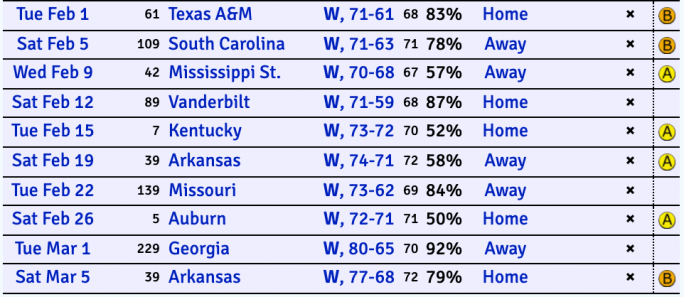
Tuesday, February 1: #22 Tennessee 90, Texas A&M 80 (15-6, 6-3 SEC)
Saturday, February 5: #22 Tennessee 81, South Carolina 57 (16-6, 7-3 SEC)

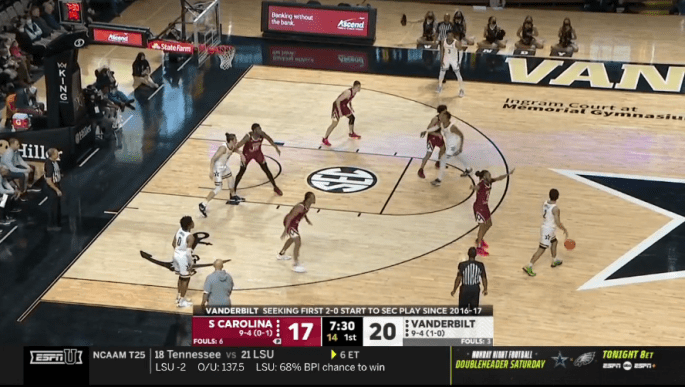
Maybe it was here:

Or here:

Maybe here:

I’m thinking this played a part:

Or, well, here:

Possibly this, too:

Or here:

I mean, frankly, maybe it started when it actually started:

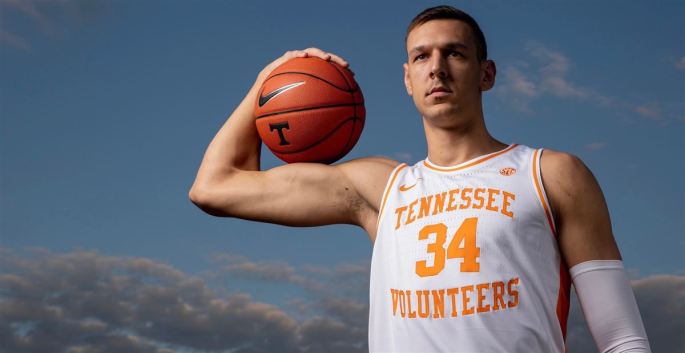
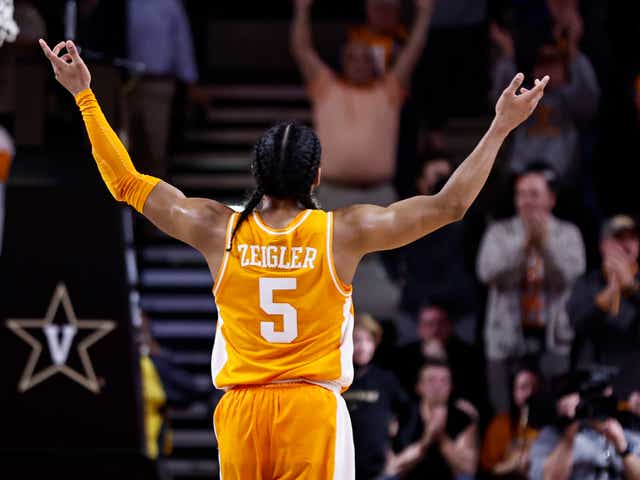
But somewhere along the last three months, Zakai Zeigler went from a New York curiosity that had no serious Division I offers until July to someone who’s on track to be one of the 3-5 all-time most beloved Tennessee players in any major sport the school has to offer. In the mild-to-moderate-to-severe annoyances this season has brought fans of all varieties, there has been one consistent tether to fandom: Zeigler. How a 5’9″ player that committed on August 27 and was initially only taken as an emergency backup for Kennedy Chandler became the fanbase’s favorite player in years is a story we get to live out in real time. What a joy, frankly.


Maybe you have to start where you’re supposed to start. A player who receives little-to-no Division I attention, beyond the Northeast Conference’s Bryant, attends the 2021 Peach Jam in Atlanta. There are probably 300 prospects there more well-known than him if not more. In the News-Sentinel piece, he describes this as his last-ditch attempt at getting a real offer before he takes a prep year. Player has a great week in Atlanta; player receives several committable offers, the most well-known of which would be Minnesota and Wichita State. Player receives a Tennessee offer two weeks after those, visits on August 22, commits on August 27, starts classes on August 31.

In the season preview, potentially the wrongest thing I’ve written online since I began writing about Tennessee basketball publicly five years ago, I listed Zeigler as a possible rotation member (fair). I said he’d play less than 100 minutes of basketball this season. I said his height (5’9″) and weight (167) would put a hard cap on playing time in Year One, because he came in too late to get serious strength training. I figured defense would be an issue. I thought wrong. I am far from the first person Zakai Zeigler has proven wrong; I am simply one of the latest and most public.

Zeigler didn’t top 13 minutes in the first three games, but he broke out in the fourth: 18 points on 7-for-10 shooting against North Carolina. He sort of laid dormant for a while but just…kept coming back. He completely flipped the script of his October scouting report: he struggled to knock down shots, but was ridiculously tenacious on defense. He picked up five steals against Mississippi, then four against South Carolina, then four against Vanderbilt, including a play that essentially sealed the game. Then he started hitting shots again. Watch that CBS video once more:

Listen to Kevin Harlan’s voice levitate. It hangs for a second as the shot drops. You hear what sounds as either “BOOM” or “OOH” but translates to “Zeigler, another three!” Harlan has voiced many beautiful moments of basketball fandom for me; the one most college basketball fans will recall is “Farokmanesh, a three…goooooooooood!” The one the average sports fan will know is this, one of the 3-5 greatest calls by any sports announcer that I know of.

Without the commentary, I don’t think this is one of LeBron’s 25 best dunks of his career. (Noting here that Harlan once used this call for a Kobe dunk that is probably better, but happened in a regular season game and has a worse YouTube video.) LeBron has gone higher, slammed harder, hurt more, defied physics and basic science more beautifully. But it is the commentary that makes me believe this is a physical accomplishment on the level of walking on the Moon. WITH NO REGARD FOR HUMAN LIFE is such a visceral, gut-rattling call. It is what you would say for an act of war, not for someone harshly placing a round ball in a basket. But when you think about it, it makes sense. Basketball is war. It is violent, brutal, and it hurts you, both mentally and physically. We can’t get enough of it and we never will.

Harlan’s voice is meant for something greater than sports. If it were still 2012 and people were still making the Facebook pages titled I Wish Morgan Freeman Narrated My Life, I would make the counter-page for Kevin Harlan. It is an absurd act of luck and grace that Kevin Harlan calls college basketball games with fair regularity. It is even more absurd that Kevin Harlan got to call this particular Zakai Zeigler game. In a just world, as much as I enjoy and love our friends Tom Hart and Dane Bradshaw, it would have been Harlan’s voice soundtracking Zeigler’s own LeBron moment:

In October, the reasonable expectation for Zakai Zeigler, and by everyone that doesn’t have the last name Zeigler, was for him to be a playable ninth or tenth man. On the worst night, you figured the emergency backup point guard would come in for 10 minutes because Kennedy Chandler got into foul trouble or something. All of this fun stuff wasn’t supposed to happen until 2022-23 at the earliest. Really, given how raw Zeigler sounded and how little strength training he’d had, you could’ve said his junior year (2023-24) would be the right time for a breakout.

It is February now. We are six days from the Super Bowl. Zakai Zeigler is, at worst, one of the five best players on Tennessee’s roster. There have been games where he’s outplayed Chandler, a near-certain first-round draft pick, by a significant margin. Zeigler and Chandler have combined for 107 points over Tennessee’s last four games. Zeigler has outscored Jabari Smith, Chandler, and TyTy Washington since January 25th. Again, this is a 5’9″ emergency freshman point guard who had as many SEC offers as I did seven months ago.

This is not supposed to logically happen. Bart Torvik’s player stats include a 0-100 recruiting rating for each player, which essentially corresponds to “how highly was this player rated by the average recruiting website.” Among freshmen at high-major schools, #1 in Box Plus-Minus is Gonzaga’s Chet Holmgren, who was the #1 overall recruit in last year’s class. #2: A.J. Griffin of Duke, who was 18th. Of this year’s top 22 players by BPM, 12 were ranked no lower than 35th in the class of 2021. All but two were at least ranked in the top 200. Only one of those 22 was, at any point of their senior year, unranked. Take a wild guess which one.

So here we are: an unranked, barely recruited 5’9″ freshman has stolen the hearts of the entire Tennessee fanbase with a full month of games left to play in his first season. And that’s Act One. Imagine what Acts Two, Three, and Four will bring. Using Torvik’s same player stats, I attempted to see what happened to freshman with a similar Year One to Zeigler (>1.5 PRPG, >5.5 BPM, high-major player, no taller than 6′). I then had to expand it because the initial list was eight people long over 15 seasons, and one of them was Zeigler’s teammate.

Alright then: 6’3″ or shorter, same PRPG, same BPM, but a 3% or better Steal% and a 20% or higher Usage Rate. This time, let’s see what happened after their freshman year.

One more: the Player Comparison tool on Torvik’s site, which takes all of Zeigler’s stats and throws up a similarity score to other seasons that match it most closely. This is freshman-only, and these are the five closest comparisons.

Please remember that this is a player who was completely unranked by any recruiting service until August 26, the day before he committed to Tennessee. Among the five players that this system feels are his closest comparisons, there are a combined 11 All-Conference First or Second Team selections. There are five players who at least touched the court in an NBA game. Three of them are active. One of them, VanVleet, is an All-Star. Of the five, only Mills failed to play all four years at his school of choice.

Consider all of that, but most importantly consider that you are strongly likely to get three more years plus the next 6-8 weeks of Zakai Zeigler in a Tennessee uniform. The beauty and horror of life is that we cannot tell the future. Anything, both good and bad, can reasonably happen from this point onward. All of what we know to look for going forward is based on past events. Yet those past events are so exciting, so charming, so singularly lovable that the uncertainty of the future is embraced with arms wide open.

Basketball, the beautiful game, has given Zeigler and his family a chance at a new life. It provides, and if there is justice, it will provide for him. I find myself most excited to see the ways the future will provide a career for a player who grew up in the shadows and deserves the spotlight like nothing else.


Various notes from the last two games:

  • Another out-of-nowhere ref show. Tennessee and Texas A&M combined for 42 fouls, a couple of which were late A&M desperation ones but most of which were organic. I was a little surprised by this, mostly because Tennessee is rarely a foul-heavy team and A&M isn’t as extreme as Carolina. Getting a little tired of noting these stats in games where the general expectation should be about 32-34 combined fouls; very much “this could’ve been an email” vibes. Let the players play.
  • On free throw variance. There were a couple weeks where Tennessee fans were in tatters over free throw shooting. That’s fine; it did look bad for a while. Those complaints have now gone quiet after Tennessee went 34-for-41 (82.9%) at the line this week, but the worst Benevolent God of Variance action was letting A&M, a team that entered the game shooting 64% at the line, go 21-for-25 (84%). You could explain five of A&M’s 80 points away right there; a 90-75 scoreline would indeed feel a little better.
  • The Josiah-Jordan James resurgence. Torvik’s site also provides an adjusted Net Rating for each player that rarely goes above, like, +8 or +9. James posted a +7.3 against A&M and +9.6 against South Carolina to go along with his two highest scoring performances of the season. James is now shooting 32.7% from deep in SEC play, which sounds average but is a percentage everyone was begging for when the guy was in the 20-25% range.
  • Positive three-point variance! When I found myself in the depths of exploring seagulls in January, it was in part influenced by Tennessee’s seeming inability to have a normal basketball game. At the time, through 14 games, these were their numbers:
    • 50% or better: 1 game (7.1%)
    • 40-49%: 4 games (28.6%)
    • 30-39%: 1 game (7.1%)
    • 20-29%: 6 games (42.9%)
    • 19% or worse: 2 games (14.3%)

Part of the frustration was that Tennessee was having significantly more bad games (8 of 29% or worse) than good ones (5 of 40% or better). Fast forward four weeks, and here’s the new numbers:

    • 50% or better: 2 games (9.1%)
    • 40-49%: 7 games (31.8%)
    • 30-39%: 3 games (13.6%)
    • 20-29%: 8 games (36.3%)
    • 19% or worse: 2 games (9.1%)

The problem still exists in that Tennessee is bizarrely incapable of having a normal, boring shooting night. The great news is that the top half of this chart has grown immensely since the LSU loss. Tennessee now has nine games of 40% or better from deep, and the median performance is now a 35.7% outing in a home win over LSU. One month of basketball changes a lot!

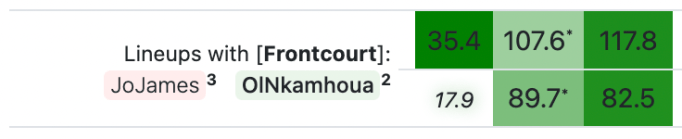
  • Four guards/wings at all times. Torvik’s algorithm considers James a ‘stretch 4,’ which is…probably fair, but Tennessee starts him at the 3 in pretty much every game. I’m sort of at the point where I don’t care about starting lineups as long as the closing lineup is the one that makes sense. Tennessee got there in the South Carolina game, unfortunately thanks to the Nkamhoua injury. Per Hoop-Explorer, lineups with any three of Vescovi/Chandler/Zeigler/Powell were +15 in 23 possessions; all other lineups were +9 in 42. Play three of those guys at all important times, and you will be happy.
  • Speaking of which: closing lineup. The data of CBB Analytics shares this: Tennessee’s most frequent lineup with 4 minutes to go this season has been Chandler, Zeigler, Vescovi, James, and Nkamhoua. Second-most frequent: the first four, but with Fulkerson. Maybe everything is fine?
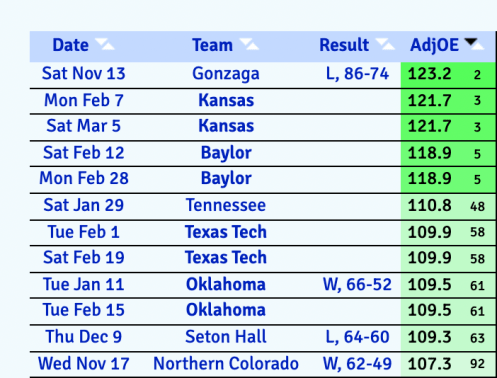
  • Finally: KenPom bump. Tennessee now sits 34th in Adjusted Offensive Efficiency, which would both be the second-highest offense of the Barnes era and also would fulfill a useful stats thing. This website scanned the NCAA Tournament field in 2018 and found that, since KenPom’s existence, 86% of Final Four teams had an offense that was at least in the top 40 nationally. 73% were in the top 20. I’m not picking Tennessee to go to the Final Four barring a very advantageous draw (more on that later this week), but Tennessee is trending in the right direction at the right time. Last year’s Elite Eight teams and their pre-NCAAT offensive rankings: 1st, 3rd, 6th, 7th, 18th, 28th, 35th, and 63rd. At least being top 35 is positive, especially after a month of being outside the top 50.
Show Me My Opponent, 2021-22: South Carolina, Part Two

EDITOR’S NOTE: Tennessee played this team just over three weeks ago and little about them has changed. Most of what’s written here is from the first preview

GAME INFORMATION
OPPONENT South Carolina (13-8, 4-5 SEC, #100 KenPom)
(6-14, 4-12 SEC, #124 KenPom 2020-21)
LOCATION Colonial Life Arena
Columbia, SC
TIME Saturday, February 5
1 PM ET
CHANNEL CBS (!)
ANNOUNCERS Kevin Harlan (PBP)
Jim Spanarkel (analyst)
SPREAD KenPom: Tennessee -8
Torvik: Tennessee -7.1

Tennessee is looking to build off of a surprising shootout win over Texas A&M and has quietly looked better offensively the last couple of weeks outside of a Texas horror show. South Carolina is…just looking, I think. This is typically the time of the year the Gamecocks pull off a variety of College Crap wins over teams that are much better than them, but I don’t know that they’ve got that same juice this year; they enter at 4-5 with about a 65% shot at entering next Saturday 4-7 and are projected to finish 7-11 in SEC play.

For some reason this game is on CBS, which is amazing news because you get Kevin Harlan and Jim Spanarkel on the call, two of the best.


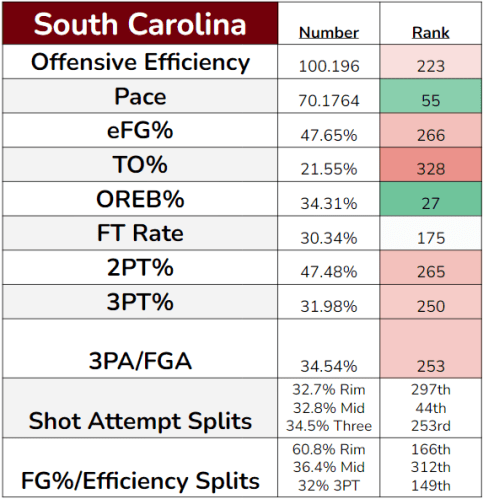
South Carolina’s offense

A little worse than last time out, when they were at least a top-200 unit. All of my complaints about this being a truly unwatchable offense have been amplified as of late. Hooray! Tennessee held this offense to 0.657 PPP in the first meeting in part because the Gamecocks turned it over on 33% of possessions and took tons of awful shots. The best South Carolina offensive performance in SEC play was against Georgia at 1.125 PPP; Georgia gave up 1.21 PPP at home to ETSU. If you think Tennessee is hard to watch, South Carolina is torturous. The funniest thing about it is that CBS knew before the season began that South Carolina’s offense has been terrible for a decade and still picked this game!

Also:

Oof. Carolina hasn’t even played Kentucky or LSU yet.

This year’s leading scorer, by way of being the oldest guy on the team, is Erik Stevenson (11.2 PPG). Stevenson is one of three players on the roster with more than seven made threes this season, which is nice. I wouldn’t call Stevenson good at creating his own shot – he’s currently posting a cool 31.4% eFG% on off-the-dribble jumpers and only has 23 rim makes this year – but he can at least shoot, which is something. Most off-ball screens the Gamecocks run are for Stevenson.

Other guys of interest: Jermaine Couisnard is somehow still here. Couisnard comes off the bench, but is third on the team in scoring at 10.1 PPG and is an efficient three-point shooter at about 36%. That’s useful on a team that doesn’t take or make many threes. The problem is that Couisnard remains a turnover machine, almost touching a 27% TO% as an individual this season. The guy can shoot, but if you ask him to dribble at all, it’s a huge win for your defense.

There are three other players worth noting. Wildens Leveque (7.9 PPG) would be my main reason to watch this team on a nightly basis if I had one. Leveque is very much not a jump shooter and isn’t good at creating his own shot, but he’s been hyper-efficient at the rim (76.9% on 52 attempts) and is really good at knowing when to cut to the basket. One change worth noting: Leveque has been kind of terrible since he first played Tennessee, scoring a total of 25 points in SoCar’s last seven games.

James Reese V (10.9 PPG) should probably be Just a Shooter because he’s sitting at 38% from three, and the danger with him is that he’s equally solid in catch-and-shoot and pull-up situations. He’s South Carolina’s new #2 scorer after being #4 in the first game and has started hitting lots of mid-range twos. Devin Carter (8.3 PPG) uses more possessions than anyone not named Stevenson, but is posting a 43.1% eFG% and is 21-for-73 on everything that’s not a layup or dunk.

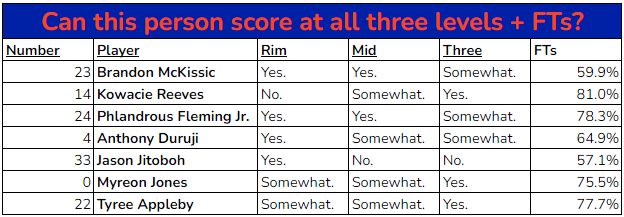
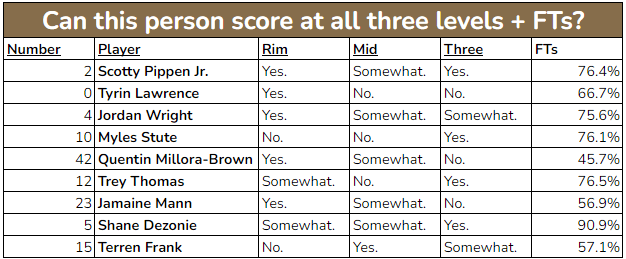
CHART! The official Chart Guide is now as follows (and yes, South Carolina plays 12 guys):

Yes: “Be afraid.” 😬
Somewhat: “They can hit this but not very efficiently.” 🤔
No: “Either never attempts this shot or is atrocious at making it.” 🥳

South Carolina’s defense

A little bit better than last time out, in that they’re now a top-30 unit. South Carolina, as a concept, is in a loose group of teams I’m calling the Cringe Posters. To qualify, your offense must rank 200th or worse while your defense must be a top-30 unit. Congrats to South Carolina, San Diego State, and VCU for Cringe Posting.

Like the offense, the patterns are pretty much always the same: a healthy amount of blocked shots, lots of forced turnovers, but little in the way of defensive rebounding and an insane amount of fouling.

Starting down low and working our way out: the rim. Synergy ranks the South Carolina defense in the 93rd-percentile in around-the-basket defense, and play-by-play stats have them 66th-best nationally, now a bit ahead of Tennessee. Carolina has a switch-heavy defense that spends most of its time in man but can bust its way to a 2-3 zone look at times:

I wouldn’t be shocked to see this simply because we already saw it for about 10-15 possessions last year when the two played. Anyway, the rim protection is pretty legitimate. Carolina’s best shot-blocker is Keyshawn Bryant, who comes off the bench, but they play a wide variety of guys at the 4 and 5 (literally nine different guys have logged significant time in the last five games in the frontcourt), all of whom seem fairly capable at making life difficult. The most fearful, by my standards, is Leveque.

The problem is that Leveque, Bryant, and nearly everyone in the frontcourt foul like crazy. The Gamecocks commit more fouls than all but eight teams in college basketball. The odds of you getting to the free throw line increase immensely if you get an offensive rebound, post up any of their bigs, or produce a well-timed basket cut.

So yeah, no wonder they play a billion guys down low. South Carolina’s been excellent at stuffing twos, but when you foul as often as they do, the risk/reward of this gets a little fuzzy. Frank Martin’s defense is hyper-aggressive for 40 minutes every single night. This produces a ton of turnovers, particularly in ball-screens and in isolation, but it leads to a lot of reaching, jumping, overexcitement, etc.

This is why they should build a Mike Schwartz statue at Thompson-Boling Arena. Tennessee is also hyper-aggressive, but they foul half as often. South Carolina is a whirling dervish of feast-or-famine. When it works, great; when it doesn’t, well, you’ll be pleased to know they have a poor Guarded/Unguarded rate (51/49) and have gotten torched from three by a few teams.

This is a defense that wants to produce variance. Whether or not this is upsetting to you probably depends on whether you’ve watched this season of Tennessee basketball.

How Tennessee matches up

The last time Tennessee played South Carolina, I noted that I was pretty annoyed by who Tennessee was letting take catch-and-shoot threes and begged for Josiah-Jordan James to find a different shot he might like more. Since that game, Josiah-Jordan James is 8-for-15 from three, so please note that you should not listen to anything I do or say.

In the first game between these two, Tennessee found most of its offensive success inside the perimeter, whether it was guards running off of screens or John Fulkerson wobbling about in the post. Tennessee’s rotational shifts since then could complicate the latter, but the former is still a pretty reasonable ask. In particular, Zakai Zeigler was the best player on the court in the first battle these two had. Zeigler seems to improve every week; asking him to continue attacking the rim like his hair is on fire makes for a very fun viewing experience.

The other thing: you’ll have to create open threes, which I think Tennessee is reasonably good at against teams that are not coached by Chris Beard or Chris Beard’s right-hand man. Tennessee went 7-for-21 from deep in the first meeting but frankly got pretty unlucky; 14 of their 16 catch-and-shoot attempts didn’t have a defender within four feet of the shooter. Tennessee did go 6-for-16 on these, and it gives me confidence that even if South Carolina adjusts their coverage Tennessee could still exploit it pretty well. So: why not feed your hottest three-point shooter in Josiah-Jordan James? (Or a variety of other options.)

Defensively, Tennessee forced a very even shot split in the first game: 16 rim, 14 mid-range, 19 threes. South Carolina couldn’t even hit 50% of their attempts at the rim and were fairly hopeless everywhere else, but the fear of game-to-game variance is always going to be there. To their credit, the Gamecocks did just shoot 9-for-19 against a top-40 Texas A&M defense. I think Tennessee’s a lot better on defense, obviously, but it’s not crazy to imagine a scenario where South Carolina hangs around for long enough to annoy you.

I would be surprised if Tennessee forces quite as many turnovers as they did in the first game simply because Carolina hasn’t topped 24% TO% in a game since. So: you have to play quality shot defense and rebound. My honest first thought with the Gamecocks is “let them shoot” because they’re in the 11th-percentile in America in half-court jumper efficiency. Let them shoot. Guard it, obviously, but I’m not gonna sweat if they’re taking guarded threes or long twos.

This could very easily turn itself into a game where neither side touches 70, but I thought that about the A&M game, too. Let’s see what happens.

Starters + rotations

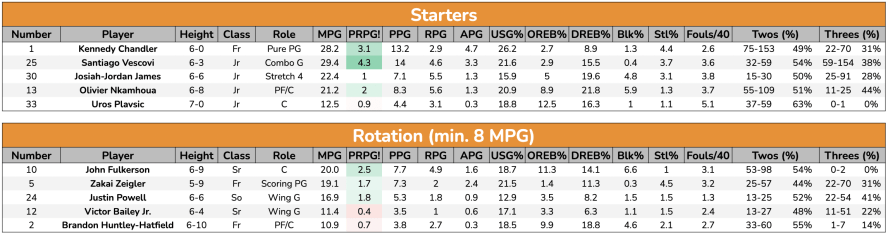
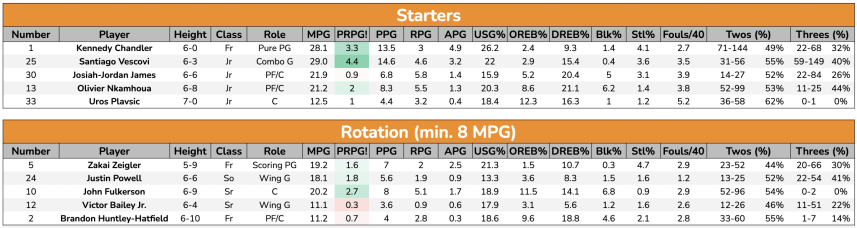
Metric explanations: Role is algorithmically-determined by Bart Torvik. MPG is minutes per game. PPG/RPG/APG/Fouls/Twos/Threes are what you’d guess. USG% is the percentage of possessions a player uses on the court. OREB%/DREB% are your available rebounds usurped. Finally, PRPG! is Bart Torvik’s Points Over Replacement metric; the higher the better. If you’re on mobile, zoom in; if on desktop, right click -> Open Image in New Tab.

Three things to watch for

  • Threes. Threes! Tennessee made 11 against Texas A&M, and quietly, it seems like they’re making a resurgence. In the last six games, Tennessee has made 10+ threes in four. The positive regression everyone’s been begging for seems to be here; if Tennessee makes 11 in this one I’m not sure what Carolina’s path to an upset is.
  • Who wins the shot volume battle? This is #6 at #30 in defensive TO%, #35 at #26 in OREB%. The path to a Carolina win involves them having at least a 4-5 possession edge in TO + OREB margin.
  • Do we get an explanation why this is on CBS? It’s very strange that they picked this one for CBS distribution back in August and not…you know, Tennessee vs. An NCAA Tournament Team. Excited to hear Harlan’s voice, though.

Key matchups

James Reese V vs. Santiago Vescovi. Reese has become South Carolina’s most reliable player in the last month; Vescovi has done the same for the Vols. Reese was the difference-maker in the Texas A&M + Vandy wins, as those are the only games this year he’s gone for more than 15 points. Keep him under 15 and limit his impact.

Erik Stevenson vs. Three Players. Stevenson will get covered by a lot of guys because Tennessee gives all of Powell/JJJ/Vescovi serious time at the 3, but also because Stevenson spends a lot of on-court time flying around off-ball screens. I’d prefer to not let him get loose.

Wildens Leveque vs. Uros Plavsic. I guess Plavsic is still starting, but this is probably Nkamhoua’s matchup by game’s end. Either way, Leveque has stopped providing much of an impact on O but is still really good on D. Leveque has finished seven games this year with 4 or 5 fouls, and when he’s off the court, Carolina doesn’t force as many TOs and fouls more frequently.

Three predictions

  1. Both teams block 4 or more shots;
  2. South Carolina has a possession with multiple offensive rebounds that results in zero points and feels incredibly deflating;
  3. Tennessee 71, South Carolina 63.

Show Me My Opponent, 2021-22: Texas A&M

GAME INFORMATION
OPPONENT Texas A&M (15-6, 4-4 SEC, #72 KenPom)
(8-10, 2-8 SEC, COVID-19 2020-21)
LOCATION Thompson-Boling Arena
Knoxville, TN
TIME Tuesday, February 1
7 PM ET
CHANNEL SEC Network
ANNOUNCERS Tom Hart (PBP)
Dane Bradshaw (analyst)
SPREAD Sinners: Tennessee -11.5
KenPom: Tennessee -11

Torvik: Tennessee -9.3

If you’re one of the growing number of Twitter people who preach the benefits of dropping a salad fork in your eye over watching Tennessee basketball games, maybe skip this one. Texas A&M has lost four in a row, has an offense ranked two spots ahead of ETSU’s, and has built off of a 15-2 start that looked legitimately promising by taking a blowtorch to their NCAA Tournament hopes. Also, their offense is still pretty rough to watch.

The great news for Tennessee is that I can’t imagine a better time to draw A&M: four losses in a row, can’t score very much, and their defense has sprung a serious leak in both rebounding and fouling. The opportunity for a get-right game is very much here. We’ll see what Tennessee does with it.


Texas A&M’s offense

More or less what it always is. A&M plays a little faster this year and isn’t quite as recklessly terrible at hitting threes, but they’re one of the worst free throw shooting teams alive (64.3%, 344th) and generate offense by way of crashing the boards and getting fouled a lot. I am sure you’ll be floored to hear this is not my favorite SEC team to watch.

Buzz Williams runs a ball-screen heavy offense with the fewest post-ups of any team in the SEC. That…basically gives you the gist. I’m trying hard to make this interesting! Similarly to Texas, A&M doesn’t have a true #1 scorer – the team leader that we’ll get to scores 12.9 points a game – but they have about six third bananas. There are two that stand out from the pack, but A&M is mostly scoring-by-committee.

The top dog is Quenton Jackson (12.9 PPG), who predictably never starts and comes off the bench in a Tari Eason fashion. Just under half of Jackson’s makes are unassisted, with the heaviest amount of his shots coming at the rim. Jackson takes a lot of jumpers, most from three, and is a decent-not-great shooter (32.9% 3PT%). The main threat here: despite mostly playing the 3 & 4, Jackson is a quality ball-handler that has proven very good at dribbling off a pick to the rim. (Same with spot-ups.) A weird thing that is true: Jackson is only 11-for-16 on dunks.

Jackson has the second-highest usage rate on the team (26.7% USG%), so you can expect him to be a major contributor. The other double-digit scorer is Henry Coleman, who has a usage profile of a plus role player (20.4% USG%, 18.8% of shots when on the court) but is super efficient with his shots. Coleman is A&M’s center by default at 6’8″, 243. He never posts up, but his shot selection is a who’s who of high-PPP process: cuts, OREBs, and plays in transition. Coleman is a very poor jump shooter, but he’s so good at the rim that it rarely matters.

Beyond that, A&M has four players that score between 8.2 and 9.4 PPG. In order of most to least points:

  • Marcus Williams (9.4 PPG) is the starting point guard. He is an okay deep shooter (31.2% 3PT%), but his main feature is an alarming 26.2% TO%. Also kind of a bad finisher at the rim.
  • Tyrece Radford (9.3 PPG) transferred from Virginia Tech and has taken a bizarre step back in fouls drawn (1.2 fewer per 40) while still being a bad jump shooter. Excellent finisher at the rim, though.
  • Wade Taylor IV (8.2 PPG) is atrocious at the rim (39.4% FG%) but hitting 35% of threes. Both the team’s best passer and team’s most aggressive offensive player (33% USG%).
  • Andre Gordon (8.2 PPG) is the closest thing to Just A Shooter A&M has. 31-for-65 (47.7%) on threes, 51% on twos.

CHART! The official Chart Guide is now as follows:

Yes: “Be afraid.” 😬
Somewhat: “They can hit this but not very efficiently.” 🤔
No: “Either never attempts this shot or is atrocious at making it.” 🥳

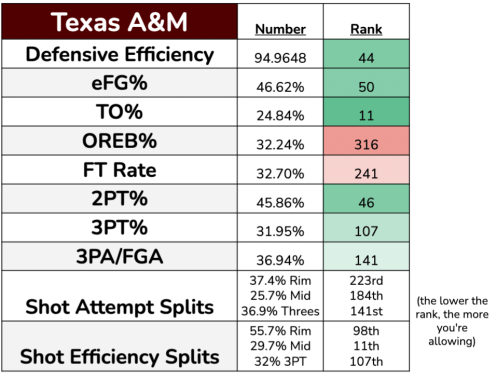
Texas A&M’s defense

A same-but-different thing? Texas A&M’s signature as long as Buzz Williams has been head coach is a defense that shifts between a 2-3 zone and a man-to-man defense, often within the same possession. It makes charting them quite difficult, but there are a couple of noticeable differences with this year’s unit:

  1. Texas A&M has stopped allowing as many three-point attempts, dropping their 3PA% all the way to 36.9% after 47.4% last year;
  2. They’ve also tightened up their rim defense and have made it really, really hard to score.

Essentially, A&M’s goal is to win as many games by a 66-65 score as humanly possible. This year alone, nine of their 21 games have been decided by six or fewer points. What’s interesting about A&M’s defense is that a lot of the same hallmarks are still there: lots of catch-and-shoot attempts, lots of attempts down low, not many off-the-dribble jumpers, and a genuinely monstrous amount of turnovers forced. In particular, ball-handlers, whether in pick & roll or isolation, have had a whale of a time simply holding onto the ball.

When you can get off a shot against them, the results haven’t been optimal. You’re certainly able to score against them if you get shots off – Synergy rates A&M as 28th-percentile in catch-and-shoot defense and in the 59th-percentile at the rim – but it’s just not been easy. #3 (by KenPom) Kentucky posted just 0.898 PPP against A&M, while #39 Arkansas went for only 0.966 PPP. Both were losses because of the anemic-as-always Aggie offense, but the amount of havoc plays they produce are remarkably high. There’s not just one blocksmith on the team, but several; everyone gets a share.

The good news is that there’s a path to success here. A&M has played eight Top 100 opponents; six went for 1+ PPP. Top 100 offenses have gone for an average of 1.045 PPP, with a lot of damage being done on the boards. A&M has allowed opponents to go for a 31% or higher DREB% 12 times; they are 6-6 in those games and 9-0 in all others. All you can do is what the system would suggest: attack the paint with cuts to the basket, kick out for open threes, and avoid taking mid-range twos.

How Tennessee matches up

It would frankly be nice if Tennessee’s offense kicked itself into gear so I could stop writing the exact same thing twice a week on a loop. Tennessee probably doesn’t have a roster that fits the new rim-and-threes philosophy very well, but the results should be better than what fans have seen thus far. Anyway, this matchup presents a couple of get-right opportunities: the chance to take and make a good amount of threes while driving to the rim out of spot-up situations after you hit a couple.

Justin Powell should be taking more shots. If you would like one “Will, what fix do you propose?” answer to the question I get every week, it is that. Think about it: today is February 1. If on November 1, I had told you that Justin Powell would rank in a three-way tie for third on the team in made threes, fifth in three-point attempts, and seventh in minutes played, I imagine you would be either disappointed or truly blown away at how well the rest of the roster developed in one offseason. It is okay to be disappointed.

For Powell to make these final two months count, he has to shoot. Period. Rick Barnes is right when he claims Powell passes up several open looks every game. If Tennessee wants to squeeze everything they can out of a bruised, rotting lemon that they call an offense, Powell’s over/under for three-point attempts over the final ten games of the season should be 45. It starts here, against a defense that’s below-average at closing out on true catch-and-shoot possessions.

The other thing that’s gotta turn is something that should be borderline obvious by now: the starting (and in close games, closing) lineup. Understandably, Barnes has fiddled with this lineup for a while because the team has two standout players (Chandler/Vescovi), five “let’s see where the night takes us” guys, and four players somewhere between fledgeling and farting on any given night. My proposal is this: embrace the fact that you mostly have no center. Play Nkamhoua at the 5. Play James at the 4. Play Chandler, Vescovi, and Rotating Guard/Wing of the Day at 1/2/3. It works. God, I promise it works.

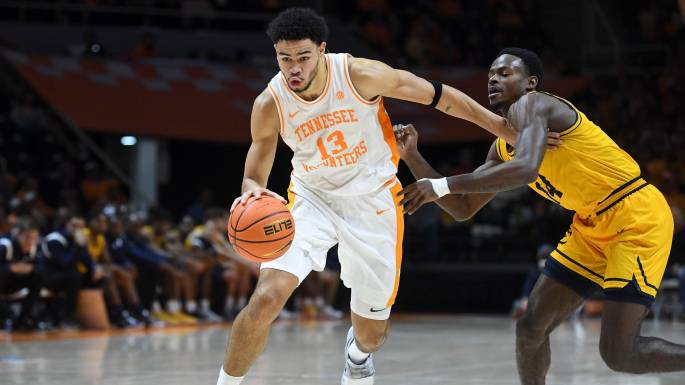
Do it, and I promise things will get better sooner rather than later. Here’s Kennedy Chandler driving to the basket as a bonus.

The defensive section is becoming pretty easy to write. Texas posted a 63.5% eFG% on Saturday – a number that normally translates to, like, no worse than 1.15 PPP (AKA 66ish points) – and had one of their worst offensive games of the year because Tennessee dominated the boards and forced 19 turnovers. The defense is rock-solid and remains the very opposite of The Problem. If Tennessee shuts down the deep balls A&M wants to loft up and forces low-quality shots on the whole, which isn’t that hard to do, this should be a get-right win. Given the high amount of shots A&M wants to take at the rim, I would like to see Tennessee post at least five blocks.

Just win.

Starters + rotations

Metric explanations: Role is algorithmically-determined by Bart Torvik. MPG is minutes per game. PPG/RPG/APG/Fouls/Twos/Threes are what you’d guess. USG% is the percentage of possessions a player uses on the court. OREB%/DREB% are your available rebounds usurped. Finally, PRPG! is Bart Torvik’s Points Over Replacement metric; the higher the better. If you’re on mobile, zoom in; if on desktop, right click -> Open Image in New Tab.

Three things to watch for

  • How often does Tennessee play a James/Nkamhoua frontcourt? Really, how often does Tennessee play James at the 4? The Fulkerson/Plavsic frontcourt, for reasons beaten to death, is an offensive black hole. Nkamhoua/Fulkerson is producing a 0.97 PPP (not schedule-adjusted) offensively because Nkamhoua doesn’t take enough threes to create the offensive spacing necessary for such a lineup. (Look at Fabian White at Houston for how a 6’8″ back-to-the-basket player with a similar build can still take 2-3 threes a night.) Of Tennessee’s four best frontcourt combinations (min. 100 possessions), three have James at the 4. There shouldn’t be a question anymore because the answer exists. How soon Tennessee realizes it is up to them.
  • Shot volume. Tennessee should own an advantage in both TOs + rebounding, but to what extent will be determined by Tennessee’s own offensive turnover struggles.
  • Tennessee’s pass deflections. This is tracked internally, but Tom Satkowiak (Tennessee SID) reports Tennessee averages 28.5 pass deflections per game. That’s an insanely high number; if Tennessee gets to 28 or more in this one they may win by 20+.

Key matchups

Olivier Nkamhoua vs. Henry Coleman. I guess this could be any number of centers, but Nkamhoua should be getting the most minutes at the 5. Coleman is a bear to deal with at the rim, but Nkamhoua could exploit Coleman’s foul troubles (4.3 per 40).

Quenton Jackson vs. Basically Half of the Tennessee Roster. Jackson splits his time at the 3 & 4; across the last five games, six different Tennessee players have seen at least 8+ MPG at either the 3 or 4.

Andre Gordon vs. Santiago Vescovi. Shooter vs. Shooter. The goal here: Vescovi either ends with more made threes or Gordon is held to fewer than four three-point attempts.

Three predictions

  1. Tennessee wins three of the Four Factors (losing Free Throw Rate);
  2. Dane Bradshaw correctly uses part of the second half to start a Santiago Vescovi First-Team All-SEC campaign;
  3. Tennessee 70, Texas A&M 59.

Process

January 26: #18 Tennessee 78, Florida 71 (14-5, 5-3 SEC)
January 29: Texas 52, #18 Tennessee 51 (14-6)

And I saw Sisyphus at his endless task raising his prodigious stone with both his hands. With hands and feet he tried to roll it up to the top of the hill, but always, just before he could roll it over on to the other side, its weight would be too much for him, and the pitiless stone would come thundering down again on to the plain.

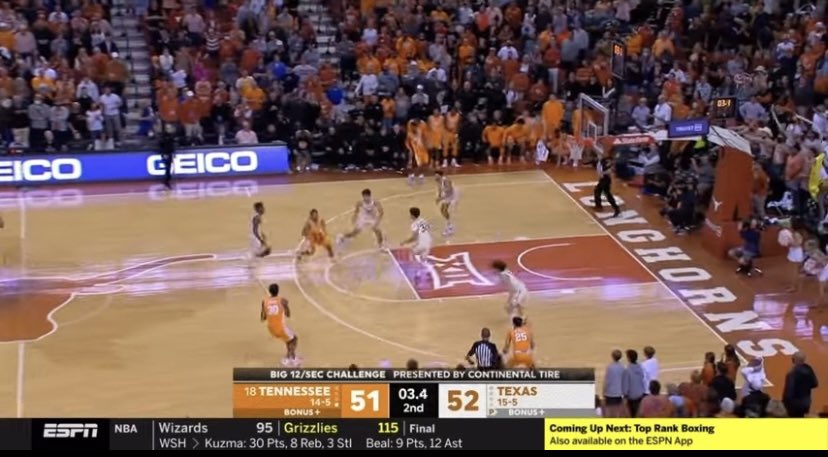
Here is the final play of Saturday’s game with precisely 3.4 seconds on the clock. Zakai Zeigler takes the inbound, uses his Jared Harper-like speed to get down the court extremely quickly, and goes into the final play. Right here, right now, Zeigler is stopped as he touches the top of the key. With Nkamhoua trailing by way of receiving the final inbounds pass, Tennessee is playing 4-on-5, but look at the attention Zeigler draws. This turns the play into a 3-on-2.

Image

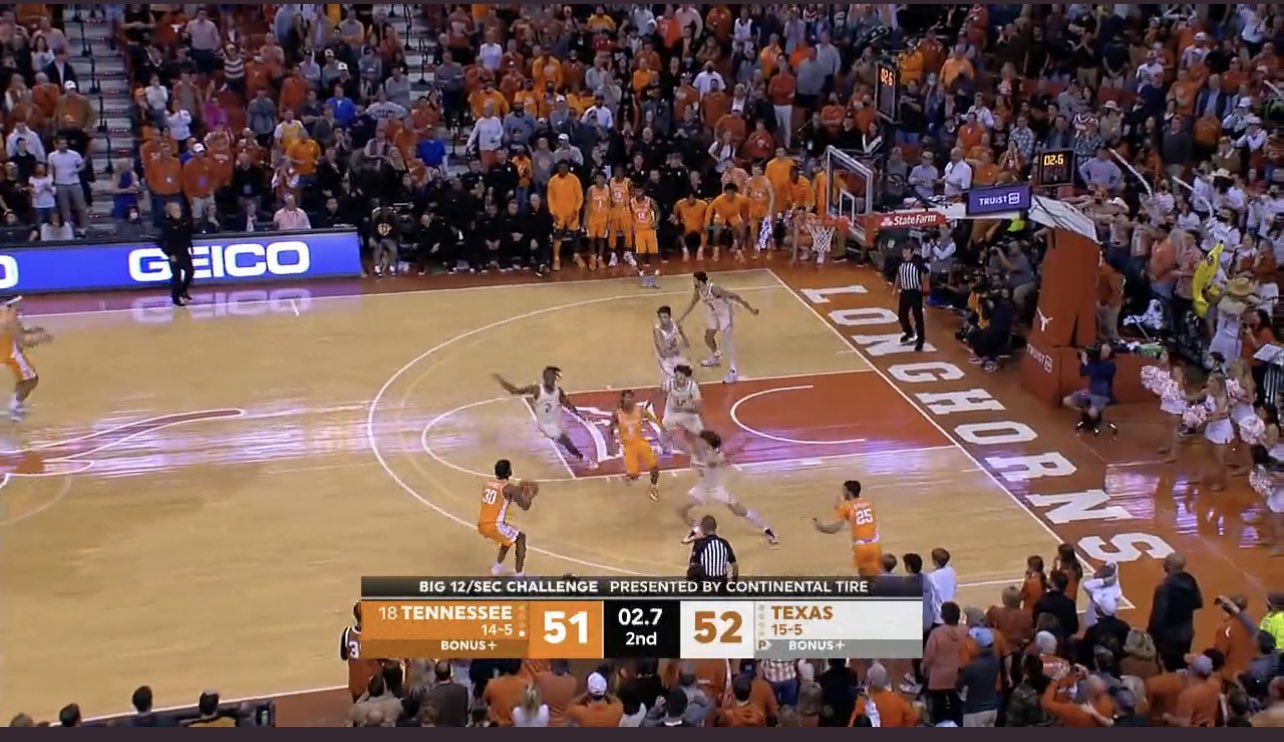
Two players are covered up: Victor Bailey, Jr. in one corner, Santiago Vescovi in the other. Would I have had Bailey on the court? Probably not, because Justin Powell is objectively better. But Justin Powell did not tie the game with a genuinely spectacular rebound and putback, so I get why Bailey is there. When Zeigler pulls up at 3.4 seconds to pass the ball, the highest-quality option on this play, as this screencap suggests, is Josiah-Jordan James for an open three on the right wing.

For his career on this shot – a three-pointer of any kind on the wing – James is a 31% shooter. For his career in general, James is a 31% three-point shooter. For his career on catch-and-shoot threes of any kind, James is 31% from the field. He is remarkably consistent, if nothing else. Yet some context is needed. When James receives the ball, he has scored eight of Tennessee’s 16 points as part of a 16-0 run that turned the game from a 51-35 ball of pathetic annoyance to a 51-51 ball of I Am Actually Laughing. He is 3-for-6 from three; every other player on the team combined is 2-for-11, including partner Vescovi, who is 0-for-5 from deep and 1-for-8 from the field.

James receives the ball. Here’s how it looks with 2.7 seconds to go.

Image

When James starts his shooting motion, I would charitably say that the closest Texas defender is five feet away. In the study Jimmy Dykes showed during last week’s LSU game, Tennessee had been shooting roughly 38% on any three where the defender was four feet or further away. James could have passed this to Vescovi, which I would’ve been fine with, but at that time, the Texas defender (Devin Askew) is closer to Vescovi than James.

The final play, which Rick Barnes drew up out of a timeout, gave Tennessee’s best three-point shooter on the night a pretty open look. People online keep screaming “YOU DON’T NEED A THREE!” or whatever. I suppose they are factually correct. Zakai Zeigler could have taken his little body, plowed directly ahead into three players of oncoming traffic, and either attempted to draw a foul that may or may not have been called or tossed up a floater over triple coverage. Considering that Zeigler has attempted all of four floaters this season, maybe you’re right. Maybe that is the right call: a shot that Tennessee’s roster as a whole hits 41% of the time, or 0.82 points-per-shot.

Or maybe the process of the play provided the best outcome it reasonably could have. If James gets the ball to Vescovi, great. Take off a second for the pass, take off an additional 0.5-1 seconds for Vescovi to get into his shooting motion. Vescovi reasonably gets that shot off with 0.7 or so seconds left, and maybe it goes in. Fine, luckfarts happen, whatever. But Tennessee did that exact same thing in this exact same game two months ago and everyone pretended they hated it then because “YOU DON’T NEED A THREE!”

That was on a night where the entire team shot at the rate the non-James players shot against Texas.

Because neither of these shots went in, everyone hates them, and everyone wants Rick Barnes jailed for some sort of crime against humanity. (Let it be known that Chris Beard should be held equally accountable for an offense that turned it over on a third of their possessions.) Because no one can seem to understand that the process is fundamentally different than the result, and the process can be good even if and when the result is bad, and the process can be bad even when the result is good (remember when a certain beloved player who shot 30% from three his final two seasons somehow made a fadeaway three to beat VCU?) we are here yet again. And boy, what an absolute joy it is to write about it.

Karl Havoc / "I Don't Even Want To Be Around Anymore" | Know Your Meme


The good news is that Tennessee overcome what felt a little like a luckfart game in midweek against Florida. It’s the exact kind of annoying slop you have to get through to achieve an SEC Tournament double-bye. I no longer have delusions of grandeur that Auburn is somehow going to blow the 1 seed; that seems very well locked up. The more interesting thing is that Tennessee still remains on track to battle Kentucky for the 2 seed. While neither side would admit it, it benefits both to simply avoid Auburn as long as they have to.

The process of Tennessee’s midweek game against Florida was pretty fantastic. In that one, Tennessee got off 21 catch-and-shoot attempts; 12 were deemed unguarded by Synergy, which was genuinely surprising and positive against a Florida defense that hadn’t allowed that many open three-point attempts in months. Tennessee deservingly had their best day from deep in some time.

That Vescovi open three was the result of Justin Powell, of all people, driving to the lane and dishing it to the corner to the best shooter on the team. Florida and Texas have fundamentally different defensive structures that result in much different outcomes, but in this game, Tennessee’s roster simply knew where to strike to create good processes that resulted in good, happy outcomes.

The funny thing about all of what’s happening with Tennessee basketball right now is that immediately after I described them as the kings of slop, they went out and produced the most watchable SEC game they’ve played in since 2018-19. Florida/Tennessee would’ve been a blast to watch if you were a neutral fan, or if you simply were unaware that Pat Adams was in existence. All sorts of great shot-making; all sorts of quality individual play. Tennessee played really good defense for most of this game and still got a test they probably needed after shutting down LSU. I liked it!

I think I would like it more, though, if Tennessee simply never receives Pat Adams for a basketball game again. For the first time ever Wednesday, my little brother (a freshman at Tennessee) and I attended a Tennessee basketball game ‘together.’ Well, he’s in the student section and I’m in the upper deck where I hear what I assume to be an otherwise-sweet child yelling “BOO VOLS! GO GATORS!” in the middle of every free throw attempt, but whatever.

I bring this up because with two minutes left, I made plans to meet up with him after the game to say hello. That was at 7:56 PM Eastern. The game ended 26 minutes later. This is not a sustainable thing. If the SEC wants to get calls right, that’s fine, I get it. But the SEC must find a way to both 1) Get calls right; while 2) Doing it in 30 seconds or less. We do not need full two-minute timeouts for every review. We do not need to hand both teams a chance to get a breather. We can surely officiate a game correctly – which Pat Adams did not do – and surely get in and out of an arena in a reasonable span of time. Maybe next year, when I’m reminded again that being a member of this conference Just Means More.


Here are the last 32 Elite Eight teams and how they ranked on KenPom on January 30.

That is a long image. Here is the point: of the last 32 teams to make the Elite Eight, 12 ranked outside of the KenPom top 15 on January 30. 10 had either an offense or defense that ranked outside of the top 50 nationally. The #1 team made it every year – hello, 2021-22 Gonzaga – but #2 had a 50% success rate. #5 made it once. #6 and #7, supposedly both on track for the Elite Eight, went a combined 0-for-8.

It is a long season that culminates in a tournament where you have zero control of your strength of schedule after the first round. Weird stuff happens every single year. Upsets happen every single year. I would advise not pulling the ripcord until the ripcord has been pulled for you, especially when the operators of the ripcord are currently 13th on KenPom.


Various notes and stuff that didn’t make it in:

  • Ban 6 PM weekday tips. On a normal day with no game, my wife and I live 20 minutes from the University campus. We left home at 4:57 PM ET, the earliest we could leave. We did not park for the Florida game until 6:07 PM ET; we did not enter the arena until 6:18. I understand that television decides everything now. I understand that money is money. I also understand that doing this horse[REDACTED] to fans for another decade is going to lead to a whole new wave of articles about Why Fans Have Stopped Attending College Sports Events in 2032.
  • All that said about Pat Adams, Tennessee did get the normal home whistle. Everyone has seen Josiah-Jordan James obviously fouling a three-point shooter and somehow not getting called for it, but there were a few other things Tennessee got away with. The foul differential settled at Florida +3, which is pretty much average for a game involving Pat Adams.
  • Plavsic minutes, we hardly knew you. Fulkerson played his way into the game-closing lineup against Florida in a deserving manner. Tennessee went with James/Nkamhoua as the closing frontcourt against Texas, which is something I’ve only been asking for since November. Uros will have good games here and there, but I think I overreacted last week. That’s on me.
  • Texas shot extremely well and still only scored 52. That is wild! Texas posted a 63.5% eFG%. They still somehow only managed 0.918 PPP. That’s the lowest offensive efficiency of any team in 2021-22 with a minimum of a 63% eFG%. Tennessee had to deal with an outlier shooting night from three for Texas and still nearly won.
  • A team finally forced Tennessee back to 2020-21. Part of why the Texas game was frustrating as it was: the play-by-play stats credit Tennessee as taking 18 non-rim twos. I think these were more of the hook shot/floater variety than anything with mid-range jumpers, but it helps explain why Tennessee had such a hard time finding points. Texas really did play a terrific defensive game for 35 minutes.
  • Zakai Zeigler has earned a starter-level role. After last night, Zeigler now sits in a virtual tie with Justin Powell for fifth on the team in PRPG!, Bart Torvik’s all-encompassing Points Above Replacement stat. He’s third in box plus-minus. The team is 6.8 points better with him on the court than off, per Hoop-Explorer. The closing lineup should be Chandler/Zeigler/Vescovi/James/Nkamhoua until further notice.

Show Me My Opponent, 2021-22: Texas

GAME INFORMATION
OPPONENT Texas (15-5, 5-3 Big 12, #15 KenPom)
(19-8, 11-6 Big 12, Round of 64 2020-21)
LOCATION Erwin Center
Austin, TX
TIME Saturday, January 29
8 PM ET
CHANNEL ESPN
ANNOUNCERS Jon Sciambi (PBP)
Fran Fraschilla (analyst)
SPREAD KenPom: Texas -3
Torvik: Texas -4

Well, they had to play this eventually. Rick Barnes and Tennessee return to Texas for the first time since Barnes was fired in 2015. For all the complaints Tennessee fans have about their head coach and his March record, he has three more NCAA Tournament wins since getting canned than Texas does (zero).

Texas fired their previous flashy new toy (Shaka Smart, now at Marquette) to hire a new flashy toy in Chris Beard, former Texas Tech coach. Beard pulled in the highest amount of transfer portal talent in modern basketball history for a high-major team. It has resulted in an amazing amount of success: beating Kansas State and TCU on the road for Texas’ only Quadrant 1 victories, having one win over a likely NCAA Tournament team three months into the season, wait where are you going come back


Texas’ offense

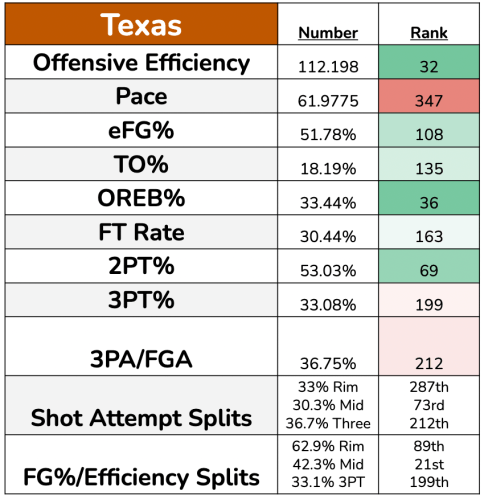
So: I think it’s worth noting the difference between the Four Factors and your eyeballs here. The stats will tell you that this is a pretty good offense. They’re slow, sure, but they’re an above-average shooting group on the whole. They hammer the boards. They’re bringing the mid-range game back. I like watching Timmy Allen, a 6’6″ wing that plays like a center at the 4. Despite a relatively weak schedule so far, the offense is almost precisely as efficient as the 3-seed version of this team last year that I genuinely enjoyed watching.

The eyeballs tell a different story. I wrote about my watchability metric CBBWAR recently; it brings Texas in at 86th nationally. This is because Texas doesn’t hit many threes, has the fewest dunks of any Big 12 team (after nearly leading the country in dunks a year ago), and…just doesn’t do anything that’s interesting? Among the five players on the roster with 20+ three-point attempts, none hit more than 36% of their threes. Four times in their last five games, they’ve hit 50% or worse on twos. They consistently hammer the boards, but the most exciting thing about this offense is that they hit a lot of mid-range twos. The leading scorer doesn’t crack 12 points per game. Hooooo-ray.

Chris Beard runs an offense that aims to generate lots of cuts to the basket via off-ball screens and motion. There’s also a good amount of post-ups, some ball screens, some ISOs, and a genuinely crazy amount of possessions that go down to the final second. Before we get there: the actual players.

Timmy Allen (Utah transfer, 11.9 PPG) is the one player I do genuinely find watchable and interesting. He’s the 6’6″ small-ball 4 that plays like a 5 yet is sized like a 3. Allen takes about two threes every three games, a very low rate for a starting power forward in today’s game. (Of the 234 6’6″ players averaging 16+ MPG in America, Allen ranks 210th in three-point attempt rate, per Torvik.) More than maybe any other player in the sport, Allen is extremely talented in knowing where and when to cut to the basket; only six players in America have more points off of cuts this year, per Synergy.

Marcus Carr (Minnesota transfer, 11 PPG) and Courtney Ramey (9.3 PPG) comprise the starting backcourt; they’re paired together because they have fairly similar skill sets. Shot Quality ranks both as being very good at creating their own shots and I’d say normal play-by-play data backs that up. 38% of Carr’s makes and 61% of Ramey’s are unassisted. Carr is the main ball-handler on the team and can be expected to pull up off the dribble pretty frequently:

While Ramey’s the best shooter Texas has to offer, coming in at 36% on threes and an astounding 48% on all catch-and-shoot attempts. He was at 44% on catch-and-shoots last year, so I feel pretty safe deeming him a legit, scary threat from downtown. If only he took more than four a game from deep.

The fourth and fifth players to highlight are intriguing because both keep bobbing in and out of the starting lineup. Andrew Jones takes more threes than any other Texas player but is a 33% shooter this year and 35% for his career. For reasons I’m not sure how to explain, Jones has consistently been better off-the-dribble than in catch-and-shoot situations over the course of his career, so making him take a dribble or two is actually the worse option.

Lastly: Tre Mitchell (UMass transfer, 9.2 PPG). Mitchell’s gotten more starts at the 5 as of late, displacing Creighton transfer Christian Bishop. (Recall the note up top about all the transfers, please.) He posts up a lot and is a quality passer for a big man; the notable thing he brings right now is extra spacing due to the fact he’s a decent three-point shooter.

You might notice something among these four GIFs: only one was an attempt at the rim. That’s by design. In the to-be-expanded SEC, Texas would rank 13th of 16 in terms of rim attempt rate. They’re decent at finishing when they get there, but they have almost as many attempts from 5-21 feet as they do 0-4. In terms of pure mid-range jumpers, they average 10 a game. On Bart Torvik’s site, you can compare a team’s statistical profile to those from previous seasons. If you boost the importance of eFG% and 3PT attempt rate, you may snicker at the results.

Ask Tennessee fans how those Marches felt.

CHART! The official Chart Guide is now as follows:

Yes: “Be afraid.” 😬
Somewhat: “They can hit this but not very efficiently.” 🤔
No: “Either never attempts this shot or is atrocious at making it.” 🥳

Texas’ defense

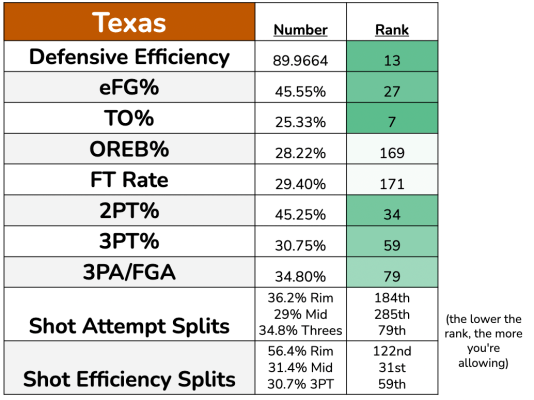
Interesting! This is the side that keeps Texas watchable: the Texas Tech defense with hand-picked transfer portal kings that forces a bonkers amount of turnovers and is excellent at forcing bad shots. The stats graphic spells it out pretty well: terrific at defending twos and threes, good at defending the rim, generally good all around. I like that. There is a problem, however:

That graphic encapsulates every Top 100 offense on the Texas schedule. Something you’ll immediately notice: just four games against Top 100 competition, two of which were losses. Something else: Tennessee is the second-best offense Texas has played. Please think about this edition of Tennessee basketball and speak that out loud. Tennessee is the second-best offense Texas has played. God almighty.

Unfortunately, all efficiency numbers are adjusted for competition, and those seem like useful proof that Texas is smashing the weak schedule it’s been given. (Texas’ offensive SOS ranks 185th on KenPom, which is like playing Missouri, the 181st-best offense, 20 times.) Texas promotes relatively low-variance games by not giving up many three-point attempts and instead forcing a lot of non-rim twos. The same principles that aided Beard at Texas Tech are still helping him here:

The difficulty with playing this defense is that you’re likely to see a variety of ball-screen coverages depending on personnel. Texas will ice to the sideline whenever possible, but as evidenced above, they’ll switch when it makes sense and hedge a ball screen to push you away from the perimeter. Rarely, if ever, will you see a drop coverage employed; I would think they’d learn a lesson from what Arizona did against Tennessee that proved to be a fatal flaw in the Wildcats’ game plan.

Aside from the tons of turnovers, I do genuinely think Texas makes the shots against them at the rim difficult. As much as you can be moderately unlucky in game-to-game rim FG%, Texas probably deserves better results than the middling number you see in the graphic. No one player blocks tons of shots aside from backup Dylan Disu (Vanderbilt transfer), but the backcourt doesn’t get exploited by faster guards terribly often. When they do, the system itself does a great job of making life difficult.

On a lot of possessions, Texas simply doesn’t allow you many places to go that are statistically reasonable or efficient. They’ve been terrific at guarding the perimeter, both by 3PT% and by them allowing an average of just 12.5 catch-and-shoot attempts per game, the lowest average in the Big 12. They allow nearly as many off-the-dribble jumpers as they do catch-and-shoots, which is quite impressive. They’re still struggling with defensive rebounding at times and they do foul a bit, but for the most part, this is a really tight top-to-bottom unit.

The few teams that have experienced success against Texas since the Gonzaga game have either gotten hot from deep (Oklahoma State 8-for-17, Iowa State 10-for-23), rode the wave of Texas having a bad offensive night (Kansas State), or both. For what it’s worth, the hyper-aggressiveness of this defense has its holes. Synergy rates Texas as being in the 45th-percentile at defending cuts to the basket, which is interesting. While Texas doesn’t give up many threes in general, the ones they do give up are open, both C&S (55/45 Guarded/Unguarded) and off-the-dribble (Shot Quality gives an expected hit rate of about 31% on these threes; Texas currently sits at 25.5% allowed). If Tennessee can get the Regression Devil on their side, it could be a happy reunion for Rick Barnes.

Lastly: opponents are shooting 62.2% from the free throw line against Texas. Considering free throw defense is not a thing, I doubt that’ll last.

How Tennessee matches up

I think the obvious hope here is that Tennessee doesn’t fall back into a wave of mid-range jumpers like this defense wants to force. The good news is that the defense most like this is Texas Tech’s, which was a game where Tennessee got 90% of their shots at the rim or from three. The bad news is that Texas Tech is called the Act of God Game on this site for a reason. If Tennessee’s willing to forget that, they can create pressure in the paint the same way Texas does offensively: lots of penetration by Tennessee’s deceptively quick guards that ends in a cut to the basket.

Having a quality paint penetrator like Kennedy Chandler will help with this. I wouldn’t be shocked if Chandler has his own excellent game, but given his penchant for turnovers, I also would not be shocked to see him struggle. The team will go over the Texas Tech film to prepare for Texas, and a thing in Tennessee’s advantage is that Texas is simply not nearly as switchable or as tall at all five positions. Still: they force a ton of turnovers for a reason.

The other side of this equation is that you’re going to have to generate a lot of catch-and-shoot threes. Texas has done an excellent job of ensuring these simply don’t happen often this year, but Tennessee just got done getting off 21 catch-and-shoot attempts against a Florida team. The only side to toss up more C&S attempts against Florida this year: Alabama. Tennessee is deeply committed to the three, and in a road game where some amount of positive variance is needed to win, you’ve gotta get shots off.

An interesting stat to note: per CBB Analytics, of the 17.5 three-point attempts Texas allows in an average game, just 5.2 (or 29.7%) come from the right corner or right wing. 7.8 (44.6%) are from the left corner or left wing. This is likely by design; Texas wants to keep you out of the middle of the floor, and Tennessee has to be creative with where they place spot-up shooters. If Tennessee can find a way to keep getting Santiago Vescovi (or the other obvious shooters) open on the left side of the floor, they could get the extra juice they need to steal one on the road.

Defensively, Tennessee could have a similar concern in directionality. Texas has guards who are pretty good at driving the right half of the court and a frontcourt that can clean up the mess with an offensive rebound or a well-timed basket cut. Most annoyingly, if you keep them out of the paint, the odds they’ll nail a mid-range jumper are higher than anyone else on Tennessee’s schedule. So: pick your poison.

My first instinct is that Tennessee’s got to scheme a way to make Texas feel indecisive when driving. I’m still of the opinion that making the right players take mid-range jumpers is a perfectly fine strategy, and if Ramey or Carr want to take those ~40% shots instead of ~53% ones at the rim, do your thing. Still, Timmy Allen and crew are going to try to get Tennessee’s frontcourt out of sorts early with a basket cut every third possession. Tennessee has been very good at defending these this year, but Texas will try them more often than anyone else on the schedule. If Tennessee shuts a couple down in the first five minutes, Texas may ease up on how often they go to it.

Beyond that, this is a Texas team that has some quality shooters but no lights-out shooter on it. All of Jones, Ramey, Carr, and Mitchell are threats in the mid-range and from deep, but you’re not drawing the Kellan Gradys of the world here. The best and most proven strategy with Texas has been to make them take a lot of jumpers in half-court offense. They’ll hit a decent amount, but it beats letting them get to the rim or the post. As crazy as this sounds, I think I’m fine with the mid-range jumpers. Here’s why:

  • 2021-22 Texas, mid-range jumpers (per Synergy): 86-for-200 (43%), or 0.86 points per shot
  • 2021-22 Texas, threes: 133-for-402 (33.1%), or 0.993 points per shot

No matter how you slice it, it’s 13 points worse per 100 shots. The only player I genuinely don’t want to see pulling up from 17 feet is Marcus Carr. Everyone else: have at it. It’s less-damaging on the whole than threes.

Starters + rotations

Metric explanations: Role is algorithmically-determined by Bart Torvik. MPG is minutes per game. PPG/RPG/APG/Fouls/Twos/Threes are what you’d guess. USG% is the percentage of possessions a player uses on the court. OREB%/DREB% are your available rebounds usurped. Finally, PRPG! is Bart Torvik’s Points Over Replacement metric; the higher the better. If you’re on mobile, zoom in; if on desktop, right click -> Open Image in New Tab.

Three things to watch for

  • How many extra possessions can Tennessee create? I wouldn’t be surprised if turnovers are a stalemate or are slightly in favor of Texas. The more interesting thing is rebounding. Texas’ DREB% on missed threes: 263rd. Tennessee’s OREB% on missed threes: 44th.
  • Can either team crack 60% at the rim? These are both excellent two-point defenses; if either tops 60% down low I would be mildly surprised.
  • Threes. Obviously. Texas is 11-1 when their opponent shoots 35% or worse from deep; Tennessee is 9-1 when they simply crack 30%.

Key matchups

Timmy Allen vs. Josiah-Jordan James. This will be Allen vs. Nkamhoua to start, but JJJ is a near-identical body match for Allen and Tennessee’s been running with JJJ at the 4 more frequently as of late. Allen’s main source of points are cuts to the basket and rebounds; it would be ideal for JJJ to shut one of those valves off.

Marcus Carr vs. Kennedy Chandler. Carr has dropped 20+ twice in conference play, while Chandler hasn’t dropped 20+ since December 4. The points are only one part of this. Chandler must force Carr into tough, low-expectancy shots while avoiding the turnovers that have become unfortunately common on the other end.

Courtney Ramey vs. Santiago Vescovi. Hope you like threes! Ramey’s goal will be to get up 4-5 threes in this one, but Vescovi taking 9-10 genuinely should happen.

Three predictions

  1. Tennessee blocks more shots than Texas;
  2. Multiple times this game, you will be annoyed by a Texas player hitting a mid-range jumper;
  3. Texas 64, Tennessee 61.

Show Me My Opponent, 2021-22: Florida

GAME INFORMATION
OPPONENT Florida (12-7, 3-4 SEC, #42 KenPom)
(15-10, 9-7 SEC, Round of 32 2020-21)
LOCATION Thompson-Boling Arena
Knoxville, TN
TIME Wednesday, January 26
6 PM ET
CHANNEL ESPN2
ANNOUNCERS Tom Hart (PBP)
Jimmy Dykes (analyst)
SPREAD Sinners: Tennessee -9.5
KenPom: Tennessee -9

Torvik: Tennessee -7.5

I think that one of the nicest things that has ever happened to me is the University of Tennessee switching email addresses from the tidy “@utk.edu” to the monstrous “@vols.utk.edu.” Terrible? Obviously. But what this has done is:

  1. Kept me from accessing an email account I have no use for, aside from a letter of recommendation I forgot to save;
  2. Has erased an email I sent to a sportswriter about why Tennessee should hire Mike White after the 2013-14 basketball season.

Praise be for this disappearance into the digital ether.

Tennessee has not lost at home to Florida since said 2013-14 season and has impressively only done so once since 2011. The Gators have as many wins in Thompson-Boling since 2011 as Chattanooga and Austin Peay. Florida did beat a good (#26 KenPom) Ohio State team this year, but has also lost to Maryland (#82), Mississippi (#116), and most embarrassingly, Texas Southern (#174). If they get football every single year, Tennessee gets basketball. Seems fair to me.


Florida’s offense

Barring something surprising, Tennessee is going to go two consecutive seasons without playing a full-strength Florida side. Colin Castleton is Florida’s best player and most reliable scorer; you can’t tell the story of these Gators without talking about him. The story when he’s off the court is pretty fascinating (‘On’ is Castleton, ‘Off’ without):

Even when adjusting for 3PT% luck, it’s a pretty similar split: Florida is about 10-11 points worse per 100 possessions when Castleton doesn’t touch the court. The shot selection is perhaps the most interesting part of this:

  • Castleton On: 43.3% of FGA at rim/17.7% midrange/39.1% 3PA
  • Castleton Off: 29.9% rim/17.3% midrange/52.8% 3PA

That is a massive swing. Florida goes from generating what would be the 29th-highest attempt rate in CBB at the rim to 337th sans Castleton. It’s two completely unique and different offenses. If you’re like me and live in frequent fear of three-point variance, this is a little scary, but the people taking these shots for Florida are doing a great job at smoothing over potential fears.

Anyway, onto the show. Mike White made a big deal of changing his offense in the offseason to a more 5-out style where even Castleton was occasionally taking a three. Eric Fawcett is the main guy to go to if you want to learn about Florida. His observations are that Florida started out entirely pursuing this new 5-out style in November (when they started a 72-hour period of Ohio State’s athletic programs eating it on national television):

The problem is that teams began to adjust to Florida’s new style. In December, Florida lost a game that was understandable (Oklahoma), one that was…less understandable (Maryland), and one that was a complete debacle (Texas Southern). Shockingly, Mike White proved slow to adjust to others’ adjustments.

In January, Florida lost three in a row, then got back on the wagon until Castleton’s injury, then got smoked in a COVID makeup game by Mississippi. The good news for Florida: it isn’t really the offense’s fault. Torvik rates it out as a top-40 unit since SEC play started, and to White’s credit, he’s sort of turned his offense into a blend of what they used to run and what he wants to run.

The individual players you’ll see running these sets in the post-Castleton era (however long it lasts) are Phlandrous Fleming Jr. (10.3 PPG), Tyree Appleby (9.7 PPG), and Anthony Duruji (9.6 PPG). All three will take turns scoring and attempting to put up enough shots (also, points) to drag Florida to a road victory.

Fleming is the most versatile of the three. He’s horrifically inefficient on twos (53% at the rim, 33% on non-rim twos), but if you squint, he’s a player that can score at all three levels and does so somewhat well. Aside from having a truly insane and amazing name, Fleming is the co-secondary ball-handler behind Appleby along with Myreon Jones. My guess is that Fleming would like to think he’s at his best going downhill to the rim, but he’s been at his best as a shooter. 33% on threes is…not great, but also useful enough to make sense.

Appleby is the main ball-handler in Florida’s numerous ball-screen sets. You’ll see him run these with Duruji (the 4) or Jason Jitoboh (the 5) as the screener; Tennessee has to be prepared for Duruji in particular to pop out for a three. Without Castleton, Appleby has turned into Just A Shooter; of 27 shot attempts in Florida’s last three games, 26 were threes. Appleby is a career 35% shooter that is somehow better off the dribble than spotting up.

Last is Duruji, the best non-Castleton player on the roster and seemingly the only non-center who can score at the rim with any regularity at all. With Castleton off, Duruji is the best/most versatile frontcourt option the Gators have. He can score from outside and down low, sometimes coming from outside to the low post:

Beyond those three, you have a smattering of Just A Guys. Brandon McKissic is a Summit League transfer that mostly takes threes, but is nailing them at a 25% rate. Jason Jitoboh is an absolute behemoth (6’11”, 305) that is exclusively a threat at the rim. Myreon Jones takes a lot of shots but can’t hit them (44.1% eFG%, 30.1% 3PT%) well at all. CJ Felder is interesting (41.4% 3PT%) but is a minus defender that didn’t play against Mississippi due to a non-COVID illness.

CHART! The official Chart Guide is now as follows:

Yes: “Be afraid.” 😬
Somewhat: “They can hit this but not very efficiently.” 🤔
No: “Either never attempts this shot or is atrocious at making it.” 🥳

Florida’s defense

Very similar to 2020-21 to the point that I could fart out last year’s previews and be done with it. They press after made baskets but don’t force a lot of turnovers with it; they exclusively run man-to-man defense; they almost always hedge or double on ball screens. I don’t know, Florida’s defense has sort of reached this stage of boring competency where they’re never bad and often fairly good but never a serious threat to be great.

There’s a couple of reasons why this is the case:

  1. Florida is excellent at forcing bad shots but really bad at rebounding them;
  2. Florida is excellent at forcing turnovers but their aggressiveness can either lead to foul trouble or easy twos, depending on the opponent.

No team is perfect by any means; even Gonzaga and Arizona and, yes, Auburn have their flaws. Florida’s just seem particularly potent. This year, the Gators have become one of the nation’s most three-averse defenses. Only 29.8% of opponent shots are from deep, which the graphic notes as the 12th-lowest rate in America. That’s a pretty notable jump for a team that did this for the first three years of the White era then backed off for the last three. To White’s credit, Florida surrenders one of the lowest rates of catch-and-shoot threes in America, forcing a ton of off-the-dribble twos and runners instead.

That’s good. Even the fact that Florida allows a ton of attempts at the rim – the 24th-highest rate in America! – is largely fine, because Florida (read: Colin Castleton) has done a great job at blocking attempts down low. The Gators sit 15th in the nation in Block% largely because Castleton has 42 of them.

The problem is that Castleton has 42 blocks, no other Florida roster member has more than 13, and Castleton is likely still unavailable. Even when filtering out garbage time and regressing for 3PT% luck, Florida’s defense is about 5.6 points worse per 100 possessions when Castleton is off the floor. I assume you’ll be shocked to hear what the biggest difference is.

  • Castleton On: 48.3% 2PT% allowed, 33.7% FG% midrange, 57.1% FG% rim
  • Castleton Off: 52% 2PT% allowed, 40% FG% midrange, 59.7% FG% rim

I think that there should probably be some sort of luck-adjustment function for midrange attempts as a majority of those are jumpers, but you get the point. Sans Castleton, Florida forces fewer turnovers (24.8% TO% versus 21.4%), fouls way more (22.8% FTR vs. 34.3%), and blocks far fewer shots (6.1 BPG when Castleton plays, 4.0 BPG when he doesn’t).

There hasn’t been a huge shift in shot selection in the post-Castleton era, but when your center options are a guy who commits 8.1 fouls per 40 (Jitoboh) or one that commits 7.2 (Tuongthach Gatkek), well, you know what’s coming. Florida’s given up a 62.3% hit rate down low while just demolishing anyone who touches the paint. Florida’s given up 20+ free throw attempts in three straight games and is averaging 20.3 fouls a game or, you know, a double bonus every half.

That’s after giving up 20+ FTAs in just five of their first 16 games. The other thing of note here: the rebounding. Florida still forces turnovers at a good rate, but their defensive rebounding this season is poor. KenPom Plus breaks down how a team ranks by their DREB% on shots at the rim, midrange, and from three. Florida: 255th in DREB% on missed threes. Tennessee: 48th in OREB% on missed threes. Don’t be surprised if/when Tennessee picks up three or four OREBs on deep-ball misses.

Again: still a good defense, still will force Tennessee into their fair share of tough situations. Yet I would be significantly more fearful of this unit if Castleton were on the floor.

How Tennessee matches up

Kind of a fascinating game theory matchup, no? One team that takes more shots from three than it has in program history playing a defense whose main goal is to funnel you inside the three-point line. This is the only team in 2021-22 Tennessee plays that’s remotely this focused on denying threes, but if you like encouraging notes, the next-closest opponent (so far) is Arizona. (Texas is ahead of Arizona, but that game hasn’t been played yet, obviously.)

To Florida’s credit, I think they’ve been really good at forcing turnovers in ball-screen situations. That hard hedge can force younger guards to either pick up their dribble and find themselves in a double team or make a bad pass to a person that’s not open. If you can work your way around a hedge, you should be able to at least get a shot up with the remainder of your possession.

I wouldn’t be surprised to hear that Rick Barnes and staff have looked towards Oklahoma for some portion of their scout. Oklahoma got 14 points off of ten P&R Roll Man possessions in their 74-67 win, easily the most points anyone’s exploited Florida’s P&R coverage for. Shockingly, Tennessee hasn’t really done much of that so far, but of all teams, they found a hole in Alabama’s ball-screen coverage that allowed for several easy points down low. All of them were via Olivier Nkamhoua.

If Tennessee can draw that secondary defender (likely Duruji) out to the perimeter, Nkamhoua can use his body to create space either for two points or a foul.

Along with this, Florida had a shocking amount of trouble slowing down Daeshun Ruffin of Ole Miss on Monday. Ruffin is a miniscule point guard that jitterbugged his way to 21 points, all of which were either at the rim or the free throw line. Ruffin drew six fouls across 33 on-court minutes and it genuinely could’ve been ten if they imported officials from 2012. Florida fans seem terrified of what Kennedy Chandler and Zakai Zeigler could do to them. I say exploit these issues anywhere and everywhere possible.

Defensively…well, you have three guys to stop and only one of them is really potent at all three levels. Appleby has turned into Just A Shooter, and really, the entire team has. When you’re taking 53% of your shots from deep when a certain player is out of the game, that’s genuinely pretty wild. About 79% of Florida threes are of the catch-and-shoot variety, per Synergy.

There’s a couple of ways I think Tennessee could exploit this to great success; forcing Appleby and Myreon Jones into some really ill-advised kickouts when they touch the paint is probably my favorite. But, as usual, this game is going to come down to if you’re doing everything you physically can to make Florida’s deep balls hard, difficult shots. The Gators generate lots of corner threes; per CBB Analytics, they get off 9.2 a game, which is the third-most in America behind Alabama and, uh, Purdue Fort Wayne. Kickouts will happen; Tennessee’s just gotta be there to make them hard shots.

I’m of the opinion that you can do relatively little to control the outcome of an opponent’s three-pointer, but per the study you saw in Saturday’s game via Jimmy Dykes, I would imagine that being within 3-4 feet on as many shots as possible is a great way to maximize your potential for success. Frankly, if Florida is unable to hit 10+ threes in this one, it would take a serious overperformance elsewhere to win this game.

Starters + rotations

Metric explanations: Role is algorithmically-determined by Bart Torvik. MPG is minutes per game. PPG/RPG/APG/Fouls/Twos/Threes are what you’d guess. USG% is the percentage of possessions a player uses on the court. OREB%/DREB% are your available rebounds usurped. Finally, PRPG! is Bart Torvik’s Points Over Replacement metric; the higher the better. If you’re on mobile, zoom in; if on desktop, right click -> Open Image in New Tab.

Three things to watch for

  • Which team attempts fewer mid-range twos? Florida has become even more mid-averse than Tennessee, a genuinely surprising turn for a team that loved mid-range twos not long ago.
  • Can Tennessee get one of Duruji/Jitoboh in foul trouble? The Gator backcourt doesn’t commit many, so forcing Mike White to use depth pieces he really doesn’t want to use would be ideal.
  • Who gets the higher-quality threes? Any team can barf up a bunch, but getting lots of open, catch-and-shoot threes isn’t easy. I wouldn’t be surprised if Florida put up 30 deep balls in this one, but if they require multiple dribbles or are well-guarded, you have to live and be comfortable with that defensive process.

Key matchups

Anthony Duruji vs. Olivier Nkamhoua. Nkamhoua could really use a good performance; it feels like the last time he stood out in a positive manner was the Mississippi game three weeks ago. Meanwhile, Duruji’s been struggling with fouls as of late, but is a very legit threat both inside and out.

Tyree Appleby vs. Kennedy Chandler. If Chandler forces Appleby to take a bunch of tough threes, he’s done all he can do; Appleby is gonna toss ’em up from deep no matter what Chandler does. On the other end, Appleby was a defensive liability against Mississippi but is typically better than that. Chandler needs to push the issue in the paint early and often.

Phlandrous Fleming vs. A Cornucopia. All of Justin Powell, Josiah-Jordan James, and Santiago Vescovi are currently averaging 8+ MPG at the 3, so who knows. Fleming is the only three-level scorer I see on the Florida roster, though he’s not that efficient.

Three predictions

  1. Multiple times, I think about Alabama somehow losing to both Georgia and Missouri in a two-week span and start laughing;
  2. Florida goes on a run of 2+ made threes and follows it with 6+ consecutive misses;
  3. Tennessee 72, Florida 62.

You Merely Adopted the Mud, We Were Born In It

January 18: #24 Tennessee 68, Vanderbilt 60 (12-5, 3-3 SEC)
January 22: #24 Tennessee 64, #13 LSU 50 (13-5, 4-3 SEC)

Sometime during Tennessee’s wire-to-wire beating of top-15 LSU on Saturday – maybe when it was 42-28 and Tennessee had held LSU to three points across the last 10 minutes of play – I had a realization. For all of the complaining, all the whining about how this offense isn’t terribly good and the product on the court is genuinely unwatchable at times, we are discussing a team that ranks in the top 15 nationally in the advanced metric of your choosing. They are very, very good at several things. The thing they are very best at is taking about 90% of their opponents, turning the heat up on defense, watching as the dirt turns to wet, wet mud, and seeing these overmatched opponents flop around, unable to find stable footing in the Knoxville slop.

This is the genesis of good things for Tennessee. Sure, you get the occasional great shooting nights…sure, Tennessee still has the capacity to do a lot of good inside the perimeter…sure, there are other ways to win. But this – dragging other teams into the mud like little pigs, watching them flounder as you laugh at how uncomfortable they are – this is Tennessee’s identity. And at some point, you have to be alright with that.

I’m there. I’m good with it. If Tennessee has to win games 64-50 and 66-46 and 69-54 and 66-60, good. They’re wins. Three of those are butt-kickings. Tennessee is wholly uncharmed by style points. They simply don’t care if you think it’s pretty or watchable or goody-goody two-shoes happy happy joy stuff. They are winning games by stuffing the opponent in a locker for 40 minutes. Only two teams have managed to escape an opponent-adjusted locker-stuffing this season; they are ranked #6 (Villanova) and #7 (Kentucky) on KenPom as I type.

The most fun Tennessee team of all-time is still 2018-19 Tennessee, the only team of the Rick Barnes era to have a truly good offense. I don’t mind speaking that as a truth, because it is a truth. I like watching great offense a lot more than I do great defense, because I like watching the orange ball go in the net and the crowd going bonkers. It is a good thing and it is supposedly why anyone watches this sport in the first place. Then again, attempting to figure out what Tennessee fans want on a weekly basis has proven difficult.

The point of this is that Tennessee basketball has an identity. Tennessee basketball is Mountain Wisconsin. Bo Ryan, outside of about two years where he had a top 10 pick on his roster, was entirely unconcerned with making you happy with lovely offensive play. He did not care about how much you liked watching the ball go in the net. He only cared about winning by any means necessary. (Reportedly, he also cared pretty deeply about quitting midseason because ALLEGEDLY an affair was going on. I do not believe that will ever be a concern with Rick Barnes.)

Bo Ryan-era Wisconsin would drag you into the mud and watch you flail around helplessly as the Badgers cruised to wins of 57-50 and 52-45 and 68-56, all over top 15 opponents. You were not born in the slop. You were not raised in the slop. This Tennessee team seems wholly comfortable pulsing your team in the blender for an uncomfortable amount of time.

Nothing about this is terribly pretty. I also am not sure that ‘pretty’ really matters right now when the team is 13th on both KenPom and Torvik and cruising right along towards being a 3 or 4 seed in the NCAA Tournament. It is exactly what most of us expected preseason. The route to get there has been choppy, but with Tennessee’s most difficult month out of the way, maybe February is where you get the style points and the capital-F Fun back. Look at this:

And tell me you can’t feel at least a little bit of excitement for the local basketball program. Even taking those games in the 50s as coin-flips, you can pretty easily stare at that and see an 8-2 run in SEC play to the finish with at least two added Quadrant 1 wins. That would be 13-5 in the SEC, or merely tying the second-best SEC effort Tennessee basketball has seen in 14 years. That’s pretty good. The team is pretty good. It’s worth acknowledging, even if they don’t play a style most actively desire.


The other thing that has happened is that Tennessee has sort of kiboshed the idea of Smokey as the team’s mascot. This role is now Uros Plavsic’s to lose.

In the span of three weeks, Plavsic has turned from a guy most fans saw as completely unplayable to arguably the team’s best post player. I’m typing that out now and it still feels unbelievable. I promise you it’s real. These are the conference-only numbers via Bart Torvik’s site:

The last thing we saw prior to SEC play was John Fulkerson dropping 24 points on an Arizona team that looks like, at worst, one of the four or five best college basketball has to offer this year. The last time Uros Plavsic had scored double-digit points was February 1, 2020. His career-high for rebounds in a game: four. This is for a 7-footer who entered college as a low four-star recruit that convinced both Arizona State and Tennessee to take a chance on him.

Plavsic drawing a billion fouls against Alabama is one thing. Plavsic putting up 13 & 7 on the road at Vanderbilt is another thing. But hitting this, the longest shot attempt of his season:

And doing this two minutes later:

Is something entirely new. (I don’t care that the block probably should’ve been goaltending. It looked cool and that counts.)

Uros Plavsic will probably never be a dominant basketball player. The agility may never be there. I obviously would prefer to never see him attempt a jumper because I’m sure that would look as weird as it does in my head. Also, all of the previous three sentences are entirely meaningless. Right now, Uros Plavsic is doing everything he can to make Tennessee the best basketball team it can be. He’s earned his right to start and finish games ahead of John Fulkerson and Brandon Huntley-Hatfield. Right now, the team is about 1.5 points better per 100 possessions when he’s on the court versus when he’s off.

For this man at this time, I couldn’t be happier. I think of all the tweets and online comments he’s seen about how he’s an embarrassment to basketball. How he shouldn’t be a scholarship player at an SEC university. How he somehow tricked 1.5 coaches (sorry, Bobby Hurley isn’t a real coach) into giving him a scholarship. How Rick Barnes was dumb for continuing to give him a chance. You read a quote like this:

And you read this, from Plavsic’s own writing about his basketball career before last season began:

And you remember entirely what it is that makes you care about college sports in the first place. Uros Plavsic doesn’t have to do any of this. It is entirely of his own volition. Never once has Plavsic complained to the media about not playing, about being a team cheerleader, about being a guy who didn’t really contribute much to the team during his first 2.5 seasons in orange. Every single game, whether the guy is on or off the floor, you see the energy Plavsic has that he tries to transfer to everyone else. After every dunk last season, the first person you’d see cheering from the bench was Plavsic. After every block, Plavsic was yelling at the opponent and letting them know precisely what he thought of them.

At this moment, for this time, Plavsic is the Master of Ceremonies. If you want to further the analogy of the first section of this post, Uros Plavsic is the Master of Mud. He has learned how to drag opponents, whether in the Twitter sense of dragging someone or simply lulling them to sleep with his array of hooks and quietly-improving defense. At perhaps the least-likely time of his entire career, he has emerged as a genuinely important and lovable piece of the puzzle at Tennessee.

Rooting for Uros Plavsic to succeed is almost as easy as breathing air. I look forward to continuing to do it, no matter how the rest of his season plays out. He’s earned his moment in the sun; I sincerely hope that, for him, it lasts a very long time. In a season laden with various frustrations, he and Zakai Zeigler have been tethers to fandom in a way I haven’t experienced in a while. It’s nice to see them repaid for their work.


Some various notes of the last week:

  • Tennessee posted a 38.4% eFG% against Vanderbilt and won. Unfortunately, that happened, but it feeds into our pig-slop narrative so hang on with me. Tennessee’s now won five games in the last three seasons where they posted a 40% or worse eFG%; only Texas A&M, among SEC teams, is able to say the same. Obligatory!
  • Tennessee’s now held 15 of 18 opponents below 1 PPP. So, without context, you probably don’t care much about this stat, but I promise it’s pretty important. KenPom rates Tennessee’s schedule so far as the 8th-toughest in America, with nine games in the Tier A (his equivalent of Quadrant 1) grouping. Only three teams – Villanova, LSU, Kentucky – have topped 1 PPP. Consider that last year’s awesome defense allowed nine teams to go >1 PPP, the 2017-18 killers gave up 15 >1 PPP games, and as far as I could find, no Tennessee team in a non-COVID season has allowed fewer than 12 of these games (2009-10). This is on track to be a historically good defense, and they’re a week away from finishing the meat of their schedule. The final ten games feature six against Quadrant 2 or lower competition, or one more than all of December/January combined.
  • Even the LSU slop was actually pretty successful on offense. Tennessee managed 64 points on 65 possessions (0.985 PPP), which looks bad on its face…but is also the highest PPP surrendered by LSU this season by a good margin. Torvik translates this to about a 1.23 PPP performance against an average defense, which is insane.
  • The Jimmy Dykes thing. He reached out Tuesday morning with a request and, thanks to some features I have via Synergy, I provided an answer Wednesday night. He is a good guy that I find myself constantly thankful for.
  • One bad thing: the Fulkerson/Plavsic lineup. Without fail, it seems like this gets anywhere from 3-10 minutes of run each game. It’s perhaps the one thing Barnes does that drives me the nuttiest, because it’s objectively a terrible combination. I would stop doing this immediately and just play one or the other, because it’s an offensive disaster.

Lastly: Game Scores. Bart Torvik has this awesome metric called Game Scores that are essentially telling you on a scale of 0-100 (average being 50) how good or bad your performance was. Basically, if you put up a 95, you’re playing like a team with a Pythag rating of .9500 (which would be top 5 right now). All of this to say that these are the current 95+ Game Score rankings:

Half of Tennessee’s performances have been really, really good. The other half have been somewhere between ‘still good’ and ‘oh God.’ Anyway, while I do think LSU’s are aided by some insane 3PT% luck, this feels like a mostly-fair representation of how good the very best of the SEC is. Auburn is a step ahead of everyone else; LSU gets there on their best nights; Tennessee is capable of crushing an opponent on any given night. The real surprise is seeing that Kentucky’s only uncorked a few truly dominant outings, one of which was obviously against Tennessee. Also, this should help you understand why Texas A&M isn’t even a top 60 KenPom team despite being 15-4: they have no results of any significance and are almost never dominating.

Thanks for reading. For more Tennessee basketball content and whatever else, head to @statsbywill on Twitter. If you would like to reach out privately: statsbywill at gmail.

Show Me My Opponent, 2021-22: LSU, Part Two

GAME INFORMATION
OPPONENT #13 LSU (15-3, 3-3 SEC, #10 KenPom)
19-10, 11-6 SEC, Round of 32 2020-21
LOCATION Thompson-Boling Arena
Knoxville, TN
TIME Saturday, January 22
6 PM ET
CHANNEL ESPN
ANNOUNCERS Karl Ravech (PBP)
Jimmy Dykes (analyst)
SPREAD KenPom: Tennessee -2
Torvik: Tennessee -1.1

Look, Will Wade, it would be nice to like you. For four years, you have had chaotic, hilarious, exciting college basketball teams that score and give up lots of points and made for the most fun SEC championship game in a decade. You have embraced your destiny as a Cancelled Coach. You haven’t backed down to the NCAA. You are, against all odds, the head coach of the LSU Tigers. All of that is cool. But I can’t get down with this.

Corny, corny, corny! Not cool. This is almost the only thing you could’ve done to be in serious contention for the SEC Online Cringe Coach of the Year (defending winner: Eric Musselman, three-time champion). Now, when I look at you, I think of this:

Unfortunate. Anyway, the LSU Tigers are a basketball team with an impressive collection of athletes that have traded offense for defense and have gone from extremely watchable to sort of unwatchable. Has it made them a better team? Undoubtedly, because they’re 10th on KenPom right now. But I’d be lying if I said I didn’t miss the chaos.


LSU’s offense

Well, considering I previewed it two weeks ago and LSU’s offense is still bad, I’m not sure what exactly should change other than a simple copy-paste. I mean they’re still the same offense that

Pardon?????

…okay, that does change the tone a little bit. Because this is how things go sometimes, LSU became the first team in nearly two months to post >1 PPP on Tennessee and then immediately followed that up with three dog-turd performances against Florida (0.972 PPP), Arkansas (0.843), and Alabama (0.903). In some aspect it could be beneficial that LSU got their one good game out of their system against Tennessee at home. Even including that game, you’re talking about an offense that’s gone over 1 PPP once in their last six games and just thrice since November 27.

I wouldn’t say it’s even been bad shooting that’s the pure culprit; LSU went 10-for-22 in the loss to Alabama from deep and hit 44% of threes against Tennessee. The problem is extremely easy to spot: six games in a row with a 21% offensive TO% or worse.

A shocking amount of the turnovers are unforced, which is a huge red flag for a flagging offense. LSU has turned it over 52 times since the Tennessee game across three affairs; 28 of these turnovers were labeled as unforced, per KenPom. That is hilariously bad and a pretty obvious reason why this should-be-better offense is struggling to get off the ground. A team with LSU’s defense (still #1 by a mile, spoiler) and LSU’s talent should probably be in the top 5 right now; they are not, because this offense blows.

Anyway, the rest of this scout is the same. The best player (and scorer) is Tari Eason (16 PPG), a Cincinnati transfer that’s a poor shooter but is relentless at getting to the paint, whether in transition or in half-court. If it makes sense, Eason is like a co-#1 option in transition but a co-second banana in half-court; the guy just rim-runs and is crazy dangerous when LSU picks up the pace. I still am baffled that he doesn’t start, but he finishes every close game for LSU, so I guess it doesn’t matter much.

The problem with Eason being your leading scorer but your second/third half-court banana is that the role of main scoring option in the half-court falls to Darius Days (13.5 PPG), a stats darling and efficient player that nonetheless isn’t built to be the #1 scoring option. On the last two LSU NCAA Tournament teams, Days posted Usage Percentages of 17.6% and 16.1%, which helped him be super-efficient but also penned him in as a role player. If you look at his measurables – 6’7″, 245 – you may guess that Days is a bully-ball big. Not so; more than half of his shots come from three, and at 34.5% on 113 attempts, he’s LSU’s most dangerous shooter.

The problem is that a guy who sits at 34.5% is LSU’s best shooter. Even after a couple of quality team-wide shooting games over the last two weeks, LSU still only sits 198th in 3PT%. Five players have 30+ three-point attempts this season. The three-point percentages of those five players, in order of most attempts to least: 34.5%, 33.3%, 33.3%, 23.4%, 31.6%. Xavier Pinson, the Missouri transfer and final double-digit scorer (10.9 PPG), takes about five per game…and is barely cracking 33%. To be fair to Pinson, he’s been exceptional at pushing LSU’s offense to the rim off of the aforementioned ball screens. (Worth noting: Pinson missed the last three games and is a game-time decision for tomorrow.)

Other players of interest: Brandon Murray (9.4 PPG) has emerged lately as a go-to guy offensively, but he’s a very streaky shooter and is mostly good for applying pressure at the rim. Efton Reid (7.7 PPG) is the center and actually appears to be a promising 2.5-level scorer, but fouls like crazy. Eric Gaines (9.2 PPG) is extraordinarily inefficient (88.3 ORtg, 40.4% eFG%).

CHART! “Yes” means “is efficient at doing so”; “somewhat” means “can, but not efficiently”; “no” means “rarely or never.” SPECIAL NOTE: I’ve included free throw percentages here upon request. The numbers used are a player’s career FT%, not 2021-22.

LSU’s defense

Still pretty darn good. Last time out, I missed on a key part of the scout that’s why they’re so hard to beat: they’ve basically adopted what Texas Tech does by switching 1-5 (when Eason’s on the court instead of Reid, obviously) and making smaller guards score over the top of long, athletic wings/forwards. Good on Will Wade for learning in Year 5 that you have to have a good defense to win meaningful games.

And this defense has to be as good as it is because its offense is so thoroughly stuck in the mud. I still retain my original thought that LSU is not going to hold opponents to a 26% 3PT% for the entire season; it’s hard to sustain that even for two months, let alone four or five. Simon at Shot Quality believes similarly, and I trust in his numbers:

I am the Regression Devil and I have come to reap your soul. Or something. I just wanted to type that out.

Anyway, again, LSU is running the same stuff they ran two weeks ago.

We’ll start with the main difference-maker: a full-court man-to-man press that accomplishes taking several seconds off the clock and forcing a solid amount of turnovers. LSU currently presses on 28.7% of all possessions, per Synergy; that rate was barely 9% a year ago. Against higher-end competition, I haven’t seen them force a ton of turnovers prior to the half-court line, but the corner trap they enforce with Pinson and Eason here is obviously hard to get around.

Once you actually do get into your half-court offense, I would strongly advise against posting up with much frequency. LSU’s frontcourt is demolishing post-ups right now; they sit in the 96th-percentile nationally in part because they’re completely closing down driving lanes with their length and forcing a lot of bad decisions.

So: you do get up actual shots against this team. It is hard to find good ones, though. LSU is different from a lot of heavy rim-protection teams (8th in Block%) in that they really don’t force many runners; they just make you take a ton of jump shots, particularly from deep. About a third of opponent attempts have come at the rim against this team, and 18% of those attempts have been swiftly smashed into the dirt. You can score down low against LSU, but you either have to play fast or be really smart and decisive with cuts to the basket. Their ball-screen defense ranks in the 99th-percentile, and with Eason/Efton Reid both blocking shots at a high rate, well, I guess that was your accomplice in the wood chipper.

The most interesting part of this, though, are the threes. I look at that stat from Simon…I look at what my own eyeballs see…I look at the fact nobody sustains 26% for a full season. I think that eventually, someone’s gonna get LSU. The fact that no team has managed to shoot better than 33% against them is absolutely insane. If you doubt the un-sustainability of this, check out the last five defenses to rank #1 on KenPom:

  • 2020-21 Memphis: 7 games where opponent shot 35% or better from three, three games 40% or better
  • 2019-20 Virginia: 12 games 35%+; 4 games 40%+
  • 2018-19 Texas Tech: 12 games 35%; 6 games 40%+
  • 2017-18 Virginia: 12 games 35%; 10 games 40%+
  • 2016-17 Gonzaga: 13 games 35%+; 6 games 40%+

The only team to stay below 12 for a full season was Memphis, who played only 28 games. That still means you’d expect one out of every four games to see the opponent hit 35%. The Regression Devil is waiting.

Whether Tennessee is the team that finally does this, I have no clue. And I’d like to make it clear that I think LSU is, at worst, one of the five best defenses in America and very well could be the best. But specifically from three, what they’re doing will not last. It’s a matter of time until someone hits a lot of threes against a team with a 55/45 Guarded/Unguarded ratio.

How Tennessee matches up

The good side of this matchup is two-fold:

  1. Tennessee has 40 minutes of experience against this defense and did a decent job of garnering open looks from three and the rim;
  2. The game is at home.

Any time you can get the back-half of a home-and-home at your house is generally a positive thing. Home-court advantage is a real thing, whether it’s fan-driven or whistle-driven. The goal this time for Tennessee will be to work harder on the boards, not turn it over as frequently, and…uh…hope the threes go down?

Last time out, Tennessee did a good job in avoiding post-ups and used basket cuts to their advantage instead to get post players involved. It helped that LSU committed approximately one billion fouls, of course, but the strategy made sense on paper. LSU fouls more than average, so why not use the switching philosophy to make them over-aggressive with the ball-handler, who can dump it to a cutter for two points or a foul? Makes sense to me. I imagine LSU will have a counter to this, but until they show it, Tennessee should continue to exploit it.

Also, Tennessee had a variety of ways to create open looks from deep last time out. As with most teams, the more open you are, the more likely you are to hit a shot, but it’s become especially noticeable with Tennessee. Synergy says Tennessee’s getting an excellent amount of open looks; their offensive Guarded/Unguarded is about 6% better than the national average at 50/50. Some variety of ball-screens and ball reversals can very well get the job done.

Tennessee simply has to hit these. They’re at 33% on open threes on the season; the national average right now is 37.1%. If Tennessee managed to become 4% better at hitting threes somehow by season’s end, I guarantee that literally everyone reading this would feel much differently about the Tennessee offense. Fingers crossed.

Defensively, I recommend letting LSU commit a bunch of stupid mistakes and reaping the benefits. Tennessee forced plenty of turnovers last time out and should be able to do the same at home; the key this time is hoping that three-point regression lands in your favor and a mediocre 3PT% team doesn’t hit 44% of their deep balls.

More interestingly, Tennessee has to find a way to control the rim in a fashion they didn’t the first time out. LSU went 16-for-25 (64%) at the rim in the first game; more so than any amount of threes or missed free throws, that felt like the true tell of the game. Tari Eason destroyed Tennessee at the rim, going 6-for-8, with almost all of his work either coming in transition or on the offensive boards. I’m not going to GIF a defensive rebound because it doesn’t come across as terribly sexy on video, but you can GIF proper transition defense. This is not it:

Tennessee is a fantastic defense, but every single college basketball defense has flaws. I just spent part of the LSU defensive section exploring how a team that’s smoking the field in defensive efficiency has its own problems to deal with. If Tennessee forces LSU to play slowly and gets back in transition off of misses + turnovers, this will be a much different game than the first time out.

My general theory here is this: more LSU half-court offense = a greater chance of Tennessee winning. You’re playing a team that ranks 11th in the SEC in half-court offensive efficiency and only ranks that high because of the existence of Missouri, Ole Miss, and South Carolina, three extremely wretched offenses. If you can hold Ole Miss to 51 in regulation and South Carolina to 46, holding LSU to, like, 60 is not that far-fetched at all.

Starters + rotations

Metric explanations: Role is algorithmically-determined by Bart Torvik. MPG is minutes per game. PPG/RPG/APG/Fouls/Twos/Threes are what you’d guess. USG% is the percentage of possessions a player uses on the court. OREB%/DREB% are your available rebounds usurped. Finally, PRPG! is Bart Torvik’s Points Over Replacement metric; the higher the better. If you’re on mobile, zoom in; if on desktop, right click -> Open Image in New Tab.

Notes: Xavier Pinson hasn’t played since the Tennessee game and is doubtful for this one, but isn’t ruled out entirely. Josiah-Jordan James received a “cut above the eye” (Rick Barnes, not me), not a concussion, and is a game-time decision…but I would be mildly surprised if he cannot play.

Three things to watch for

  • Can Tennessee hit some threes? It is literally this simple: either you do and you win, or you don’t and you maybe still win but the path to a win is much narrower. My personal desire is an over/under of 9.5 made threes; go over that and it would require a serious LSU overperformance elsewhere to beat you.
  • How much offense can Tari Eason generate at the rim? Last four games: 18-for-27 at the rim; no other player on LSU has more than 10 makes. If Tennessee can keep him to four or fewer made twos, that’s huge.
  • Which team gets the better whistle? Obligatory. Neither team really generates much offense at the line, but LSU fouls more than Tennessee and it’s a home game. I’m simply preparing you for the potential online anger from those in purple.

Key matchups

Tari Eason vs. Olivier Nkamhoua. This became literal in the last game, when Eason pummeled a pall through Olivier’s soul and Olivier responded by blocking Eason on the next possession. Eason is the only LSU player I deem truly fearful on the offensive end; if Tennessee forces him to take four or more jumpers, that’s a huge win. (Synergy labels Eason as 12-for-44 on jumpers this year, almost all from three.)

Darius Days vs. Somebody. The status of Josiah-Jordan James is apparently up in the air, but if he plays this is his matchup. Regardless, I think JJJ, Justin Powell, John Fulkerson, and even Nkamhoua will all split time in defending him. Days is the best shooter on the roster, but is oddly inefficient at the rim for someone with his body size.

If Xavier Pinson plays: Xavier Pinson vs. Kennedy Chandler.

If Xavier Pinson doesn’t play: Eric Gaines vs. Kennedy Chandler. Pinson picked up a nasty-looking injury in the first meeting between these two and still hasn’t touched the court. LSU writers seem a little doubtful he plays but it wouldn’t be a total surprise. Either way, Chandler has to eventually realize that the best version of himself is the super-aggressive ball-driving that attacks the paint on most possessions, not the one who hangs out on the perimeter with or without the ball.

Three predictions

  1. One or both teams picks up a technical foul;
  2. Tennessee beats LSU in eFG% and TO%;
  3. Tennessee 66, LSU 62.

College Basketball Watchability Above Replacement (CBBWAR): A new-old way to find the NCAA’s most entertaining teams

I think anyone who’s read my writing on Tennessee basketball can tell that over the course of the last month, the writing itself has grown more…negative? Cynical? Downward-looking? Over it? I’m not sure what the phrase is, but I’ve had a couple of people reach out with suggestions like “watch other teams.” I appreciate said suggestion, as I already do watch other teams, but that idea became rooted in my head as something I’d like to explore.

Long ago on Fangraphs, a baseball statistics site, writer Carson Cistulli created NERD, “an attempt to summarize in one number (on a scale of 0-10) the likely aesthetic appeal or watchability, for the learned fan, of a player or team or game.” I like baseball, but I realized about ten years ago that what I really love is postseason baseball. Regular season baseball…it’s 162 games, man. But instead of giving up on 162 games entirely, I loved reading Cistulli’s NERD reports every day, pinpointing the most interesting games of the week.

Cistulli left NERD (and Fangraphs) behind a few years ago, but the formula remains out there. I copied it to run my own sort of NERD for MLB this season, with a few tweaks (higher emphasis on homers, because homers) and new calculations. It selected the Los Angeles Dodgers, Toronto Blue Jays, and Tampa Bay Rays as the three most watchable baseball teams of 2021, which, yeah. (Braves fans: you were fifth. I imagine that if Weighted NERD existed, you would probably be top four or top three.)

Anyway, this is a long way of getting to the point: I’ve workshopped a similar idea for college basketball. Ensuring that all 359 team ratings are 100% accurate is borderline impossible, because 1) I have a day job and 2) As such, I’m unable to watch a lot of teams until they either play the team I cover or they’re on a network that everyone can agree on. I watch a lot of college hoops, but Sean Paul (not the singer) and others are whooping me in this regard.

To make up for this, I’ve devised a metric I’m loosely calling College BasketBall Watchability Above Replacement (CBBWAR). The name could be changed, but it’s a name that describes the point of the project and the acronym makes it sound like something that will get $41 billion dollars in military funding somehow. Here are the components involved, all sourced from either KenPom or Hoop-Math:

  • Tempo (alternately possessions per game)
  • KenPom Adjusted Offensive Efficiency (Adj. OE)
  • Effective Field Goal Percentage (eFG%)
  • Percentage of Shots That Are Long Twos (Mid%)
  • FG% at the Rim (Rim%)
  • Three-Point Efficiency (3PT%)
  • Defensive Block Rate (Block%)
  • Defensive Steal Rate (Steal%)
  • Three-Point Attempt Rate (3PA%)

Here’s how these components are currently weighted in my Excel sheet:

Tempo*0.5 + OE + eFG*1.5 – Mid*0.5 + Rim*0.5 + 3PT%*.75 + Block*0.5 + Steal*0.5 + 3PA*0.25 + Constant (currently 2.2, a completely arbitrary number to provide us with higher-rated teams)

What this roughly comes out to is an equation that values offense at 75%, defense about 18%, and tempo 7%. I like fast games, but I like seeing shots go in the net more. I do not like watching a bunch of mid-range twos by teams that generally cannot hit them. (Consider that the NBA average on a mid-range shot this season is 40.3%; in college basketball, it’s 36.9%, and only 21% of teams in America shoot at 40.3% or better. Thanks, but no thanks.) I like when teams hit threes. Also, I like when teams create havoc on defense by blocking a bunch of shots and forcing turnovers.

Unsurprisingly, eFG% and Adj. OE have the strongest correlation to a higher CBBWAR score at +0.94 and +0.86. Of the defensive stats, blocks (+0.30) have a higher correlation to watchability than steals (+0.10), which makes sense, because really good blocks are freaking cool. Tempo makes very little of a difference, which is ideal.

Your personal formula is probably different, which is fine. No two watchability metrics would ever be the same. But for me, this makes sense, and maybe it will for you, too. This metric is a work in progress, so don’t be surprised if/when it changes. For now, CBBWAR is what I’m using going forward to figure out which games and which teams are the ones I want to watch the most.

The initial CBBWAR rankings can be scrolled at the sheet below. A version where you can see the individual Z-scores is linked here:

As seen above, here’s the initial top 10 teams:

  1. Gonzaga (+14.19)
  2. Purdue (+12.5)
  3. Arizona (+11.48)
  4. Kansas (+10.56)
  5. South Dakota State (+10.15)
  6. Auburn (+10.08)
  7. Duke (+9.83)
  8. Iowa (+9.68)
  9. Davidson (+9.62)
  10. Colorado State (+9.46)

I genuinely like and would approve of this initial draft. To my eyes, I don’t see many teams missing from this top 10 (or top 20, to extend) that would be huge misses. Some of the selections will certainly appear strange, such as a 9-7 Memphis team being 18th overall or Santa Clara, the fifth-best WCC team, being in the top 12. What I would offer is this: no metric is perfect, and these two are early outliers. Still: as someone who isn’t a Memphis fan, this Memphis team is hilarious and amazing to watch. Santa Clara plays fast, scores efficiently, and is one of the best shooting teams in America. I kind of get it.
There are improvements to be made, certainly. I’ll expand on CBBWAR in coming weeks, with more changes after further testing and additional analysis with fair frequency. Hopefully, this gets us closer as a college basketball community to some sort of tool that combines team quality and subjective enjoyment. It will never be perfect or fully satisfactory, but I think it’s a decent start to expand upon.

Lastly, here’s a sheet that will be updated daily with the day’s most watchable games, per CBBWAR.

Show Me My Opponent, 2021-22: Vanderbilt, Part One

GAME INFORMATION
OPPONENT Vanderbilt (10-6, 2-2 SEC, #77 KenPom)
(9-16, 3-13 SEC 2020-21)
LOCATION Memorial Omnidirectional Gym
Nashville, TN
TIME Tuesday, January 18
9 PM ET
CHANNEL SEC Network
ANNOUNCERS Tom Hart (PBP)
Dane Bradshaw (analyst)
SPREAD Sinners: Tennessee -6.5 (!)
KenPom: Tennessee -5

Torvik: Tennessee -4.2

Tennessee returns to the court after a game you may have heard about on Saturday to play Epic Reddit University. Aside from all of the other horrors these people have birthed upon the dying embers of this country, they also have a basketball team that is both the most recent SEC program to go 0-18 and also is the only SEC program to play in a gym where the benches are under the basket rather than along the baseline.

The nicest thing I can say about Tennessee’s opponent is that I rewrote this section four times to be less personally vindictive and harsh.


Vanderbilt’s offense

One of the few general positives of the Jerry Stackhouse Era has been Scotty Pippen, Jr. Pippen has allowed Vanderbilt to build a heliocentric offense (not that much unlike what the Mavs did with Luka pre-Jason Kidd) where he’s free to create shots, whether they’re his own or someone else’s. This year is no different; Pippen is responsible for 39% of Vandy’s points this season through both his shots and his assists, per Synergy.

For a guy who gets the headlines as a ball-dominant guard, Pippen’s passing acumen is genuinely fairly good.

The problem comes when Pippen has to pass the basketball. Pippen still draws fouls like crazy (6.8 fouls drawn per 40, 17th-most nationally), but no one else comes close. Pippen is the only guard on the team that can get to the rim. Pippen is the only guy that can regularly create his own shot from deep. That’s why this Vandy offense has genuinely been pretty disappointing. Pippen is capable of spectacular things when the ball is in his hands.

Unfortunately, you can’t spend the entire game with the ball in your hands. Pippen leaves the floor for about a 3-minute break in each half, usually near the midway point. When that happens, Vanderbilt’s already just-okay offense becomes dust. Vandy’s offense goes from performing like a top-80 unit with Pippen on to a top-290 unit when he’s off. Pippen is only really allowed to take about five minutes off in a close game; any more and Vandy’s simply accepting a loss.

Pippen’s only main help is Jordan Wright, a 6’6″ wing that can drive to the basket but isn’t nearly as efficient a scorer at the rim (52.3% vs. 60%) or in mid-range (26.8% vs. 38.9%). Wright is an alright deep shooter, but he’s reliant on Pippen to help create opportunities. (Lineups with Wright on and Pippen off are scoring just 0.876 PPP.) Still, Wright is a pretty dangerous catch-and-shoot scorer, and he’s hitting 58% on unguarded threes. Don’t let him get loose.

There’s a few other intriguing parts if you squint. Myles Stute is mostly Just A Shooter (8.5 PPG, 78% of all shots threes) who’s been terrific from deep (40%). Trey Thomas is Pippen’s backup PG and also mostly Just A Shooter (75% of all shots from deep), but less efficient. Excellent beat writer Aria Gerson claims that Vanderbilt is a lot better with Quentin Millora-Brown on the court and I completely believe it; even with luck-adjusted numbers, Vanderbilt is an astounding 26.5 points better per 100 with him on the court. (He mostly just hangs out in the post and sets screens.)

Still: when your entire system is built around one guy and you fail to give him much to work with, I guess it’s not a mystery that the offense is a disappointment. If they were as good as projected in preseason (#61 nationally, per KenPom), this team would be ranked in the top 50 nationally and be on the NCAA Tournament bubble. Unlucky.

CHART! “Yes” means “is efficient at doing so”; “somewhat” means “can, but not efficiently”; “no” means “rarely or never.” SPECIAL NOTE: I’ve included free throw percentages here upon request. The numbers used are a player’s career FT%, not 2021-22.

(Special note here: Might be wise to foul QMB instead of letting him go up uncontested.)

Vanderbilt’s defense

So…this is good! Well, “good.” Technically, Vanderbilt has a below-median SEC defense that’s 8th-best out of 14 in the conference, but when you were projected to be 12th or 13th-best in this department entering the season, it’s cause for mild celebration. Plus, surprisingly, it’s the defense that’s keeping Vandy afloat this year.

The most interesting thing here isn’t that Vandy has suddenly started in working in some zone defense (though they do include a zone about 8-10 times per game) or that they’re forcing more jumpers than ever before. We’ll get to that. First, it’s worth noting that Vandy has changed up its ball-screen coverage. This year, the Commodores are doing a little of what Arizona did: different coverages based on different personnel.

If Quentin Millora-Brown is the big involved in the pick-and-roll, you can expect him to drop and force a shot or a floater over the top of the defense:

If it’s…well, just about anyone else, you’ll see more of a hedge/double coverage that runs the ball-handler out of the screen and forces him to give the ball up.

Providing multiple things to watch for on defense rather than just one or the other has led Vandy’s ball-screen defense to improve quite a bit, up to the 85th-percentile this year from the 70th-percentile in 2020-21. It’s not that different from what Stackhouse and company did before, but working in more quirks like this have forced jumpers on 57% of Vandy half-court defensive possessions, one of the highest rates among Big Six teams in America.

Like any defense, though, it has holes. The main ones Vandy has are deep and two-fold:

  1. A defense that forces lots of jumpers doesn’t force many off-the-dribble ones, instead giving up a shocking amount of open threes (Guarded/Unguarded of 42/58, worst in the SEC);
  2. The actual rim protection scheme still doesn’t have a true rim protector beyond the fledgling Millora-Brown, who only plays 23 minutes a game.

The first is easier to decipher. Vandy does a lot of good in forcing opponents to shoot over the top of them, but they’ve had a hard time actually guarding said shots. They’ve been remarkably lucky that opponents are shooting just 29% on those unguarded threes; I would be surprised if that number isn’t worse by March. You can’t give up 10-11 wide-open threes a game and expect to survive it every time out.

In that clip, Vandy simply sinks way too deeply on Jaylin Williams of Arkansas; when he throws the ball to the corner, he’s being triple-teamed. The aggression has helped Vanderbilt immensely in forcing buckets of turnovers (24% TO%, 19th-best) and in ending possessions prematurely for the opponent. (In particular, Pippen has improved on D and Jamaine Mann has been excellent when on the court.)

Unfortunately, the aggression leaves Vanderbilt open to loads of basket cuts. The average Division 1 team gives up a cut to the basket on about 7.4% of possessions; Vandy is almost at 9%, fourth-worst in the SEC and second-worst among teams that aren’t majority-zone on defense.

This is a good, improved defense that can be beaten by forcing them to collapse inside and making them make a lot of snap decisions. SMU did it to the tune of 1.263 PPP, Kentucky 1.215, Loyola Chicago 1.161. Only one of those teams (Loyola) made more than nine threes. Basically, I like it, but I don’t love it, and as long as you avoid turning it over on 25% or more of your possessions, you’ve got a great chance to win.

How Tennessee matches up

I mean, this is an opponent that forces a butt-ton of jumpers. You’re going to have to take and make some threes in this one. I consider it a good sign that Tennessee just got done posting its first 40% or better performance from three since December 14. Even if Tennessee settles down for some boring games in the 33-37% range, that still easily beats going 6-for-24 or whatever every time out.

Vanderbilt gives up an above-average amount of left corner and left wing threes, which would normally be called a blip if it weren’t pretty consistent throughout the season. The only spot on the court they allow fewer threes than average is the top of the key, which makes sense. Tennessee will be asked to drive to the right pretty frequently, so they better be ready for a lot of ball reversals. The good news is reversing the ball against this extremely-aggressive defense should result in plenty of open looks on the aforementioned left third of the court.

The other thing is that this is a just-fine rim defense – nothing great, nothing terrible, just agreeable. They were able to mostly slow down Loyola Chicago and BYU inside the arc, but SMU/Arkansas/Kentucky/even South Carolina had qualifiable success against the Commodore interior. What I’d like to see is what you saw in that BYU clip: quick, decisive passes that force Vanderbilt to get aggressive. When they push their aggression too far, that’s when one of your various frontcourt options should head to the basket.

Defensively: well…it’s pretty much Pippen, isn’t it? Vanderbilt obviously has other players, but when one guy essentially accounts for 40% of an offense, you build your scouting report around that guy and live with it if a Trey Thomas or Jamaine Mann scores 16 as long as Pippen has to take 18 shots to get 20 points.

The least-good version of Pippen is the one that settles for jumpers and doesn’t allow himself to get to the rim. If Tennessee is able to force Pippen to take seven threes off the dribble and doesn’t let him shake loose in catch-and-shoot or cutting scenarios, they’ll be on track to win this somewhat handily. Tennessee has been terrific in forcing ball-handlers to take ill-advised threes late in the clock in particular; CBB Analytics notes that on possessions lasting 24+ seconds, opponents are shooting 17-for-61 (27.9%) from deep. I’ll take a 0.837 expected PPP every time, even if Pippen hits a couple.

You could easily talk yourself into this game being an embarrassing five-point road loss where Tennessee can’t produce enough points or you could just as easily see Tennessee winning by 14 and you suddenly feel a bit better about Saturday’s game against LSU. I am no oracle; I just write. For the sake of season-long interest, this would be a nice win to pocket against a not-bad opponent.

Starters + rotations

Metric explanations: Role is algorithmically-determined by Bart Torvik. MPG is minutes per game. PPG/RPG/APG/Fouls/Twos/Threes are what you’d guess. USG% is the percentage of possessions a player uses on the court. OREB%/DREB% are your available rebounds usurped. Finally, PRPG! is Bart Torvik’s Points Over Replacement metric; the higher the better. If you’re on mobile, zoom in; if on desktop, right click -> Open Image in New Tab.

Three things to watch for

  • Can Tennessee get Quentin Millora-Brown into foul trouble? This is reductive, but think of it this way: Vanderbilt is 2-4 when QMB commits 3+ fouls. They’re 8-2 when he commits 2 or fewer. He only played 22 minutes against South Carolina in a two-point loss, and those On/Off stats suggest his absence might have been the entire difference.
  • How frequently does Scotty Pippen, Jr. get to the foul line? He draws more fouls than any other SEC player. It’s honestly a huge victory if you can keep him to six or fewer attempts at the line, especially given the career 76.4% hit rate.
  • Can the Predators defeat the Canucks? Vancouver’s 6-3-1 in their last 10 and isn’t outright terrible, but their surge seems a little smoke-and-mirrors. This is the type of game the Preds need to win to keep pace with the Avs/Wild for the Central.

Key matchups

Scotty Pippen, Jr. vs. Kennedy Chandler. Chandler performed well offensively on Saturday, but could use a defensive bounce-back game. Pippen has the capacity to go for 30 on any night; if he goes for 30 here, it’s pretty obviously a loss.

Quentin Millora-Brown vs. John Fulkerson. QMB is a weird one: one of the lowest-usage starters Tennessee will face, yet hugely important to Vandy on both ends of the court. Fulkerson, meanwhile, either needs to show up or sit out.

Jordan Wright vs. Justin Powell or Josiah-Jordan James. Doesn’t really matter which one starts. Wright is the secondary scorer and the main goal is to restrict him to tough jumpers. It would be ideal if the Powell/JJJ combo hit 3+ threes.

Three predictions

  1. Tennessee wins three of the Four Factors;
  2. Vanderbilt picks off at least one Tier 1 victory (Alabama on February 22?) before the end of the season, but not this one;
  3. Tennessee 69, Vanderbilt 64.